Responsible AI: Principles Turned into Practice for Professional Firms
Responsible AI is the practice of designing, deploying and using AI in ways that are safe, fair, transparent, secure and accountable. For professional firms it means clear policies, grounded tools, protected client data, documented review and a named human responsible for every AI-assisted decision.
On this page
Most organizations agree on responsible AI principles. Fewer turn them into daily practice. This guide focuses on the second part, for firms whose reports others rely on. It is part of our generative AI series.
The core principles
| Principle | In practice for a consulting firm |
|---|---|
| Safety and reliability | AI output is verified before it reaches a client |
| Transparency | Clients know when and how AI supports the work |
| Fairness | Errors are monitored for patterns across project types |
| Privacy and security | Client data stays isolated and is not used to train models |
| Accountability | A qualified professional approves every deliverable |
| Human oversight | People make findings and decisions; AI assists |
These principles align with the OECD AI Principles, adopted in 2019 and updated in 2024, which many national frameworks reference.
From principles to policy
- List approved tools and the tasks each may be used for.
- Prohibit client data in tools without contractual and technical safeguards.
- Require citations or evidence links for AI-drafted factual statements.
- Require review and approval by the responsible professional.
- Define how AI assistance is disclosed to clients when relevant.
- Assign an owner who keeps the policy current.
A management system standard such as ISO/IEC 42001 provides structure for firms that want certification or already run ISO systems.
Responsible AI in engineering practice
Engineering bodies have translated responsible AI into professional terms. ASCE’s AI Roadmap for Application in Civil Engineering is founded on the principle that AI can enhance practice, but responsibility for public safety and professional judgment must remain with people.
For environmental due diligence, that means the Environmental Professional classifies findings and signs the Phase I ESA, even when AI drafted most of the text. See our guide to generative AI in engineering.
Designing tools for responsible use
Responsible use is easier when the tools are built for it. Useful design choices include drafting only from project evidence, citing sources, flagging unsupported text, tracking every change, and isolating each firm’s data. The Aivinson Platform follows these choices: Vinson Author drafts from evidence, and reviewers approve in Report Writing.
Roles and responsibilities
| Role | Responsibility |
|---|---|
| Firm leadership | Approves the AI policy and accepts residual risk |
| Policy owner | Maintains the policy, inventory and vendor reviews |
| Project manager | Decides where AI is used on each project |
| Author or assessor | Uses approved tools and verifies drafts |
| Responsible professional | Approves findings and signs the deliverable |
Common responsible AI pitfalls
- Policies written once and never updated as tools change.
- Approved tools that quietly add new AI features.
- Review requirements that exist on paper but not in the workflow.
- No record of which deliverables used AI assistance.
- Staff using personal accounts on public tools for client work.
A quarterly review of the policy and tool inventory catches most of these before they cause problems.
Disclosing AI use to clients
Disclosure expectations are evolving. A practical approach is to describe AI use in proposals or engagement terms, explain how outputs are verified and who signs, and answer client questions openly. Disclosure is easier when the workflow itself is defensible: grounded drafting, protected data and professional review.
Responsible AI for small firms
Small firms do not need a large program. A two-page policy, one approved grounded tool for client work, a rule that every AI-assisted deliverable is reviewed by the responsible professional, and a simple log of errors caught cover most of the risk. Revisit the policy every quarter as tools and client expectations change.
Measuring whether it works
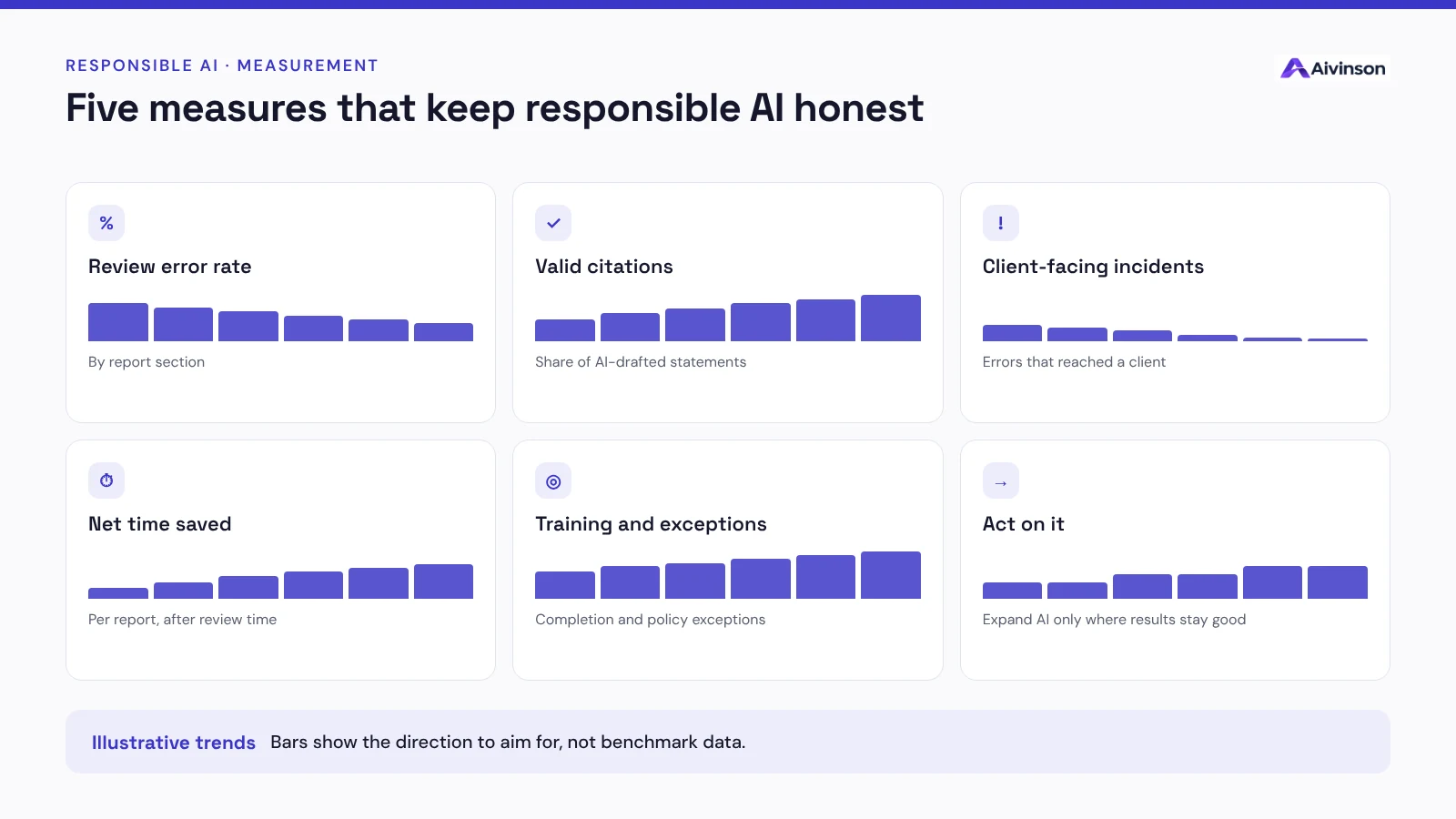
- Error rates found in review, by report section.
- Share of AI-drafted statements with valid citations.
- Incidents where an error reached a client.
- Time saved per report, balanced against review time.
- Staff training completion and policy exceptions.
Measurement keeps responsible AI from becoming a slogan. Review the figures with project leaders, adjust the policy, and expand AI use only where results are consistently good. Our AI governance guide covers the wider framework.
Draft technical reports from your evidence
See how Aivinson grounds every draft in your site data and appendices, while your experts review, edit and sign.
Frequently asked questions
What is responsible AI?
Responsible AI is the practice of designing, deploying and using AI systems in ways that are safe, fair, transparent, secure and accountable. It turns ethical principles into concrete policies, controls and review steps, so that people remain responsible for decisions made with AI assistance.
What are the principles of responsible AI?
Common principles include safety and reliability, transparency, fairness, privacy and security, accountability, and human oversight. International references such as the OECD AI Principles express similar values, and many organizations adapt them into internal policies for their own work. Each principle should map to a concrete control.
How do professional firms implement responsible AI?
They adopt a written AI policy, approve specific tools and uses, protect client data, require evidence-linked output, and mandate review by the responsible professional. Many firms also log errors, train staff on verification, and use a management system such as ISO/IEC 42001.
Is responsible AI the same as AI governance?
They overlap. Responsible AI describes the principles and behaviors an organization commits to, while AI governance is the structure of policies, roles and controls that enforces them. In practice, governance is how a firm proves it is using AI responsibly. Clients, insurers and regulators increasingly ask to see it.
Does responsible AI mean avoiding AI?
No. Responsible AI means using AI where it adds value and managing the risks. For report-heavy professional work, that often means using grounded drafting tools to save time, while keeping verification, findings and signatures with qualified professionals. Those professionals remain accountable for the work.