Generative AI in Engineering: Uses, Limits and Responsible Charge
Generative AI in engineering is the use of models that generate text, code or designs to support engineering work, such as drafting reports, summarizing documents and exploring design options. Professional bodies are clear that it is a tool: the licensed engineer keeps responsible charge and accountability.
On this page
Engineers have used computation for decades, from finite element analysis to optimization. What is new is a tool that writes. That changes report production most of all, and it raises new questions about verification and ethics. This article is part of our generative AI series.
Where engineers use generative AI today
| Use | Value | Main risk |
|---|---|---|
| Report and memo drafting | Large time savings on structured documents | Unverified statements |
| Document and code review | Finds inconsistencies and gaps | False confidence in a clean result |
| Literature and standards summaries | Faster background research | Fabricated or outdated citations |
| Specification writing | Consistent language from templates | Wrong edition or project mismatch |
| Generative design exploration | More options considered early | Options not validated by analysis |
| Field data organization | Photos and notes structured by system | Mislabeling without review |
Research and education are moving quickly too. A 2025 ASEE paper, “Generative AI in Engineering: Tool or Trouble?”, examines how the technology helps and where it misleads in engineering education and practice.
Responsible charge does not transfer to AI
In July 2024, ASCE adopted Policy Statement 573 on AI and engineering responsibility. It states that the civil engineer must maintain responsibility for project work and that protecting public health, safety and welfare remains the primary focus when AI is used under a licensed engineer’s direction.
ASCE’s 2026 AI roadmap goes further, stating that AI does not hold responsible charge and cannot sign, seal or certify engineering work. In environmental due diligence the parallel is the Environmental Professional, who must make the findings and sign the declaration for a Phase I ESA.
Limits engineers must account for
- Hallucinated facts and citations: fluent text can contain dates, values or references that do not exist.
- Weak arithmetic: language models are not reliable calculators; use validated engineering software.
- Context limits: long project files must be retrieved selectively, so missing context can change conclusions.
- Version drift: models may cite superseded codes and standards unless current documents are supplied.
- Confidentiality: client data must stay within systems that meet contractual and legal obligations.
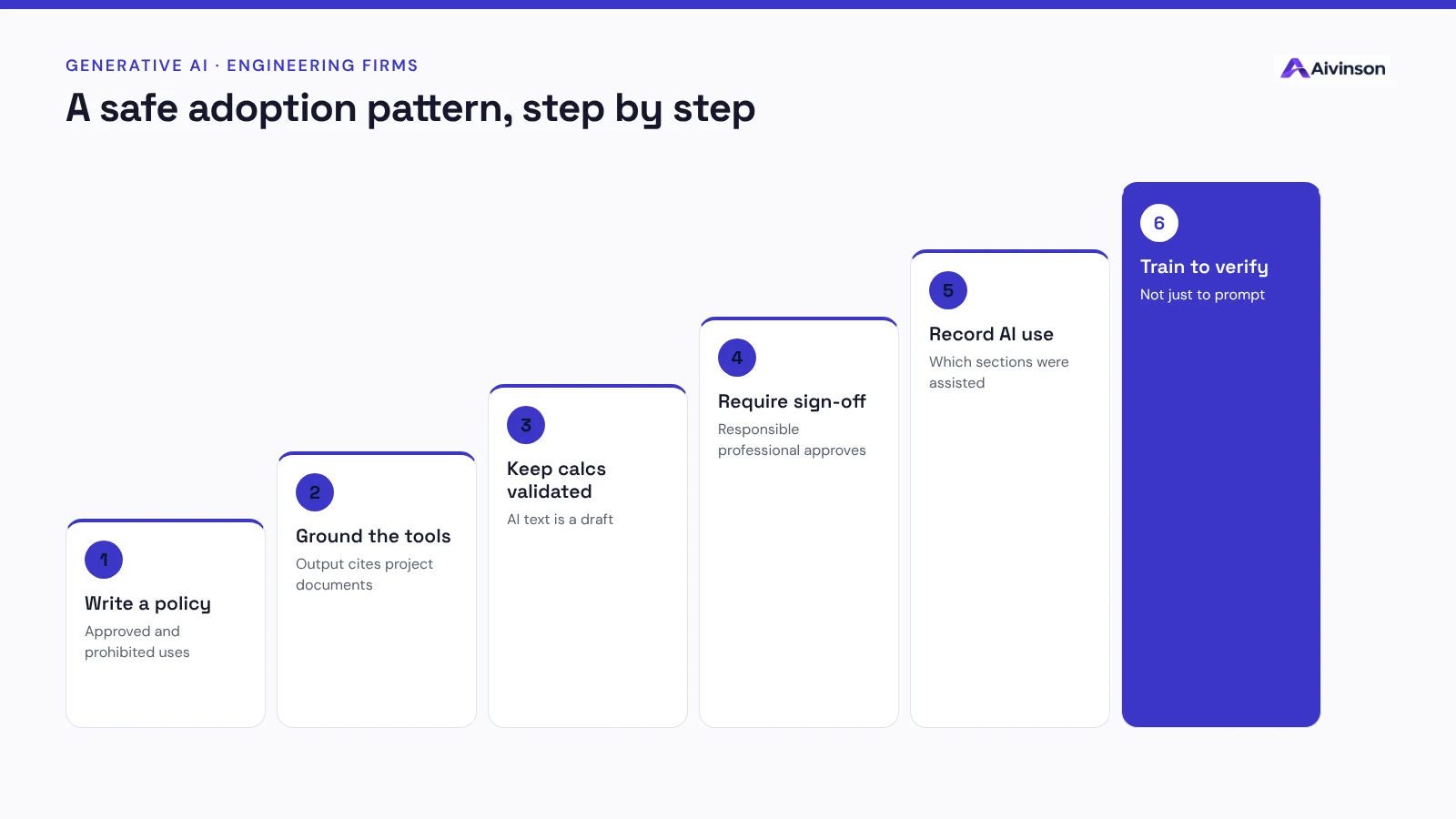
A safe adoption pattern for engineering firms
- Define approved uses, and uses that are prohibited, in a short written policy.
- Use tools that ground output in project documents and cite sources.
- Keep calculations in validated software and treat AI text as a draft.
- Require review and sign-off by the responsible professional for every deliverable.
- Record which sections were AI-assisted for internal quality records.
- Train staff on verification, not just prompting.
Johns Hopkins’ engineering program summarizes the same balance in its review of how transformative generative AI is: large opportunity, equally significant challenges such as bias and misinformation. Our responsible AI guide turns these principles into controls.
Questions to ask before using AI on a deliverable
- Is this task one where errors would be caught by normal review?
- Is the source material available to ground the output?
- Does client confidentiality allow this data in this tool?
- Are any calculations involved that need validated software?
- Who will review and approve the result, and how will that be recorded?
If any answer is unclear, the safer choice is to use AI only for organizing material and to keep drafting manual for that deliverable.
Training engineers to verify AI output
Training on prompting is less valuable than training on verification. Engineers should practice spotting unsupported statements, checking citations, confirming standard editions and recognizing overconfident conclusions. Short internal sessions using real examples of caught errors build these habits quickly.
Senior reviewers also need guidance on how review changes when the first draft is AI-assisted: the draft may be more polished, which makes errors less visible, so reviewers should focus on evidence and conclusions rather than grammar.
Generative AI in report-heavy disciplines
Report-heavy services such as environmental site assessments and property condition assessments benefit most, because much of the effort is assembling evidence into a standard structure. In a Phase I ESA workflow, Vinson Analyst reads appendices to flag candidate conditions and Vinson Author drafts the full report, while the EP decides and signs.
The gain is not only speed. Consistent structure and evidence links make reviews faster and reduce the chance that a finding is missed or misworded.
Draft technical reports from your evidence
See how Aivinson grounds every draft in your site data and appendices, while your experts review, edit and sign.
Frequently asked questions
How is generative AI used in engineering?
Engineers use generative AI to draft reports and memos, summarize documents and standards, review specifications and code, organize field data and explore early design options. Its output is treated as a draft that must be verified, and calculations stay in validated engineering software.
Can AI take responsible charge of engineering work?
No. ASCE Policy Statement 573 and its 2026 AI roadmap state that the licensed engineer keeps responsibility, and that AI cannot sign, seal or certify engineering work. AI can support analysis and writing, but accountability for decisions stays with qualified people. The same applies to Environmental Professionals.
Is it ethical for engineers to use generative AI?
Yes, when used competently and transparently. Engineering codes require engineers to understand the capabilities and limits of the tools they use, protect client confidentiality and remain responsible for their work. Verifying AI output and protecting data are part of that duty. Disclosure to clients may also be expected.
What are the biggest risks of generative AI for engineers?
The main risks are hallucinated facts and citations, unreliable arithmetic, outdated standards, missing project context and confidentiality breaches. Each can be managed with grounded tools, validated calculation software, current reference documents, secure systems and mandatory professional review. Review must happen before any deliverable is issued.
Will generative AI replace engineers?
Unlikely in any profession built on licensure and accountability. Generative AI automates parts of writing and research, which changes how engineers spend their time. Judgment, site knowledge, ethics and the legal responsibility to sign remain human roles. Engineers who use AI well will simply deliver more work.