Phase 1 Environmental Site Assessment: The Complete Technical Guide
A Phase 1 Environmental Site Assessment (Phase I ESA) is a non-intrusive investigation of a property’s current and historical uses that identifies recognized environmental conditions (RECs). An Environmental Professional performs it under ASTM E1527-21, and it satisfies EPA’s All Appropriate Inquiries rule, a precondition for CERCLA landowner liability protection.
On this page
Almost every commercial real estate acquisition, refinance and brownfield redevelopment starts with the same document. It decides whether a deal moves forward, whether a lender funds it and whether the buyer inherits someone else’s cleanup bill. This guide explains how an Environmental Professional (EP) works through it, and where reports most often go wrong.
Key takeaways
- ASTM E1527-21 is the only version of the standard EPA recognizes for All Appropriate Inquiries since February 13, 2024.
- Four components feed the EP’s opinion: records review, site reconnaissance, interviews and user-provided information.
- Findings are classified as RECs, CRECs, HRECs or de minimis conditions; only RECs typically trigger a Phase II.
- Five components must be completed or updated within 180 days before acquisition, counted from the earliest one.
What is a Phase 1 Environmental Site Assessment?
A Phase I ESA is the first tier of environmental due diligence for commercial property in the United States. Its stated objective is to identify, to the extent feasible, recognized environmental conditions in connection with the subject property. It answers one question: based on reasonably ascertainable information, is there evidence that hazardous substances or petroleum products were released at the property, or are likely to have been?
The investigation is defined by ASTM E1527-21, Standard Practice for Environmental Site Assessments: Phase I Environmental Site Assessment Process, published by ASTM International. EPA references this practice in its All Appropriate Inquiries (AAI) rule at 40 CFR Part 312. The earlier E1527-13 version stopped satisfying AAI on February 13, 2024, so a report prepared today should cite E1527-21. See what changed in ASTM E1527-21.
Three boundaries define what a Phase I ESA is not. It is not a compliance audit of current operations. It is not a sampling program; nothing is drilled, dug or analyzed in a laboratory. And it is not a guarantee: no assessment eliminates uncertainty, so the report documents its limitations and data gaps.
Why it matters: AAI and CERCLA liability protection
Under the Comprehensive Environmental Response, Compensation, and Liability Act (CERCLA), liability for contamination is strict, joint and several. A current owner can be ordered to pay for cleanup of a release that happened decades before it bought the property. CERCLA offers three landowner liability protections to limit that exposure:
- Bona fide prospective purchaser (BFPP): a buyer who acquires property knowing, or suspecting, that it is contaminated.
- Contiguous property owner (CPPO): an owner whose property is contaminated only by migration from a neighboring source.
- Innocent landowner: a buyer who did not know, and had no reason to know, about contamination at acquisition.
All three require the owner to have conducted all appropriate inquiries before acquiring title. A Phase I ESA under ASTM E1527-21 is the standard way to document AAI. It is a threshold requirement rather than the whole defense: owners must also meet continuing obligations, including reasonable steps to stop or prevent releases, cooperation with response actions, and compliance with land use restrictions.
When a Phase I ESA is needed, and who performs it
The party that relies on the report is the user. Typical triggers include a commercial or industrial acquisition, a refinance, a foreclosure or deed-in-lieu, a long-term ground lease, a development or rezoning application, and a brownfield grant or redevelopment. Owner-occupied residential purchases rarely include one.
Only an Environmental Professional can sign the conclusions. The qualification is set in federal regulation; the full text is available on Cornell Law School’s Legal Information Institute. In summary, an EP must have one of the following:
- A current PE or PG license, or a government license or certification to perform environmental inquiries, plus three years of relevant full-time experience.
- A bachelor’s degree or higher in engineering or science plus five years of relevant full-time experience.
- Ten years of relevant full-time experience.
Field staff who do not meet the definition can perform the site visit, records review or interviews, but only under the supervision or responsible charge of an EP. The EP must still declare in the report that the inquiry meets the AAI standards.
The Phase I ESA process, step by step
ASTM E1527-21 organizes the inquiry into four components. Each one produces evidence; the EP then evaluates that evidence as a whole. Figure 1 shows how the components connect and which ones fall under the 180-day rule.
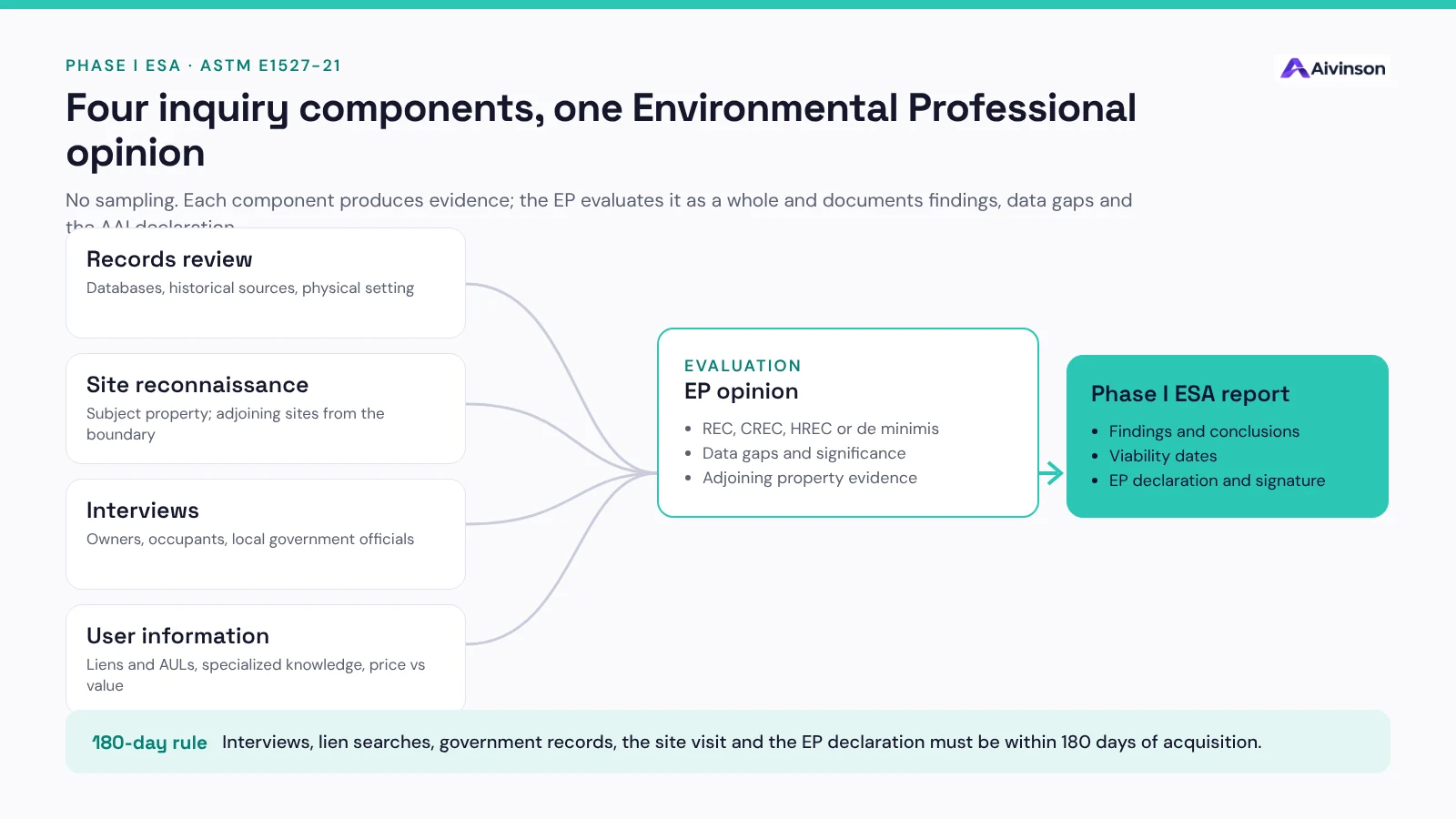
1. Records review
The records review has three parts. The first is regulatory records: federal, state and tribal databases searched within approximate minimum search distances. The National Priorities List and RCRA corrective action facilities are searched to one mile, leaking underground storage tank sites to one-half mile, and registered UST and RCRA generator lists cover the subject and adjoining properties. Most firms order these as a commercial database report, then verify unmapped “orphan” listings by address.
The second is the physical setting: topographic maps, soils and geology, and the inferred groundwater flow direction. This shows whether an upgradient release could migrate onto the property.
The third is historical use. The EP reviews standard historical sources such as aerial photographs, fire insurance maps, city directories, historical topographic maps and building department records. The goal is to identify all obvious uses back to the property’s first developed use or 1940, whichever is earlier, at intervals of no more than five years where sources allow. ASTM E1527-21 extends this review to adjoining properties.
2. Site reconnaissance
The site reconnaissance is a visual walkthrough of the property, its improvements and accessible interior spaces, with adjoining properties observed from the boundary or public rights-of-way. Assessors look for aboveground and underground storage tanks, fill ports and vent pipes, drums and chemical storage, stained soil or pavement, stressed vegetation, pits and lagoons, floor drains and sumps, odors, PCB-containing equipment and wells. Snow cover, locked rooms or tenants who refuse entry are limiting conditions and must be documented. Teams that capture photos and voice notes in Site Assistant keep every observation tied to its location and evidence.
3. Interviews
Interviews capture knowledge that records miss: a removed tank, a past spill or a former tenant’s process. ASTM E1527-21 calls for interviews with the owner, the key site manager and occupants, and with at least one staff member of a local government agency such as the fire department, health department or environmental agency. Unanswered questionnaires must be reported as potential data gaps.
4. User-provided information
AAI places specific responsibilities on the user, not just the consultant. The user must search for environmental liens and activity and use limitations recorded against the property, disclose specialized or actual knowledge, report whether the purchase price reflects fair market value, and share commonly known information. If the user does not provide this, the EP notes the omission and its effect on the conclusions.
How findings are classified: REC, CREC, HREC and de minimis
Every issue the EP identifies is placed in one of the categories below. The category drives the next step for the buyer and lender, so precise wording matters.
| Finding | What it means under ASTM E1527-21 | Typical next step |
|---|---|---|
| REC | Presence or likely presence of hazardous substances or petroleum products due to a release, or under conditions posing a material threat of a future release | Phase II ESA or a negotiated risk allocation |
| CREC | Past release addressed to the regulator’s satisfaction, with contamination left in place under controls such as AULs or engineering controls | Confirm controls are recorded and maintained |
| HREC | Past release addressed to unrestricted-use criteria without required controls | Usually none; documented for context |
| De minimis | Condition that would not generally be the subject of an enforcement action | Not a REC; noted in the report |
| Business environmental risk | Risk outside the standard scope, such as asbestos or radon, if contracted | Reported separately when in scope |
ASTM E1527-21 tightened these definitions in two important ways. It added the “likely presence” standard, so a REC no longer requires certainty, and it clarified that a REC must be in, on or at the subject property. An off-site source becomes a REC only when its release has likely migrated to the property. A non-mandatory appendix adds a decision flowchart for distinguishing CRECs from HRECs.
Each category has its own guide: RECs, CRECs and HRECs. Tools such as Vinson Analyst can read database reports, aerials and fire insurance maps to surface candidate conditions for review, but classification remains the EP’s professional judgment.
What a Phase I ESA report must contain
Lenders and reviewers read hundreds of these reports, so a predictable structure is part of a report’s credibility. A complete ASTM E1527-21 report typically contains:
- A summary of findings, opinions and conclusions that lists every REC, CREC and HREC
- Purpose, scope, user, limitations, site description and adjoining property uses
- User-provided information, including title, lien and AUL search results
- Records review: regulatory databases, physical setting and a historical use summary with sources
- Site reconnaissance methodology, limiting conditions and observations
- Interviews conducted, responses received and non-responses
- Evaluation: findings, opinions, data gaps and their significance, conclusions and any recommendations
- Deviations from the standard and any additional services
- The EP’s signed declaration and qualifications
- Appendices: maps, site photographs, database report, historical sources and questionnaires
Recommendations are optional under the standard, but many lenders require them, so the scope of work should say whether they are included. Assembling this structure is where most report hours go. Firms increasingly draft it with Vinson Author and finish it in a shared report editor, while the EP reviews every finding and signs. Our guides to writing REC findings and the Phase I ESA report workflow go deeper.
How long a Phase I ESA is valid: the 180-day and one-year rules
A Phase I ESA has a shelf life. All appropriate inquiries must be conducted within one year before the date of acquisition, and five components must be conducted or updated within 180 days before acquisition:
| Component | 180-day rule applies? | Practical note |
|---|---|---|
| Interviews with owners, operators and occupants | Yes | Re-contact if closing slips |
| Search for recorded environmental cleanup liens | Yes | Usually a user responsibility |
| Review of federal, state, tribal and local government records | Yes | Database report date counts |
| Visual inspection of the property and adjoining properties | Yes | Site visit date counts |
| EP declaration | Yes | Signature date counts |
| Historical sources and physical setting review | No (one-year limit) | Rarely changes within a year |
ASTM E1527-21 requires the report to state the date of each of these components. The 180-day window runs from the earliest one, not from the report date. A report signed in June with a database search from March is already three months into its window. Missing this detail is one of the most common findings in lender reviews. The full checklist is in our guide to ASTM E1527-21 requirements.
Tip: when closing dates are uncertain, schedule the database search and site visit as late as practical, and record all five component dates in the executive summary so reviewers can verify viability at a glance.
Phase I vs Phase II ESA and other assessments
| Assessment | Purpose | Sampling | Satisfies AAI |
|---|---|---|---|
| Transaction screen (ASTM E1528) | Quick screen for lower-risk properties | No | No |
| Phase I ESA (ASTM E1527-21) | Identify RECs from records, site visit and interviews | No | Yes |
| Phase I ESA for forestland or rural property (ASTM E2247-23) | Phase I adapted to large rural parcels | No | Yes |
| Phase II ESA (ASTM E1903) | Test whether RECs represent actual contamination | Soil, groundwater, soil vapor | Not required |
A Phase II ESA is scoped directly from the RECs in the Phase I. It uses targeted sampling to confirm or rule out contamination, which turns a potential issue into a quantified risk that can be priced, insured or remediated. Compare both in Phase I vs Phase II ESA.
Non-scope considerations and common add-ons
Several familiar environmental issues are outside the ASTM E1527-21 scope unless the user adds them to the contract: asbestos-containing materials, lead-based paint, radon, lead in drinking water, mold, wetlands, cultural and ecological resources, regulatory compliance, and vapor encroachment screening under ASTM E2600. Agree any add-ons in the scope of work before the site visit.
PFAS and emerging contaminants
In May 2024 EPA designated PFOA and PFOS as CERCLA hazardous substances, effective July 8, 2024. EPA said in September 2025 that it would keep the designation, and in August 2026 the D.C. Circuit upheld it. Because the Phase I ESA scope follows CERCLA hazardous substances, PFOA and PFOS are now in scope.
In practice, the EP evaluates historical uses associated with these compounds: aqueous film-forming foam at airports, fire stations and fire training areas; metal plating; textile, leather and paper treatment; and landfills or biosolids application. For technical background on sources and fate, the ITRC PFAS Technical and Regulatory Guidance is the most widely used reference. Other PFAS that are not designated hazardous substances remain non-scope unless added by contract.
Phase I ESA cost and timeline
Market pricing for a standard Phase I ESA on a single commercial parcel commonly falls between about $2,000 and $6,000. Standard turnaround is typically two to four weeks. The main cost and schedule drivers are:
- Property type and history: industrial or long-developed sites need more research.
- Size and number of parcels, buildings and tenant spaces to inspect.
- Availability of historical sources and responsiveness of agencies and interviewees.
- Lender-specific scope additions and non-scope services.
- Expedited delivery, which usually carries a surcharge.
See our Phase I ESA cost guide for a full breakdown.
Most consulting labor sits in reading historical sources and writing. The Aivinson Phase I ESA solution drafts the report from the evidence while the EP keeps every judgment call.
How to review a Phase I ESA report
Whether you are a lender, buyer or senior reviewer, these checks catch most deficiencies before a report is relied on. If you are still choosing a consultant, see our guide to Phase I ESA consulting firms.
- The report cites ASTM E1527-21 and includes the EP declaration and qualifications.
- All five 180-day component dates are stated and fall within the window at closing.
- Historical uses are documented back to first development or 1940, including adjoining properties.
- Every REC, CREC and HREC is stated in the summary with the evidence behind it.
- Data gaps are identified, and the EP explains whether each one is significant.
- User-provided information, including the lien and AUL search, is included or its absence is explained.
Draft Phase I ESA reports from the evidence
See how Aivinson organizes site visit data and appendices, writes the full draft in your firm’s format, and keeps your EP in control of every finding.
Frequently asked questions
Is a Phase 1 Environmental Site Assessment required by law?
No federal law requires a Phase I ESA for every transaction. However, a buyer that wants CERCLA landowner liability protection must conduct all appropriate inquiries before acquisition, and most commercial lenders require a Phase I ESA as a loan condition. In practice, nearly every commercial or industrial acquisition includes one.
How long is a Phase I ESA valid?
A Phase I ESA is valid for one year before acquisition, but five components must be conducted or updated within 180 days: interviews, lien searches, government records review, the site visit and the EP declaration. The 180-day clock starts on the earliest of those component dates, not the report date.
Does a Phase I ESA include soil or groundwater sampling?
No. A Phase I ESA is non-intrusive and relies on records, site observation and interviews. If the Environmental Professional identifies recognized environmental conditions, the user may commission a Phase II ESA under ASTM E1903, which uses soil, groundwater or soil vapor sampling to confirm or rule out contamination.
What is the difference between ASTM E1527-13 and E1527-21?
ASTM E1527-21 clarified the REC definition with a “likely presence” standard, required historical review of adjoining properties, tightened viability documentation, and refined CREC and HREC guidance with a decision flowchart. EPA stopped recognizing E1527-13 for All Appropriate Inquiries on February 13, 2024, so every current report should cite E1527-21.
Who can sign a Phase I ESA report?
Only an Environmental Professional as defined in 40 CFR 312.10. That means a licensed PE or PG with three years of relevant experience, a science or engineering graduate with five years, or someone with ten years of relevant full-time experience. Other staff can assist under the EP’s supervision or responsible charge.
Are PFAS included in a Phase I ESA?
PFOA and PFOS are now in scope because EPA designated them CERCLA hazardous substances, effective July 8, 2024, and the designation was upheld in 2026. Assessors should evaluate likely historical PFOA and PFOS uses. Other PFAS remain outside the standard scope unless the user adds them by contract.