Generative AI: How It Works and Where It Fits in Technical Reports
Generative AI is artificial intelligence that creates new content, such as text, images or code, by learning patterns from large datasets and predicting likely output from a prompt. In technical reports it is most useful for drafting from project evidence, provided the output is grounded in sources and reviewed by a qualified professional.
On this page
Few technologies have moved from research to daily office work as fast as generative AI. For engineering and environmental consulting firms, the question is no longer whether to use it, but where it adds value and where it creates risk. A report that supports a property transaction or a structural decision cannot contain invented facts, and the person who signs it remains accountable.
Key takeaways
- Generative AI predicts likely text; it does not know whether a statement is true.
- Grounding the model in project evidence, with citations, is what makes it usable for reports.
- Hallucinations, outdated knowledge and confidentiality are the main risks for technical teams.
- Frameworks such as the NIST AI RMF and ISO/IEC 42001 give firms a structure for governance.
- Professional judgment and signatures stay with qualified people, as engineering bodies now state explicitly.
What is generative AI?
Generative AI refers to models that produce new content rather than only classifying or predicting values. Large language models (LLMs) generate text, diffusion models generate images, and multimodal models handle combinations of text, images and audio. The same underlying idea applies across them: learn the statistical structure of a very large dataset, then generate output that fits that structure.
Caltech’s Science Exchange overview notes that today’s models often produce content that is hard to distinguish from human work. That fluency is the source of both their value and their risk: well-written text is not the same as correct text.
How large language models work
An LLM is a neural network, usually based on the transformer architecture, trained on vast amounts of text to predict the next token, a word or part of a word. Training happens in stages: pretraining on broad text, then instruction tuning and feedback-based alignment so the model follows requests and avoids harmful output.
- Tokens and context window: the model reads a limited amount of text at once, so long reports must be broken up or summarized.
- Probabilistic output: the model chooses likely continuations; settings such as temperature control how varied the output is.
- Knowledge cutoff: the model’s built-in knowledge stops at its training date unless current documents are supplied.
- No source memory: a base model cannot tell you where a fact came from unless the system supplies and tracks sources.
These properties explain why a general chatbot can write a convincing paragraph about a property it has never seen. Nothing in the model checks the paragraph against reality.
Why generative AI hallucinates
A hallucination is fluent output that is false or unsupported. It happens because the model optimizes for plausible text, not verified facts. Common triggers in technical work include questions about specific sites, dates, regulatory citations, and numbers that never appeared in the input.
| Risk | Example in a technical report | Mitigation |
|---|---|---|
| Fabricated fact | A tank removal date that is not in any record | Ground drafts in project evidence and require citations |
| Fabricated citation | A standard section or journal paper that does not exist | Restrict references to retrieved, verifiable sources |
| Outdated knowledge | Citing a superseded standard | Supply current standards and templates as context |
| Overconfident tone | Firm conclusion from weak evidence | Separate findings from opinions; expert review |
| Confidential data exposure | Client data sent to a public tool | Use tenant-isolated systems with access controls |
Engineering bodies have seen these failures directly. ASCE’s general counsel has described a construction dispute in which a submission cited journal papers that do not exist in ASCE’s library, a reminder that every citation must be checked.
Grounding: how teams make AI output usable
The most effective technique for technical writing is retrieval-augmented generation (RAG). Instead of relying on what the model memorized, the system retrieves relevant passages from the project’s own documents and gives them to the model with the request. The approach was formalized in the 2020 RAG paper by Lewis and colleagues and is now standard in enterprise AI.
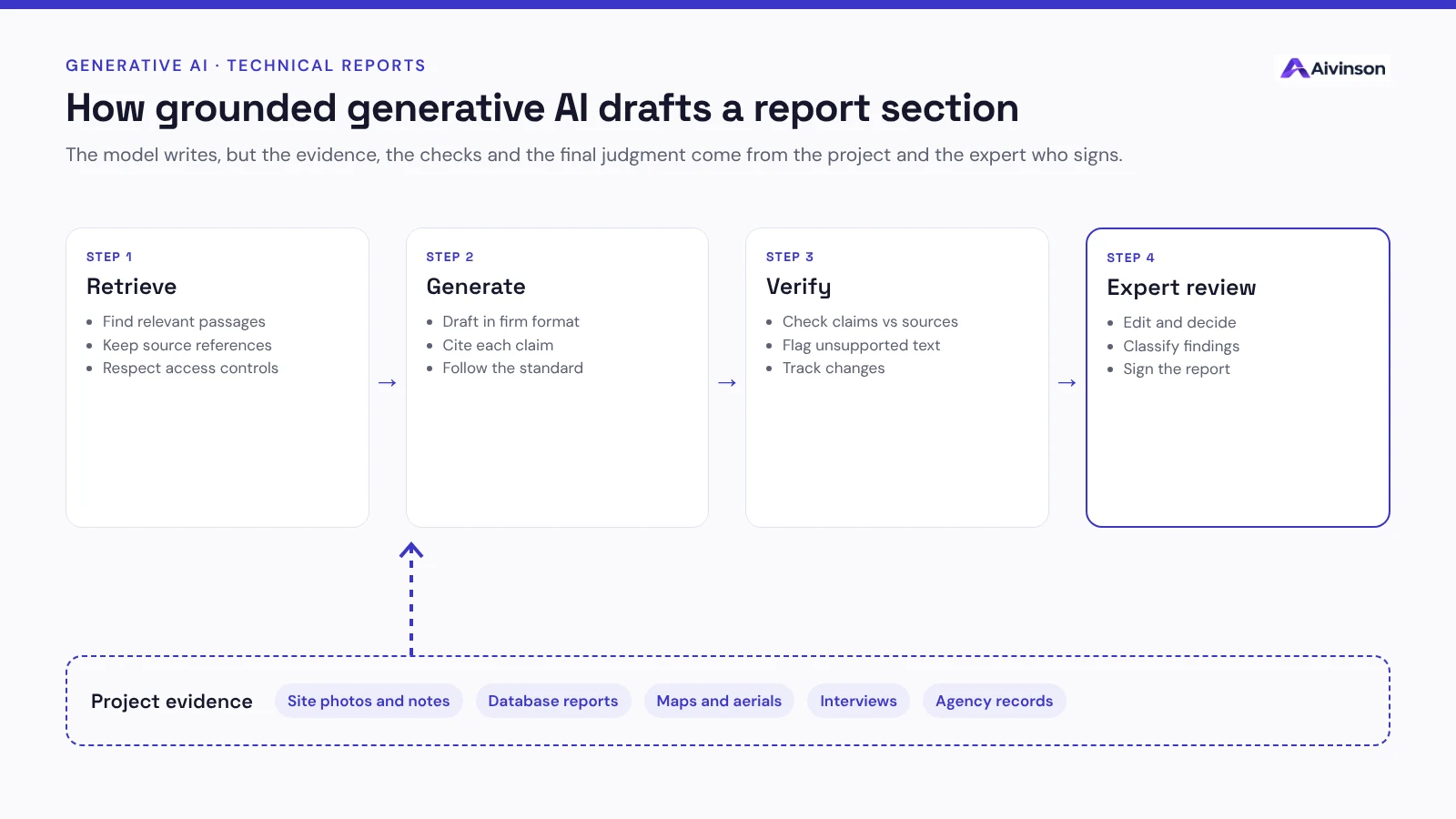
Grounding changes the question from “what does the model know?” to “what does the evidence say?” Combined with citations for every claim, it lets reviewers check a draft quickly. Ask Vinson answers project questions with sources, and Vinson Author writes full drafts from the collected evidence.
Where generative AI fits in engineering and due diligence reports
| Task | Good fit? | Why |
|---|---|---|
| Summarizing appendices and records | Yes | High volume, verifiable against sources |
| Drafting standard report sections | Yes | Structured format, reviewed by experts |
| Answering questions about a project file | Yes, with citations | Saves search time, easy to check |
| Classifying findings such as RECs | Assist only | Requires professional judgment |
| Signing or certifying a report | No | Legal and professional accountability |
| Engineering calculations | Only with validated tools | LLMs are not calculators |
For a Phase I ESA, the largest time sinks are reading historical sources and writing the report. Those are exactly the tasks where grounded drafting helps, while the Environmental Professional keeps the classification and signature. Our guide to generative AI in engineering covers the profession’s position in detail.
Governance and regulation in 2026
Organizations using generative AI increasingly follow recognized frameworks. In the United States, the NIST AI Risk Management Framework (2023) and its Generative AI Profile (2024) are voluntary references, and NIST has said a revised version of the framework is in progress. ISO/IEC 42001 provides a certifiable AI management system standard.
In the EU, the AI Act is in force, with general-purpose AI obligations applying since August 2025. The 2026 AI Omnibus moved most high-risk system obligations to December 2027 and August 2028. In the US, federal policy since 2025 has favored a light national framework and challenged state AI laws, while several states have their own rules. Our guide to AI governance explains what this means for firms.
Choosing generative AI tools for technical work
- Grounding: does the tool draft from your documents and cite them?
- Data isolation: is client data separated by firm and excluded from model training?
- Access control: can you restrict who sees which projects?
- Format control: can it follow your templates and the relevant standard?
- Review workflow: are edits, comments and approvals tracked?
- Accountability: does it keep the professional in charge of decisions and signatures?
General chat tools are useful for brainstorming and editing. For reports that others rely on, purpose-built systems are safer. Our article on domain-specific AI explains why, and the Aivinson security page describes how data is separated per firm.
A short history of generative AI
Generative models are not new, but three steps made today’s tools possible. The transformer architecture, published in 2017, made it practical to train very large language models. Models scaled rapidly over the following years, and the public release of conversational assistants in late 2022 brought generative AI into everyday office work. Since late 2024, reasoning models that work through intermediate steps have improved performance on structured problems.
For technical professions, the more important shift has been tooling: retrieval, citations, access controls and workflow integration. Those turned a general writing assistant into something that can draft from a project file.
Prompting, grounding and fine-tuning compared
| Technique | What it does | Best for |
|---|---|---|
| Prompting | Instructions and examples in the request | Format, tone and simple tasks |
| Grounding (RAG) | Supplies retrieved documents as evidence | Accurate, cited, project-specific drafts |
| Fine-tuning | Adjusts the model on domain examples | Consistent style at high volume |
| Tool use | Calls calculators, databases or maps | Numbers and lookups the model cannot do reliably |
Most report workflows rely on grounding plus clear templates. Fine-tuning is optional, and tool use keeps calculations out of free text.
Data security and confidentiality
Technical reports contain client names, property details, findings and sometimes sensitive operational data. Before using any generative AI tool, firms should confirm where data is processed and stored, whether it is used to train models, how each customer’s data is separated, who can access it, and whether every change is logged. Contracts with clients may already restrict where their data can go.
Public chat tools are rarely the right place for client material. Systems designed for professional work isolate data per firm and keep an audit trail, which also helps answer client and insurer questions about AI use.
Common myths about generative AI
- “It knows the facts.” It predicts text; facts must come from sources.
- “Better prompts fix hallucinations.” Prompts help, but grounding and review fix them.
- “It will replace the expert.” Standards and licenses still require a qualified person to decide and sign.
- “One general tool fits every task.” Specialized workflows outperform general chat on technical reports.
- “It saves time automatically.” Savings depend on how well drafting and review are integrated.
Measuring the value of generative AI
Measure what matters to the business, not just output speed. Useful measures are hours from site visit to first complete draft, review cycles per report, errors caught in review, and reports delivered per professional per month. Compare a baseline period with a pilot on similar projects.
Quality measures matter as much as speed. If review time rises because drafts are unreliable, the tool is not saving time. The goal is faster drafts that are easier to verify, which is why evidence links and consistent structure are as important as the model itself.
Generative AI vs traditional AI
| Attribute | Traditional AI and machine learning | Generative AI |
|---|---|---|
| Main output | Predictions, classes, scores | New text, images, code |
| Typical engineering use | Defect detection, forecasting, optimization | Drafting, summarizing, question answering |
| Training data | Task-specific labeled data | Very large general datasets, then adaptation |
| Main failure mode | Wrong prediction on unfamiliar data | Fluent but unsupported content |
| Validation | Accuracy metrics on test data | Source checking and expert review |
The two often work together: a generative model can explain or report results that a validated analytical model produced.
A practical pilot plan
- Pick one report type with high volume and a stable structure.
- Select three to five recent projects with known outcomes as test cases.
- Measure baseline drafting hours and review cycles.
- Run the pilot with grounded drafting and mandatory expert review.
- Compare time, errors caught and reviewer feedback after a month.
- Decide on rollout, policy updates and training based on the results.
What generative AI will not change
The legal and professional structure around technical reports stays the same. A Phase I ESA still requires an Environmental Professional’s declaration; an engineering design still requires a licensed engineer in responsible charge. Generative AI changes how quickly evidence becomes a draft, not who is accountable for the conclusion.
Adoption is broad and rising, as tracked each year by the Stanford AI Index. Firms that combine fast drafting with rigorous review will deliver more reports with the same team, without lowering the standard their clients and regulators expect.
Draft technical reports from your evidence
See how Aivinson grounds every draft in your site data and appendices, while your experts review, edit and sign.
Frequently asked questions
What is generative AI in simple terms?
Generative AI is software that creates new content, such as text, images or code, after learning patterns from large amounts of data. Given a prompt, it predicts likely output. It can write fluent text quickly, but it does not verify facts on its own, so important output must be checked against sources.
Why does generative AI make things up?
Language models are trained to produce plausible text, not verified facts. When a prompt asks for specifics the model does not have, it may generate a convincing but false answer, called a hallucination. Grounding the model in source documents and requiring citations greatly reduces this risk.
Can generative AI write an engineering or environmental report?
It can draft large parts of one when grounded in project evidence such as site notes, records and appendices. It cannot replace the professional judgment, findings classification or signature that standards and licensing require. A qualified professional must review, edit and approve the final report.
What is retrieval-augmented generation?
Retrieval-augmented generation, or RAG, is a technique that retrieves relevant passages from trusted documents and gives them to the model with the request. The model then writes from that evidence and can cite it, which makes output more accurate, current and verifiable than answers from memory alone.
Is generative AI regulated?
Increasingly, yes. The EU AI Act imposes obligations on general-purpose AI providers and, from December 2027, on most high-risk systems. In the United States, guidance such as the NIST AI Risk Management Framework is voluntary, while some states regulate specific uses. Professional codes also still apply.
Is it safe to put client data into generative AI tools?
Only in tools with appropriate safeguards. Public chat tools may retain or process data in ways your contracts do not allow. For client work, use systems that isolate each firm’s data, exclude it from model training, control access by role and keep an audit history of changes.