AI Governance: Frameworks, Laws and Controls for 2026
AI governance is the set of policies, roles, processes and controls an organization uses to make sure its AI systems are lawful, safe, accurate and accountable. In 2026 it draws on frameworks such as the NIST AI RMF and ISO/IEC 42001, and on laws such as the EU AI Act.
On this page
For engineering and consulting firms, governance answers practical questions: which tools may staff use, with which data, for which deliverables, and who checks the output? This guide is part of our generative AI series.
The main frameworks and laws
| Instrument | Type | Key point |
|---|---|---|
| NIST AI RMF 1.0 (2023) | Voluntary US framework | Govern, Map, Measure, Manage functions; revision in progress |
| NIST Generative AI Profile (2024) | Voluntary companion | Risks and actions specific to generative AI |
| ISO/IEC 42001:2023 | Certifiable standard | AI management system using Plan-Do-Check-Act |
| OECD AI Principles (2019, updated 2024) | International principles | Five values-based principles |
| EU AI Act (Regulation 2024/1689) | Binding EU law | Risk-based obligations, amended by the 2026 AI Omnibus |
ISO describes ISO/IEC 42001 as the world’s first AI management system standard. It suits firms that already run ISO 9001 or ISO 27001, because it uses the same management system structure.
The EU AI Act after the AI Omnibus
The EU AI Act entered into force in August 2024, with prohibitions applying from February 2025 and general-purpose AI obligations from August 2025. In 2026, the AI Omnibus (Regulation (EU) 2026/1744) was published on 24 July and entered into force on 27 July. It moved obligations for stand-alone high-risk systems to 2 December 2027 and for high-risk AI embedded in regulated products to 2 August 2028.
The Future of Privacy Forum’s implementation timeline tracks each date. Most uses in engineering reporting are unlikely to be high-risk, but transparency duties and client requirements can still apply when EU clients or projects are involved.
US federal and state policy
US policy shifted in 2025 toward a lighter federal approach, set out in the July 2025 AI Action Plan. In December 2025, Executive Order 14365 directed agencies to pursue a national framework and created a Justice Department task force to challenge state AI laws. An executive order does not by itself preempt state law, so state rules, including laws that took effect in 2026, still matter.
For most professional firms the practical result is a patchwork: voluntary federal guidance, some binding state laws, contractual requirements from clients, and professional codes that have not changed.
Governance controls that matter for professional firms
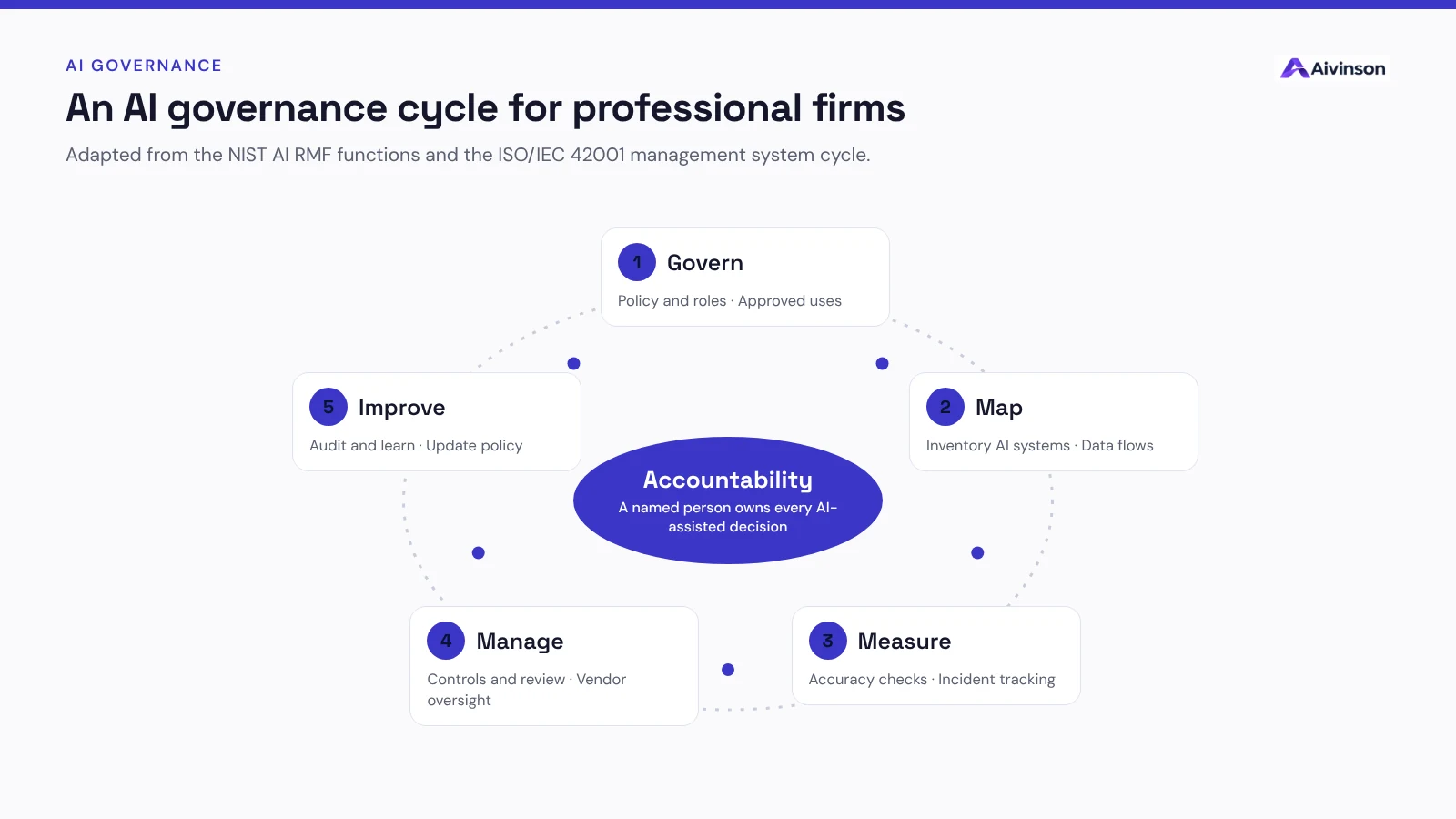
- A written AI policy naming approved tools, approved uses and prohibited uses.
- An inventory of AI systems in use, including features embedded in other software.
- Data rules: no client data in tools without contractual and technical safeguards.
- Mandatory review by the responsible professional for every AI-assisted deliverable.
- Vendor due diligence covering data isolation, training use, security and audit trails.
- Incident logging for errors that reached a draft or a client.
- Training focused on verification and limitations.
NIST AI RMF vs ISO/IEC 42001
| Attribute | NIST AI RMF | ISO/IEC 42001 |
|---|---|---|
| Nature | Voluntary framework | International management system standard |
| Certification | No | Yes, by accredited bodies |
| Structure | Govern, Map, Measure, Manage | Plan-Do-Check-Act clauses and controls |
| Best for | Risk thinking and vocabulary | Formal, auditable AI management |
Many organizations use both: NIST for risk analysis and ISO/IEC 42001 for the management system that proves controls operate.
Vendor due diligence questions
- Where is our data processed and stored?
- Is our data used to train or improve models?
- How is our data separated from other customers’ data?
- What access controls, encryption and audit logs exist?
- How are model changes communicated and tested?
- What happens to our data when the contract ends?
A 30-day governance starter plan
Week one: inventory the AI tools staff already use. Week two: write a two-page policy covering approved tools, uses, data rules and review. Week three: run vendor due diligence on the main tools. Week four: train staff and start logging AI-assisted deliverables and errors. Expand from there as use grows.
Governance in technical report production
Report workflows make governance concrete. Every AI-drafted section should be traceable to its evidence, every change recorded, and every finding approved by a named professional. Platforms built for this, such as the Aivinson Platform, keep data separated per firm, control access by role and record history, as described on our security page.
Governance does not replace professional standards; it supports them. Our responsible AI and trust in AI guides cover the principles behind these controls.
Draft technical reports from your evidence
See how Aivinson grounds every draft in your site data and appendices, while your experts review, edit and sign.
Frequently asked questions
What is AI governance?
AI governance is the system of policies, roles, processes and controls that ensures an organization’s AI use is lawful, safe, accurate and accountable. It covers which tools are approved, how data is handled, how output is checked, and who is responsible for decisions made with AI assistance.
What frameworks are used for AI governance?
Common references are the NIST AI Risk Management Framework and its Generative AI Profile, the certifiable ISO/IEC 42001 AI management system standard, the OECD AI Principles, and, for organizations active in Europe, the EU AI Act. Many firms combine a framework with a short internal AI policy.
When do EU AI Act high-risk rules apply?
After the 2026 AI Omnibus, obligations for stand-alone high-risk AI systems apply from 2 December 2027, and for high-risk AI embedded in regulated products from 2 August 2028. Prohibitions and general-purpose AI obligations already apply, from February and August 2025 respectively.
Is the NIST AI RMF mandatory?
No. The NIST AI Risk Management Framework is voluntary guidance. Organizations use it to structure AI risk management around four functions: Govern, Map, Measure and Manage. NIST has indicated that a revised version is in progress, and sector-specific profiles continue to be developed.
Does a small consulting firm need AI governance?
Yes, scaled to its size. Even a small firm should have a written policy on approved tools and uses, rules for client data, mandatory professional review of AI-assisted work and basic vendor due diligence. These steps protect clients and the firm’s professional standing.