Domain-Specific AI: Why Specialized Beats General for Technical Reports
Domain-specific AI is artificial intelligence adapted to one field, such as environmental due diligence or structural engineering, using that field’s data, terminology, standards and workflows. Compared with general-purpose AI, it produces more accurate, consistent and verifiable output for specialized tasks.
On this page
General chat tools are impressive across many topics, but technical reports reward depth, not breadth. This guide explains how domain-specific AI is built and why it matters for report-heavy professions. It is part of our generative AI series.
General-purpose vs domain-specific AI
| Attribute | General-purpose AI | Domain-specific AI |
|---|---|---|
| Knowledge | Broad, public, up to a cutoff | Field standards, terminology, firm templates |
| Data | Whatever the user pastes in | Structured project evidence and records |
| Output format | Generic | Follows the relevant standard and firm style |
| Verification | Hard to trace | Claims linked to project sources |
| Workflow | Separate chat window | Built into the production process |
| Risk of confident errors | Higher on specialized topics | Lower, with grounding and review |
Northeastern University researchers summarize the point in “Context Matters: Why Domain-Specific AI Outperforms Foundation Models”: adapting a strong general model to a specific use case keeps its general ability while adding the context it lacks.
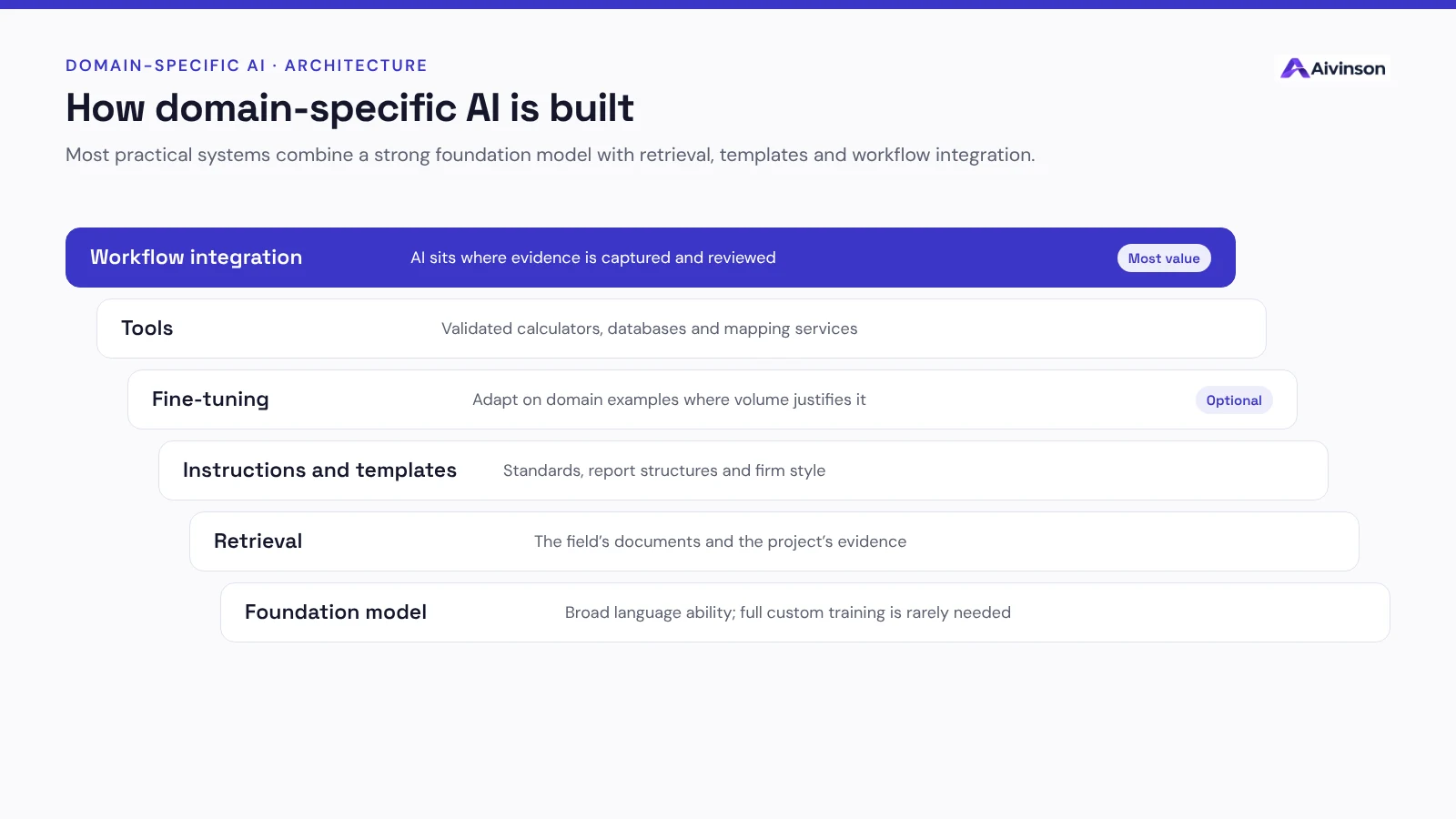
How domain-specific AI is built
- Retrieval: connect the model to the field’s documents and the project’s evidence, as in retrieval-augmented generation.
- Instructions and templates: encode standards, report structures and firm style.
- Fine-tuning: adapt a model on domain examples where volume justifies it.
- Tools: connect validated calculators, databases and mapping services.
- Workflow integration: place the AI inside the process where evidence is captured and reviewed.
Most practical systems combine a strong foundation model with retrieval, templates and workflow integration. Full custom training is rarely necessary.
Why it matters for engineering and due diligence reports
A Phase I ESA has a defined structure under ASTM E1527-21, specific terms such as REC, CREC and HREC, viability rules and evidence from many appendices. A general model may write plausible text but miss the 180-day rule, misuse terms, or invent a regulatory record. A domain-specific system is set up to follow the standard and cite the project file. Our Phase 1 Environmental Site Assessment guide shows how much structure is involved.
Engineering bodies emphasize that AI must remain a tool under professional control. ASCE’s AI roadmap for civil engineering frames adoption around keeping that responsibility with people, which domain-specific workflows make easier to enforce.
Examples in report production
- Reading database reports, aerials and fire insurance maps to flag candidate conditions.
- Drafting each report section in the firm’s format from site and records evidence.
- Answering questions about a project file with citations.
- Checking that viability dates, data gaps and findings are documented.
- Organizing field photos and voice notes by system or area.
In the Aivinson Platform, Vinson Analyst reads the appendices, Vinson Author drafts the report, and the Environmental Professional reviews and signs.
Data requirements
Domain-specific AI is only as good as the evidence it can reach. For report production that means organized project files: site photos and notes, records, maps, interview notes and prior reports, plus current standards and the firm’s templates. Capturing field data in a structured way, for example with Site Assistant, makes later drafting far more accurate.
Costs and trade-offs
Domain-specific systems take more setup than a general chat tool: templates, integrations and review workflows must be configured. In return they reduce rework and review time on every report. For firms producing many similar reports, the trade-off usually favors specialization quickly, while occasional one-off tasks may still suit general tools with careful review.
How to evaluate a domain-specific AI tool
- Does it follow the current standard for your report type?
- Does every factual statement link to your project evidence?
- Can it use your templates and terminology?
- Is client data isolated and excluded from model training?
- Does it keep the professional in control of findings and signatures?
Test it on two or three past projects where you know the right answers. The gap between general and domain-specific tools is usually obvious within a single report. See our guides to generative AI in engineering and AI reasoning for related checks.
Draft technical reports from your evidence
See how Aivinson grounds every draft in your site data and appendices, while your experts review, edit and sign.
Frequently asked questions
What is domain-specific AI?
Domain-specific AI is artificial intelligence adapted to a particular field using that field’s data, terminology, standards and workflows. It is usually built on a general foundation model, then grounded in domain documents, guided by templates and integrated into the work process, which improves accuracy for specialized tasks.
How is domain-specific AI different from ChatGPT-style tools?
General chat tools draw on broad public knowledge and whatever the user pastes in. Domain-specific AI connects to structured project evidence and field standards, follows required report formats, cites its sources and sits inside the workflow, which makes its output more consistent and easier to verify.
Do you need to train a custom model for domain-specific AI?
Usually not. Most effective systems combine a strong foundation model with retrieval of domain documents, structured templates, validated tools and workflow integration. Fine-tuning can help at high volume, but full custom model training is rarely necessary for report production. It is rarely cost-effective for report production.
Why does domain-specific AI matter for technical reports?
Technical reports follow standards with precise terms, structures and rules. General models may write fluent text that misses requirements or invents records. Domain-specific AI is set up to follow the standard and cite project evidence, reducing errors and review time. It also shortens review time.
Is domain-specific AI more trustworthy?
It can be, because grounding in project sources and enforcing standard structures make output traceable and consistent. Trustworthiness still depends on data security, transparency about limits and mandatory review by the qualified professional who is responsible for the final report. That professional owns the conclusions.