Human-in-the-Loop AI: Keeping Experts in Charge of AI Output
Human-in-the-loop AI is an arrangement in which a person reviews, corrects or approves an AI system’s output before it is used. In professional work such as engineering and environmental reports, it means AI drafts and flags, while a qualified expert makes every finding and signs the deliverable.
On this page
The phrase is everywhere, but it hides a wide range of practice. A reviewer who reads every sentence against its source is in the loop. A reviewer who skims a polished draft at 6 p.m. is technically in the loop too. This article explains the difference and how to design oversight that holds up. It is part of our Generative AI series.
What human in the loop means
Stanford HAI defines human-in-the-loop as AI systems that include human feedback or intervention as part of their operation. The term covers two different jobs. In model development, people label data and rate outputs so the model improves. In deployment, people check and approve outputs before they take effect. Report production is about the second job.
Harvard’s Chan School makes the key point in its AI glossary entry on human in the loop: the phrase does not say how much influence the person has. Involvement is only useful when the process lets the person exercise judgment. A rubber stamp is not oversight.
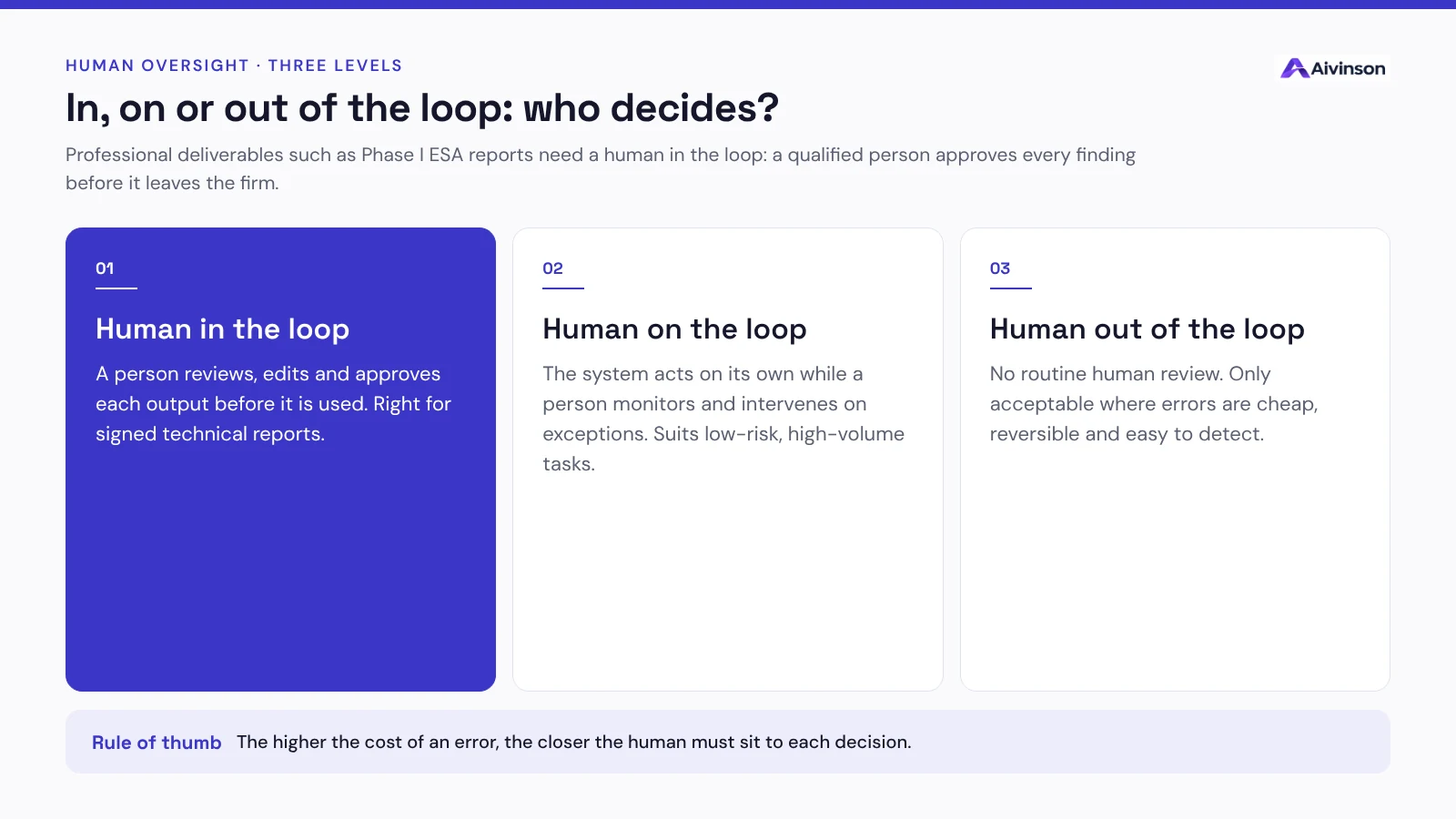
Human in, on and out of the loop
| Level | Who decides | When a person acts | Fit for technical reports |
|---|---|---|---|
| Human in the loop | A person, on every output | Before the output is used | Required for signed findings |
| Human on the loop | The system, with monitoring | On exceptions and alerts | Low-risk support tasks only |
| Human out of the loop | The system | Rarely, after the fact | Not appropriate |
The right level depends on the cost of an error. Sorting site photos by building system can run on the loop, because a misfiled photo is cheap to fix. Classifying a recognized environmental condition cannot, because the finding drives a transaction and the Environmental Professional signs it.
What regulation expects
The EU AI Act makes human oversight a legal requirement for high-risk AI. Article 14 requires high-risk systems to be designed so people can oversee them effectively, understand their capabilities and limits, interpret their output, and decide not to use it or override it. It also requires that overseers stay aware of automation bias, the tendency to over-rely on machine output. Under the AI Omnibus timeline, these duties apply from 2 December 2027 for Annex III systems and 2 August 2028 for Annex I systems.
Most report-drafting tools are not high-risk systems under the Act, but the principle transfers directly. Professional rules already put the qualified person in charge. In due diligence, the EP must make the findings; in engineering, the licensed engineer keeps responsible charge. Our AI governance guide covers the wider framework.
Designing oversight that actually works
- Show the evidence, not just the answer. Every drafted statement should link to the photo, record or page it came from.
- Make review the default path. Nothing reaches a client without an explicit approval step in the workflow.
- Flag uncertainty. Route low-confidence or unsupported text to the reviewer first, instead of hiding it in a clean draft.
- Keep edits visible. Track what the AI wrote and what the expert changed, so quality can be measured.
- Size the workload. A reviewer with too many reports per day stops checking and starts skimming.
- Train for verification. Teach staff to spot unsupported claims, wrong dates and outdated standards.
In Aivinson, Vinson Analyst flags items that deserve a closer look and Ask Vinson answers questions with sources, so the reviewer spends time on judgment rather than searching.
Common failure modes
- Automation bias: accepting fluent output because it looks finished.
- Review fatigue: early accuracy leads teams to check less, just as edge cases appear.
- Hidden AI use: staff use unapproved tools, so no one knows which text needs checking.
- Approval without access: the reviewer signs without the sources needed to verify.
- No feedback loop: corrections are made but never recorded, so the same errors repeat.
Each of these turns a human in the loop into a human near the loop. Our Trust in AI article explains how to keep trust calibrated.
Human in the loop in a Phase I ESA
| Stage | AI role | Human role |
|---|---|---|
| Site visit | Organizes photos and notes captured offline | Observes, photographs, interviews |
| Records review | Reads database reports and aerials, flags candidates | Confirms what matters and why |
| Drafting | Writes sections from the evidence, with citations | Edits wording and adds context |
| Findings | Lists supporting and contrary evidence | Classifies RECs, CRECs and HRECs |
| Signature | None | EP reviews the whole report and signs |
The pattern is the same for any signed deliverable: AI shortens the path to a decision, and the expert makes it. Reviewers can see how this works on the Aivinson for reviewers page.
How to tell if your loop is working
- Share of AI-drafted statements changed during review, by section.
- Errors found after delivery, compared with before AI adoption.
- Review time per report, which should fall without error rates rising.
- Number of unsupported statements caught by flags before review.
If review time falls and errors stay flat or fall, the loop works. If review time falls and errors rise, the human has drifted out of the loop.
Keep experts in charge of every finding
See how Aivinson drafts from your evidence, flags what needs attention and leaves every decision and signature with your team.
Frequently asked questions
What is human-in-the-loop AI?
Human-in-the-loop AI is a setup in which a person reviews, corrects or approves AI output before it is used. In professional work, the AI drafts or flags, and a qualified expert makes the decisions and signs the deliverable. The value depends on the person having real authority and the evidence to judge.
What is the difference between human in the loop and human on the loop?
In the loop means a person approves each output before it takes effect. On the loop means the system acts on its own while a person monitors and steps in on exceptions. Signed technical reports need a human in the loop; low-risk sorting tasks can run on the loop.
Does the EU AI Act require human in the loop?
Article 14 requires effective human oversight for high-risk AI systems, including the ability to interpret, override or stop the system and awareness of automation bias. These duties apply from 2 December 2027 or 2 August 2028, depending on the system category. Most report-drafting tools are not high-risk, but professional rules already require the same kind of oversight.
Is human review enough to make AI output safe?
Only if the review is real. Reviewers need the source evidence, enough time, flags for uncertain text and training in verification. Without these, review becomes a rubber stamp and errors pass through with a signature attached. Measuring how often reviewers change AI text shows whether review is real.
Can AI sign or certify a technical report?
No. Professional rules assign findings and signatures to qualified people, such as the Environmental Professional for a Phase I ESA or the licensed engineer in responsible charge. AI can prepare and organize the work, but accountability stays human. Clients and lenders rely on that signature, so it cannot be delegated.