AI Reasoning: What Models Can and Cannot Reason About
AI reasoning is a model’s ability to work through intermediate steps, such as breaking down a problem, weighing evidence and drawing conclusions, instead of answering in one pass. Modern reasoning models are much better at structured problems, but they still make errors and need verification on high-stakes judgments.
On this page
Reasoning is where expectations run furthest ahead of reality. A model that explains its steps sounds rigorous, but explanation is not proof. This guide is part of our generative AI series.
How AI reasoning works
Early large language models answered directly. Researchers found that asking models to write out intermediate steps improved accuracy on multi-step problems, a technique described in the 2022 paper “Chain-of-Thought Prompting Elicits Reasoning in Large Language Models”.
Since late 2024, several labs have released reasoning models trained to spend more computation on intermediate steps before answering. They perform better on mathematics, coding and structured analysis, and progress is tracked in reports such as the Stanford AI Index.
Types of reasoning and how well AI handles them
| Reasoning type | Example in technical work | AI performance |
|---|---|---|
| Deductive | Applying a definition to known facts | Good when facts are complete |
| Inductive | Inferring a pattern from records | Useful, prone to overgeneralizing |
| Abductive | Best explanation for a stain or odor | Plausible guesses, needs expert check |
| Quantitative | Totals, unit conversions, cost tables | Use validated tools, not free text |
| Professional judgment | Deciding whether a condition is a REC | Assist only; expert decides |
Where AI reasoning fails
- Wrong premises: correct logic applied to a hallucinated or outdated fact gives a confident wrong answer.
- Unfaithful explanations: the steps a model writes may not reflect how it actually reached the answer.
- Missing context: site-specific details absent from the input cannot be reasoned about.
- Arithmetic slips: long calculations in text remain error-prone.
- Overconfidence: uncertain situations are often described with certainty.
These failures matter most where conclusions carry legal weight, such as classifying a recognized environmental condition in a Phase I ESA.
Using AI reasoning in technical reports
The productive pattern is to let AI organize the evidence and propose reasoning, then have the expert decide. For example, a system can list every record relevant to a former storage tank, outline how each piece supports or weakens a REC conclusion, and flag missing information. The Environmental Professional reviews that structure and makes the call.
Vinson Analyst works this way: it reads appendices and flags what deserves a closer look, and Ask Vinson answers questions with sources so the reasoning can be checked. Engineering education researchers raise similar cautions, for example in ASEE’s 2025 paper on generative AI in engineering.
Reasoning models vs standard models
| Attribute | Standard model | Reasoning model |
|---|---|---|
| Approach | Answers in one pass | Works through intermediate steps first |
| Strengths | Fast, fluent drafting | Multi-step logic, math, code |
| Cost and speed | Lower and faster | Higher and slower |
| Best use in reports | Drafting sections from evidence | Checking consistency and structured analysis |
Prompting for better reasoning
- Supply the evidence and ask the model to reason only from it.
- Ask for the conclusion and the evidence for and against it.
- Ask the model to list assumptions and missing information.
- Request a confidence level and what would change the conclusion.
- Keep the final decision with the qualified professional.
AI reasoning in a Phase I ESA: an example
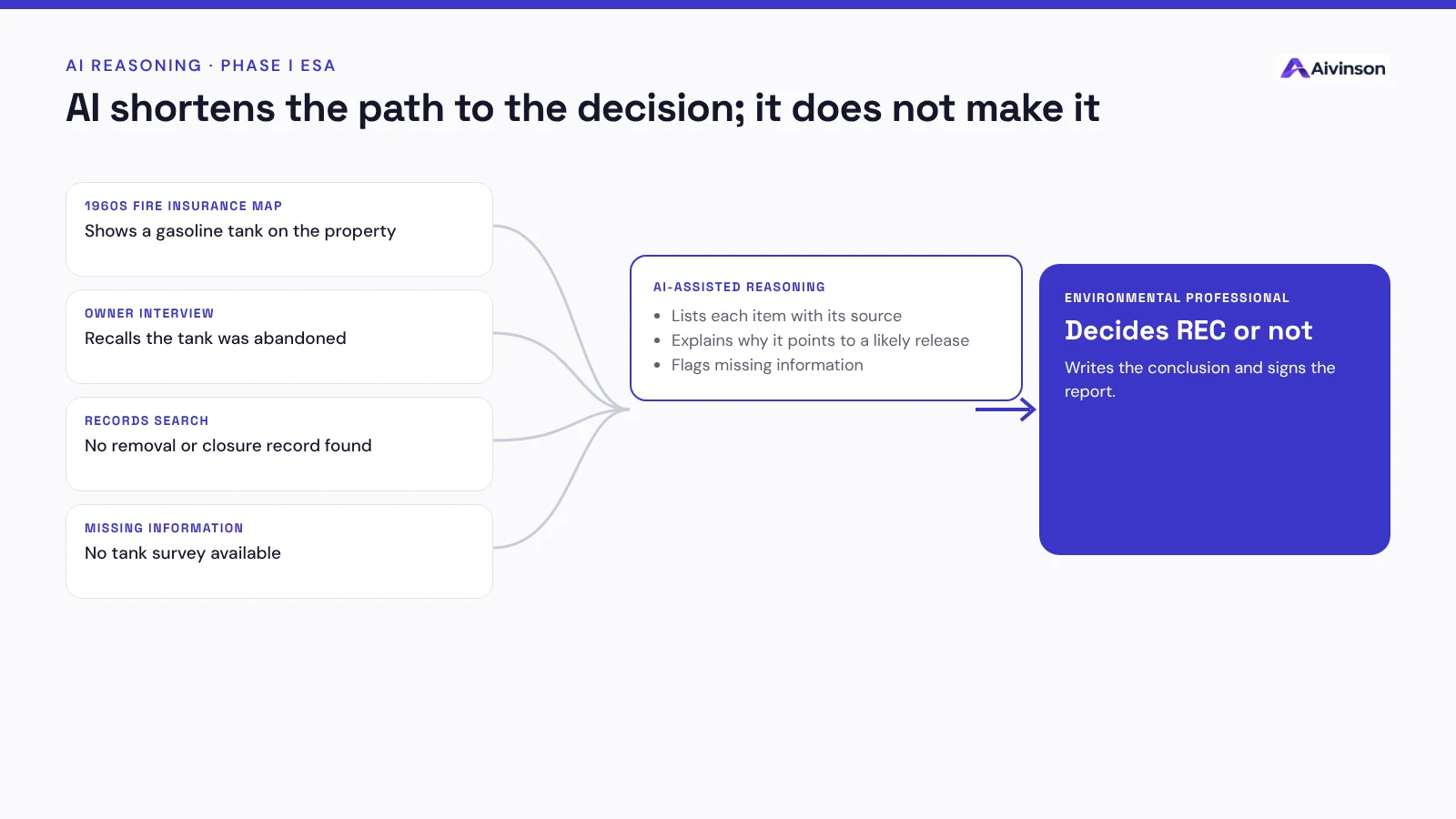
Consider a property where a 1960s fire insurance map shows a gasoline tank, the owner recalls it was abandoned, and no closure record exists. A good AI-assisted workflow lists each piece of evidence with its source, notes that no removal or closure documentation was found, outlines why this points to a likely release, and flags missing information such as a tank survey. The Environmental Professional then decides whether the condition is a REC and writes the conclusion.
The AI shortens the path to a well-supported decision; it does not make the decision.
How to evaluate AI reasoning
- Check the premises first; most errors start there.
- Ask for the evidence behind each step, not just the conclusion.
- Test on past projects where the correct answer is known.
- Look for consistency when the same question is asked differently.
- Keep quantitative work in validated tools.
Trust should grow with demonstrated accuracy on your own work. Our guides to trust in AI and domain-specific AI explain how grounding and specialization improve results.
Draft technical reports from your evidence
See how Aivinson grounds every draft in your site data and appendices, while your experts review, edit and sign.
Frequently asked questions
Can AI really reason?
Modern models can carry out multi-step reasoning on structured problems and often explain their steps, especially newer reasoning models. However, they can still reason from false premises, produce explanations that do not reflect their actual process, and overstate confidence, so important conclusions need human verification.
What is chain-of-thought reasoning?
Chain-of-thought is a technique where a model writes out intermediate steps before giving an answer. Research published in 2022 showed it improves accuracy on multi-step problems. Reasoning models now build this behavior into training, spending more computation on intermediate steps before responding.
Where does AI reasoning fail most often?
It fails most when premises are wrong or missing, when problems require site-specific context the model does not have, in long calculations written as text, and in judgments that depend on professional standards and experience. Errors are often stated confidently, which makes review essential.
Should AI make professional judgments in reports?
No. AI can organize evidence, outline arguments for and against a conclusion and flag missing information. The professional judgment, such as classifying a finding in a Phase I ESA, should be made and documented by the qualified professional who signs the report.
How do you evaluate an AI system’s reasoning?
Check its premises, ask for evidence behind each step, test it on past projects with known answers, compare responses to rephrased questions, and keep calculations in validated tools. Expand reliance only where it proves consistently accurate on your own type of work.