What Is a Recognized Environmental Condition (REC)?
A recognized environmental condition (REC) is the presence or likely presence of hazardous substances or petroleum products in, on or at a property due to a release, the likely presence due to a likely release, or their presence under conditions that pose a material threat of a future release. RECs are the core finding of a Phase I ESA.
On this page
Every Phase 1 Environmental Site Assessment exists to answer one question: are there RECs in connection with the property? The answer drives whether a buyer orders a Phase II, how a lender prices risk and whether CERCLA liability protection holds. This guide explains the definition precisely and shows how Environmental Professionals (EPs) apply it.
The ASTM E1527-21 definition of a REC
ASTM E1527-21 defines a REC as one of three situations involving hazardous substances or petroleum products in, on, or at the subject property:
- Presence due to a release to the environment, such as stained soil at a former fueling area.
- Likely presence due to a release or likely release, such as decades of solvent use at a dry cleaner with no closure records.
- Presence under conditions that pose a material threat of a future release, such as corroding drums stored on bare soil.
The 2021 revision added the word “likely”: not certain or proved, but what a reasonable observer would expect based on logic, experience and the available evidence. It also made clear that a REC must be on the subject property. Contamination on a neighboring parcel becomes a REC only when it has likely migrated onto the subject property, including through vapor migration.
Hazardous substances follow the CERCLA definition in 42 U.S.C. § 9601. Petroleum products are added by the standard because CERCLA excludes petroleum. This is why PFOA and PFOS entered Phase I scope once EPA designated them as CERCLA hazardous substances in 2024.
How a REC differs from CRECs, HRECs and de minimis conditions
Not every environmental issue is a REC. The EP places each finding in one category, and only some categories carry forward as risk:
| Category | Is it a REC? | Example |
|---|---|---|
| REC | Yes | Former dry cleaner with PCE use and no assessment |
| CREC | Yes, a controlled one | LUST closed with a groundwater use restriction |
| HREC | No | UST removed and closed to unrestricted-use standards |
| De minimis condition | No | Small oil drip under parked equipment |
| Business environmental risk | No (non-scope) | Asbestos-containing floor tile |
A CREC is still reported as a REC, but one whose contamination is managed under required controls. An HREC is a past release that was closed to unrestricted-use criteria; the EP must confirm that the closure still meets current standards before calling it historical. Our guides to the CREC and the HREC cover each in detail.
How Environmental Professionals classify a finding
Classification is a structured judgment. Figure 1 shows the sequence most EPs follow for each condition identified in the records review, site visit and interviews.
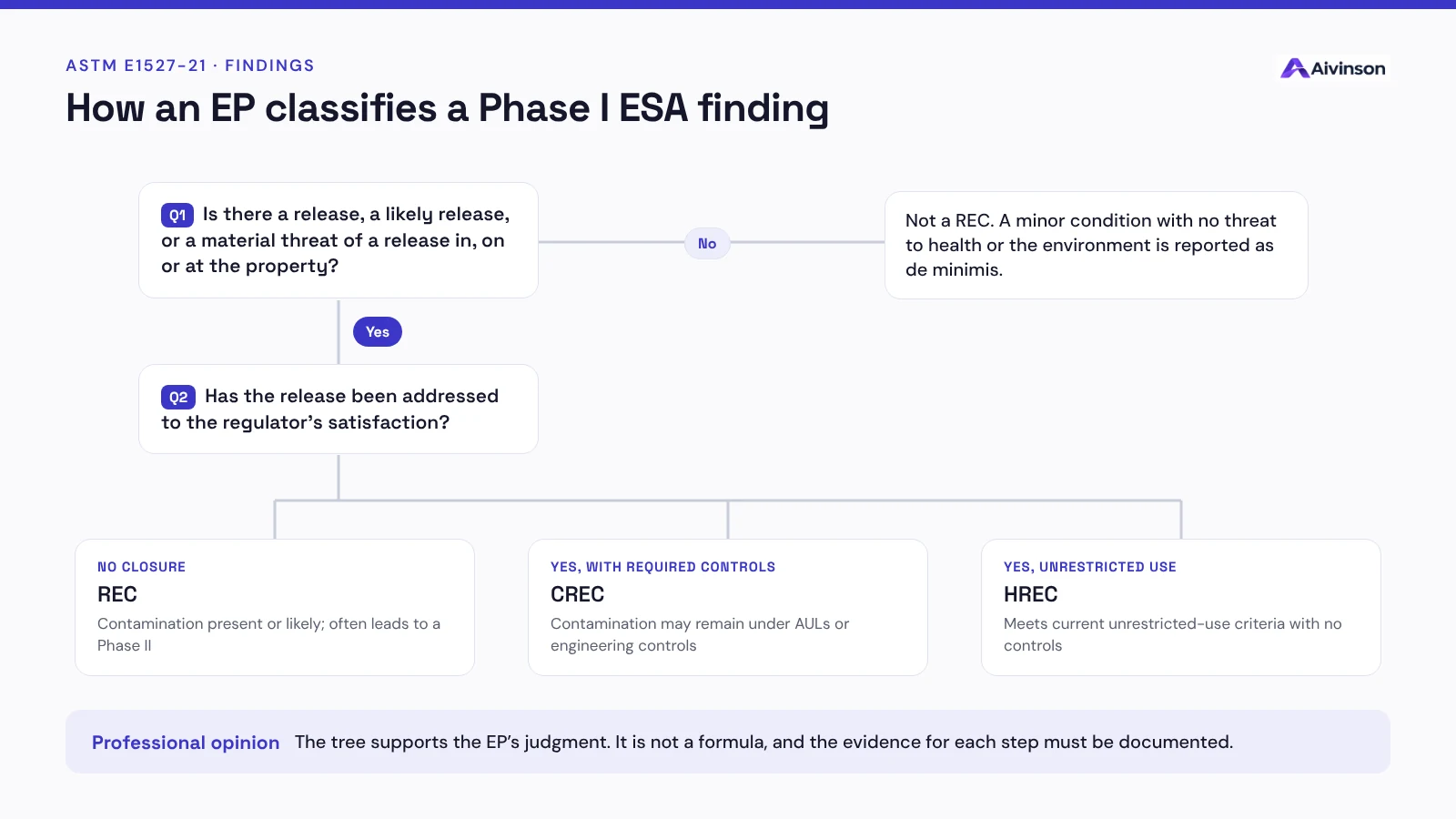
The EP first asks whether the evidence meets any of the three REC conditions. If a past release was addressed, the EP checks the regulatory file for a no further action letter and whether contamination was left in place under controls. Throughout, the EP documents the evidence and the reasoning, because reviewers and lenders will test both.
Software can help surface the evidence. Vinson Analyst reads database reports, aerial photographs and fire insurance maps to flag candidate conditions, but the classification itself stays with the EP.
Common REC examples in Phase I ESAs
- Current or former dry cleaners using perchloroethylene (PCE), especially before modern containment.
- Underground storage tanks without documented removal, closure or tightness testing.
- Former gasoline stations, auto repair shops and fleet maintenance facilities.
- Industrial uses with solvents, metals or plating operations, including historical manufacturing.
- Stained soil, stressed vegetation, floor drains or sumps connected to unknown discharge points.
- An upgradient leaking UST or solvent site with a plume likely extending under the property.
- Fill material of unknown origin, especially in historically industrial areas.
A REC is a conclusion about likelihood, not proof of contamination. Many RECs are resolved by a Phase II ESA that finds concentrations below regulatory screening levels.
Vapor migration and RECs
Since the 2013 revision, ASTM has treated migration of vapor in the subsurface the same as migration of contaminated groundwater or soil. Under E1527-21, a solvent or petroleum release on an adjoining property can create a REC at the subject property if vapor has likely migrated beneath it, even when groundwater flows the other way. EPs should evaluate the distance, the chemicals involved and the building footprint before concluding.
Vapor encroachment screening under ASTM E2600 is a separate, non-scope service that some lenders require. It does not replace the EP’s REC evaluation, but it gives a structured way to document vapor risk when the Phase I evidence points that way.
Why the REC conclusion matters
RECs drive three decisions. Buyers decide whether to order a Phase II, renegotiate, or walk away. Lenders decide loan terms and whether to require further investigation. And the user’s CERCLA liability protection depends on having identified known conditions before acquisition, so a missed REC undermines the purpose of the assessment. For a plain-language overview aimed at local governments, ICMA explains RECs for public-sector buyers. Industry glossaries such as INREV’s REC definition show how investors use the term.
Writing the REC clearly is as important as identifying it. A good REC statement names the condition, cites the evidence and explains why it meets the definition; our guide on writing REC findings shows how. Firms using the Aivinson Phase I ESA workflow draft these statements from the evidence, then the EP edits and signs.
Turn evidence into clear REC findings
See how Aivinson reads the appendices, flags candidate conditions and drafts findings your EP can review and sign.
Frequently asked questions
What does REC stand for in a Phase I ESA?
REC stands for recognized environmental condition. It is the main finding of a Phase I ESA under ASTM E1527-21 and means the presence or likely presence of hazardous substances or petroleum products at the property due to a release, a likely release, or conditions that pose a material threat of a future release.
Does a REC mean the property is contaminated?
Not necessarily. A REC means contamination is present or likely based on available evidence, not that it has been confirmed by sampling. Many RECs are resolved by a Phase II ESA that finds concentrations below regulatory screening levels, while others confirm contamination that needs management or cleanup.
Can an off-site property create a REC?
Yes, but only through migration. Under ASTM E1527-21, a REC must be in, on or at the subject property. An off-site release becomes a REC when hazardous substances or petroleum products have likely migrated onto the subject property, for example through groundwater or soil vapor from an upgradient source.
What is the difference between a REC and a CREC?
A CREC is a type of REC. It involves a past release that was addressed to the regulator’s satisfaction, but with contamination left in place under required controls, such as a deed restriction or engineering control. A plain REC has no such regulatory resolution and usually needs further evaluation.
Is an HREC a REC?
No. An HREC is a past release that was addressed to unrestricted-use criteria without required controls, so it is not a current REC. The EP must still confirm that the earlier closure meets today’s standards. If criteria have changed, the condition may be reclassified as a REC or a CREC.