ASTM E1527-21: What Changed from E1527-13
ASTM E1527-21 is the current standard practice for Phase I Environmental Site Assessments. Compared with E1527-13, it clarifies the REC definition with a “likely presence” test, refines CREC and HREC guidance, requires historical research of adjoining properties, and requires the report to date each viability component. EPA stopped recognizing E1527-13 on February 13, 2024.
On this page
For most firms, the change was about rigor rather than process. The four components of a Phase 1 Environmental Site Assessment are the same, but the evidence needed to support findings, and the way reports document it, moved up a level.
Timeline: from E1527-13 to E1527-21
| Date | Event |
|---|---|
| Late 2021 | ASTM approves and publishes E1527-21 |
| March 2022 | EPA proposes to reference E1527-21 in the AAI rule |
| December 15, 2022 | EPA publishes the final rule recognizing E1527-21 |
| February 13, 2023 | E1527-21 becomes effective for All Appropriate Inquiries |
| February 13, 2024 | E1527-13 no longer satisfies All Appropriate Inquiries |
Reports completed under E1527-13 before the cut-off remained valid for their own transactions, but any new or updated Phase I should now cite E1527-21. The standard is published by ASTM International.
1. A clearer REC definition
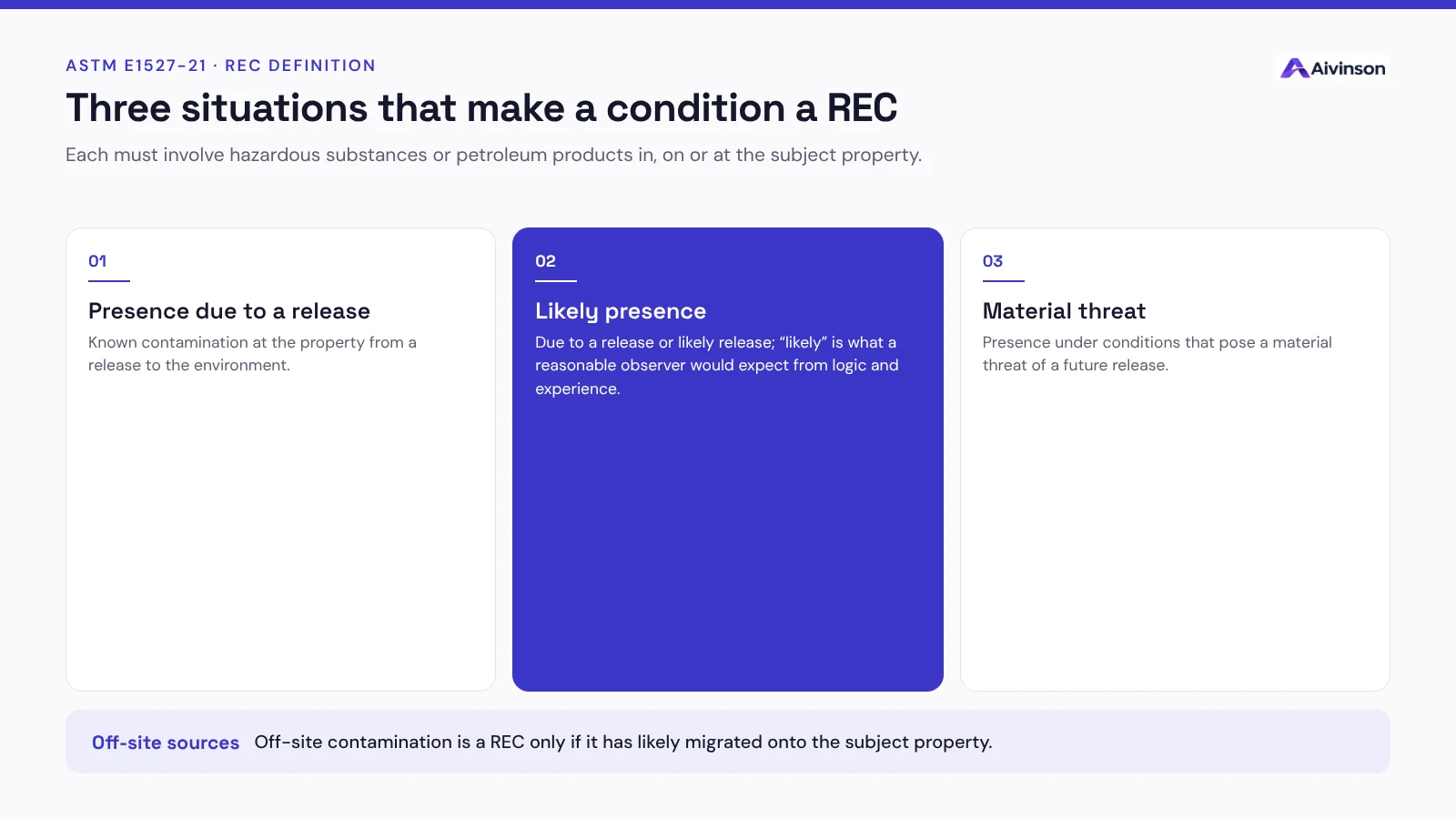
E1527-21 restructured the REC definition into three situations: presence due to a release, likely presence due to a release or likely release, and presence under conditions posing a material threat of a future release. It defined “likely” as what a reasonable observer would expect from logic and experience, short of certainty, and it emphasized that a REC must be in, on or at the subject property. Off-site contamination is a REC only if it has likely migrated onto the property. Our REC guide explains the definition in depth.
2. Refined CREC and HREC guidance
The revision tightened both categories. A CREC requires regulatory closure with controls that allow contamination to remain. An HREC requires closure to unrestricted-use criteria without controls, and the EP should confirm that the closure still meets current criteria. A non-mandatory appendix adds a flowchart to guide classification.
3. Historical research of adjoining properties
E1527-13 focused historical research on the subject property. E1527-21 requires the EP to review standard historical sources for adjoining properties as well, to identify uses such as dry cleaners, fueling or manufacturing that could affect the subject property. This added research time for many firms but closed a gap where neighbor history was inferred rather than documented.
4. Viability dates in the report
The All Appropriate Inquiries rule already required five components to be conducted or updated within 180 days before acquisition, under 40 CFR 312.20. E1527-21 requires the report to state the date of each component: interviews, lien searches, government records review, site reconnaissance and the EP declaration. The 180-day period runs from the earliest of those dates, which makes the report’s shelf life verifiable at a glance.
5. Significant data gaps and other clarifications
- Significant data gaps: the EP must explain whether a data gap affects the ability to identify RECs, not just list missing information.
- Property use limitations: a defined term for restrictions such as AULs that limit how the property may be used.
- Subject property focus: clearer separation between conditions on the property and in its vicinity.
- Findings, opinions and conclusions: clearer expectations for how each is written and supported.
- Emerging contaminants: substances such as PFAS are in scope only when designated as CERCLA hazardous substances, unless the user adds them by contract.
Updating templates and QA for E1527-21
- Replace every E1527-13 reference in templates, proposals and reliance letters.
- Add a viability table listing the date of each 180-day component.
- Add an adjoining property history section with sources for each neighbor.
- Require a significance statement for every data gap.
- Update REC, CREC and HREC wording to the 2021 definitions.
- Add PFOA and PFOS to historical-use screening questions.
Firms that update templates once avoid re-litigating the same review comments on every project. A short internal checklist built from this list catches most gaps before a report reaches the EP.
What the changes mean in practice
Since PFOA and PFOS became CERCLA hazardous substances in 2024, the emerging-contaminants clause has a real effect: those two compounds are now in Phase I scope. Reports also tend to be longer, because adjoining history, viability dates and data-gap reasoning must be shown, not implied.
For a legal perspective on why EPA adopted the revision, the American Bar Association’s overview summarizes the rulemaking. For report teams, the practical answer is a template that enforces the new structure. The Aivinson Phase I ESA solution is structured to E1527-21, so drafts include viability dates, adjoining history and data-gap reasoning by default, and the EP reviews and signs.
Reports structured to ASTM E1527-21
See how Aivinson drafts Phase I ESAs with viability dates, adjoining history and data-gap reasoning built in.
Frequently asked questions
Is ASTM E1527-13 still valid?
No longer for new work. EPA stopped recognizing ASTM E1527-13 as compliant with All Appropriate Inquiries on February 13, 2024. Reports completed under E1527-13 before then remain valid for their own transactions, but any new or updated Phase I ESA should be performed and documented under ASTM E1527-21.
What is the biggest change in ASTM E1527-21?
The clarified REC definition is the most significant change. E1527-21 adds a “likely presence” test, defines likely from a reasonable observer’s view, and requires the condition to be in, on or at the subject property. Together these changes make findings more consistent and easier for reviewers to test.
Does ASTM E1527-21 require adjoining property history?
Yes. E1527-21 requires the Environmental Professional to review standard historical sources for adjoining properties, not only the subject property, to identify uses that could affect it. Typical sources include aerial photographs, fire insurance maps, city directories and historical topographic maps, reviewed back to first development.
How does E1527-21 handle report viability?
E1527-21 requires the report to state the date of each component that must be within 180 days of acquisition: interviews, lien searches, government records review, site reconnaissance and the EP declaration. The 180-day viability period runs from the earliest of those dates, not from the report date.
Does ASTM E1527-21 cover PFAS?
E1527-21 includes substances in Phase I scope when they are CERCLA hazardous substances. Because EPA designated PFOA and PFOS as hazardous substances effective July 8, 2024, those two compounds are now in scope. Other PFAS remain non-scope unless the user adds them to the contract as an additional service.