What Is a CREC (Controlled Recognized Environmental Condition)?
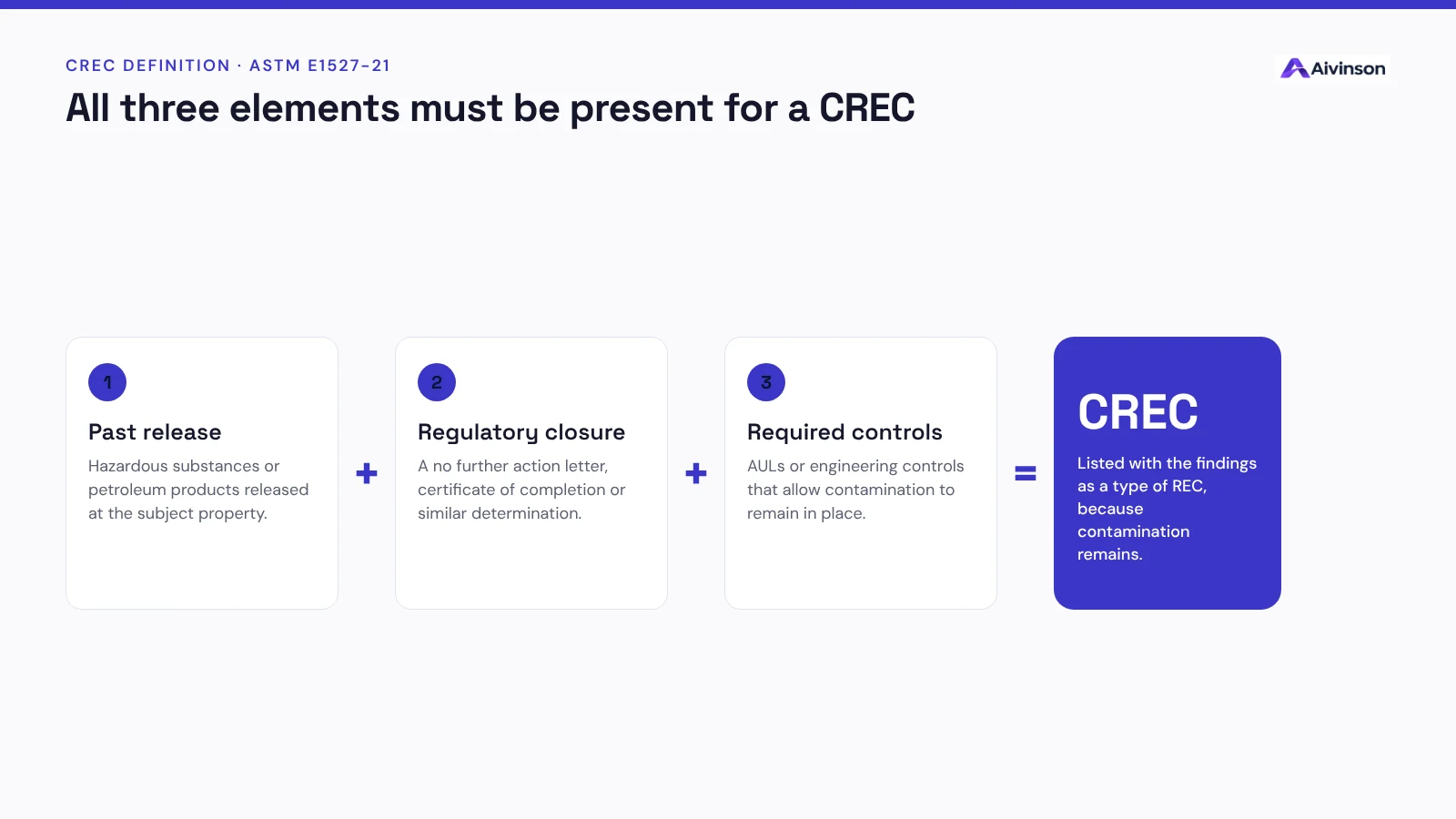
A controlled recognized environmental condition (CREC) is a REC resulting from a past release of hazardous substances or petroleum products that was addressed to the satisfaction of the regulatory authority, with contamination allowed to remain in place subject to required controls, such as activity and use limitations or engineering controls.
On this page
CRECs sit between an open problem and a closed one. The regulator has accepted the cleanup, but only because restrictions keep exposure in check. For a buyer, that means the property carries ongoing obligations. This guide is part of our Phase 1 Environmental Site Assessment series.
The CREC definition under ASTM E1527-21
Three elements must all be present for a CREC:
- A past release of hazardous substances or petroleum products at the subject property.
- Regulatory closure, typically a no further action letter, certificate of completion or similar determination.
- Required controls that allow contamination to remain in place, such as an activity and use limitation (AUL) or engineering control.
Because contamination remains, ASTM E1527-21 treats a CREC as a type of REC. It is listed with the findings, not set aside like a historical condition. The standard, available from ASTM International, includes a non-mandatory flowchart to help EPs separate CRECs from HRECs.
Typical controls behind a CREC
| Control type | Examples | What the buyer must do |
|---|---|---|
| Institutional control (AUL) | Deed restriction, environmental covenant, groundwater use prohibition | Comply with restrictions and keep them recorded |
| Engineering control | Soil cap, vapor mitigation system, barrier wall | Inspect, maintain and report as required |
| Land use limitation | Commercial or industrial use only | Avoid prohibited uses, such as residential or daycare |
| Monitoring requirement | Periodic groundwater or system monitoring | Fund and document ongoing monitoring |
The controls are often recorded in the chain of title. That is why ASTM E1527-21 makes the search for environmental liens and AULs a user responsibility: a CREC can be missed if title records are not reviewed.
CREC examples
- A former gas station where a leaking UST was closed with residual groundwater impact and a recorded groundwater use restriction.
- A manufacturing site capped with asphalt and clean fill, closed with a covenant requiring the cap to be maintained.
- A retail building with a sub-slab depressurization system required to address vapor intrusion from a closed solvent release.
- A brownfield redeveloped for commercial use only, with residential use prohibited in the closure document.
In each case, the condition is “controlled” only as long as the control works and is respected. A broken vapor system or an unauthorized change of use can turn a CREC back into an active problem.
CREC vs REC vs HREC
| Finding | Regulatory closure | Contamination remains | Controls required |
|---|---|---|---|
| REC | No | Present or likely | Not yet determined |
| CREC | Yes | Yes | Yes |
| HREC | Yes | Below unrestricted-use criteria | No |
The difference between a CREC and an HREC is the controls. If closure depended on any restriction, the condition is a CREC. Our HREC guide explains the unrestricted-use test, and the REC guide covers the base definition.
How to verify a CREC during due diligence
- Obtain the closure letter and the document that imposes each control.
- Confirm the control is recorded in the chain of title or a state registry.
- Inspect engineering controls on site, such as caps, vapor systems or barriers.
- Check monitoring and reporting records for gaps or missed deadlines.
- Compare planned use with permitted use under the restrictions.
- Budget for long-term operation, maintenance and monitoring costs.
The EP documents what was verified and what was not. If records cannot be obtained, the gap should be reported and its significance explained.
When a CREC changes status
A CREC is stable only while its controls work. A damaged cap, a vapor mitigation system that is switched off, or a change to a prohibited use can create a new release pathway, and the condition may need to be treated as a REC again. Regulators can also reopen closures if new information emerges or standards change. This is why many buyers include CREC compliance in property management plans and lender reporting, rather than treating closure as permanent.
What a CREC means for buyers and lenders
A CREC rarely stops a deal, but it changes the diligence. Buyers should obtain the closure documents, confirm the controls are recorded and enforceable, and check that current operations comply. Under CERCLA, bona fide prospective purchasers must comply with land use restrictions and must not impede institutional controls, so ignoring a CREC can forfeit liability protection. The statutory definitions are in 42 U.S.C. § 9601.
Lenders usually want to see the operation and maintenance plan and the budget for monitoring. In the report, the EP should describe each control, cite the document that imposes it and state whether the site visit showed evidence of compliance. For local-government buyers, ICMA’s overview of RECs and CRECs is a helpful primer.
Documenting controls consistently across reports is tedious. Firms using Aivinson for Phase I ESAs pull closure letters and AULs from the appendices into the draft automatically, so the EP reviews the classification rather than retyping the evidence.
Document CRECs without retyping the file
See how Aivinson pulls closure letters, AULs and controls into a draft your EP can review and sign.
Frequently asked questions
What does CREC mean in a Phase I ESA?
CREC means controlled recognized environmental condition. It describes a past release that was addressed to the regulator’s satisfaction while contamination remains in place under required controls, such as a deed restriction, environmental covenant or engineering control like a soil cap or vapor mitigation system.
Is a CREC a REC?
Yes. Under ASTM E1527-21 a CREC is a type of recognized environmental condition, because hazardous substances or petroleum products remain at the property. It is listed with the findings of the Phase I ESA, unlike a historical recognized environmental condition, which is described for context but not considered a current REC.
Does a CREC require a Phase II ESA?
Usually not. The regulator has already accepted the cleanup, so a Phase II is rarely needed to confirm the condition. However, buyers should verify that controls are recorded, maintained and compatible with planned use. A change of use or a failed engineering control may require further investigation or agency notification.
How is a CREC different from an HREC?
Both involve a past release that received regulatory closure. A CREC relies on required controls that allow contamination to remain, while an HREC was closed to unrestricted-use criteria without any controls. If closure depended on a restriction or engineering control, the condition is a CREC.
What obligations does a CREC create for a new owner?
A new owner must comply with recorded land use restrictions, maintain engineering controls, fund required monitoring and avoid prohibited uses. Bona fide prospective purchasers under CERCLA must also not impede institutional controls, so ignoring a CREC can put liability protection at risk and create new cleanup exposure.