ASTM E1527-21 Requirements: Components, User Duties and Viability
ASTM E1527-21 requires a Phase I ESA to be performed or supervised by a qualified Environmental Professional, include a records review, site reconnaissance, interviews and user-provided information, evaluate findings and data gaps, state the dates of viability components, and end with the EP’s signed All Appropriate Inquiries declaration.

On this page
This checklist turns those requirements into something a project manager or reviewer can apply. It complements our Phase 1 Environmental Site Assessment guide and the summary of what changed in E1527-21.
Who must perform the assessment
The conclusions must be made by an Environmental Professional. Under 40 CFR 312.10, an EP holds a PE or PG license or equivalent government certification with three years of relevant experience, a science or engineering degree with five years, or ten years of relevant experience. Others may perform tasks under the EP’s supervision or responsible charge. The report must include the EP’s qualifications and declaration.
Records review requirements
- Federal, state and tribal environmental records searched within approximate minimum search distances.
- Physical setting sources, at minimum a current USGS topographic map, plus soils, geology and groundwater information as needed.
- Standard historical sources reviewed to identify all obvious uses back to first development or 1940, whichever is earlier.
- Historical research for adjoining properties, as required by E1527-21.
- Intervals of no more than about five years where sources allow, with gaps explained.
Each source should be cited, and any source that was not reasonably ascertainable should be noted as a potential data gap.
Site reconnaissance and interview requirements
The site reconnaissance covers the subject property and its improvements, with adjoining properties observed from the boundary. The report must describe the method, any limiting conditions and the observations, including storage tanks, drums, stains, drains, pits and evidence of past uses.
Interviews should include the owner, key site manager and occupants, plus at least one local government official. Interviews of past owners and operators are conducted to the extent they are known and reasonably available. Unanswered requests are documented, and the EP judges their significance.
User responsibilities
| User task | Why it matters |
|---|---|
| Search for environmental liens and activity and use limitations | Reveals recorded controls and CRECs |
| Disclose specialized knowledge or experience | Required for liability protection |
| Disclose actual knowledge of releases or liens | Prevents missed RECs |
| Explain a purchase price significantly below fair market value | May indicate known contamination |
| Share commonly known or reasonably ascertainable information | Fills gaps in public records |
If the user does not provide this information, the EP should state so and explain any effect on the conclusions. Many firms send a user questionnaire at kickoff for this reason.
Viability requirements
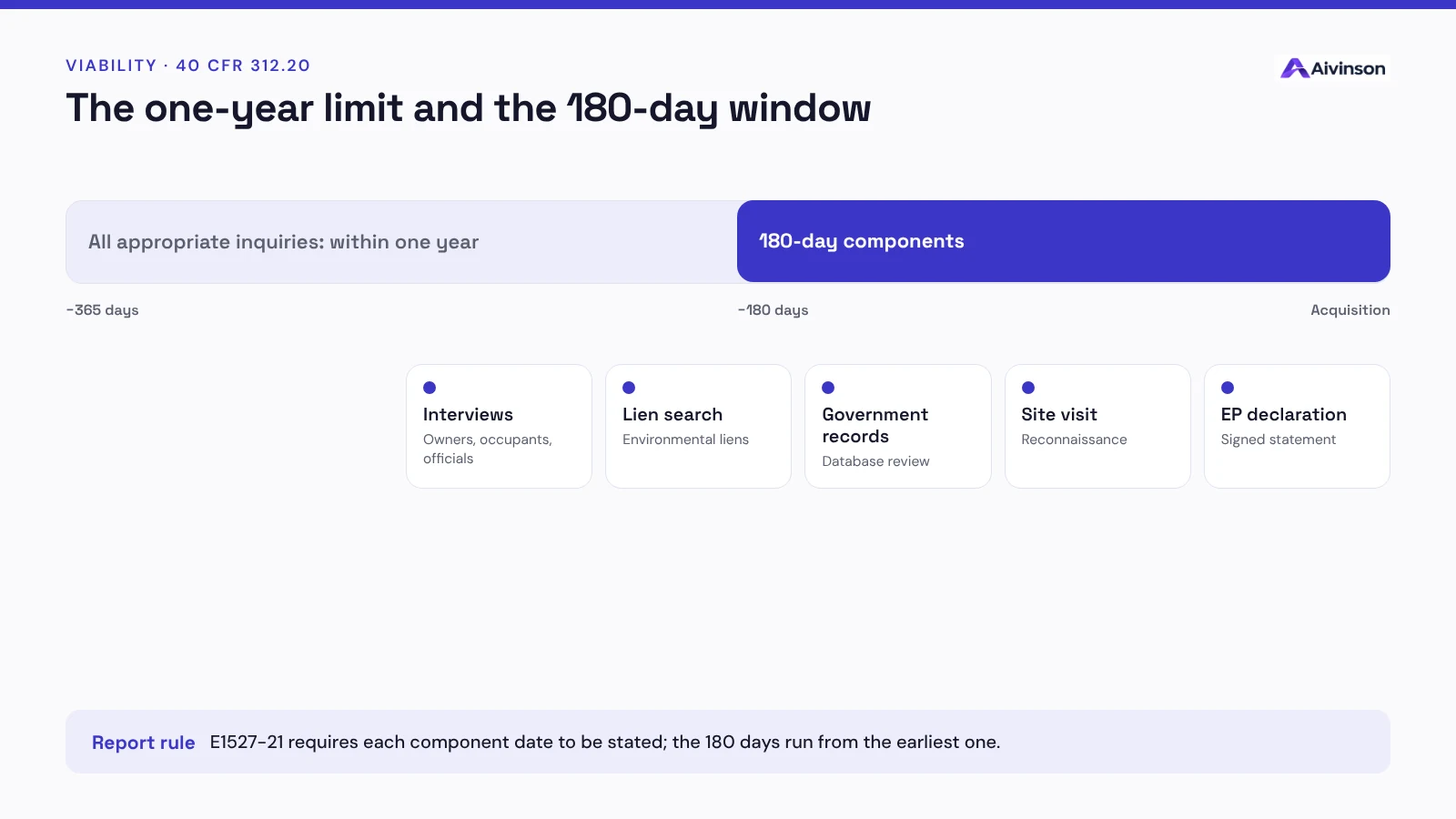
All appropriate inquiries must be conducted within one year before acquisition under 40 CFR 312.20. Five components must also be conducted or updated within 180 days: interviews, lien searches, government records review, the site visit and the EP declaration. E1527-21 requires each date to be stated, and the 180-day period runs from the earliest one.
Report content requirements
- Findings, opinions and conclusions, with every REC, CREC and HREC identified.
- Data gaps and whether each one is significant to identifying RECs.
- Deviations from the standard and any additions or deletions to scope.
- Documentation of sources, site photographs, maps and interview records.
- The EP’s signature, qualifications and AAI declaration.
Recommendations are optional under the standard. Non-scope services must be separated from the E1527-21 findings. The full practice is available from ASTM International.
Data gaps: identifying and explaining them
A data gap is a lack of or inability to obtain information required by the standard despite good faith efforts. Common examples are inaccessible areas, unanswered interviews, missing historical intervals and agency files that were requested but not received in time.
Listing gaps is not enough. E1527-21 expects the EP to state whether each gap is significant, meaning whether it affects the ability to identify RECs. A missing 1950s city directory may be insignificant if aerials and fire insurance maps cover the same period; a locked boiler room at a former industrial site may be significant.
Common compliance gaps
- Viability dates missing or the earliest date outside 180 days at closing.
- No historical research for adjoining properties.
- User questionnaire not returned and its absence not explained.
- Interview with a local government official not attempted.
- EP qualifications or declaration missing from the report.
Each of these is easy to fix before signature and costly to fix after a lender rejects the report.
How to apply the checklist
Reviewers can turn these requirements into a pre-signature check: confirm qualifications, confirm each component and its date, confirm user information, and read the evaluation for reasoning rather than labels. Missing dates and undocumented data gaps are the most common deficiencies.
Templates help, but enforcement is better. The Aivinson Phase I ESA workflow structures drafts to these requirements and flags missing items, while Report Writing tracks review comments until the EP signs.
Drafts that follow the standard
See how Aivinson structures every Phase I ESA draft to ASTM E1527-21 and flags missing items before review.
Frequently asked questions
What are the four components of an ASTM E1527-21 Phase I ESA?
The four components are the records review, site reconnaissance, interviews, and user-provided information. The Environmental Professional evaluates the results of all four, identifies recognized environmental conditions and significant data gaps, and documents findings, opinions and conclusions in the report the EP signs.
Who can perform a Phase I ESA under ASTM E1527-21?
The conclusions must be made by an Environmental Professional as defined in 40 CFR 312.10. Other staff may conduct the site visit, records review or interviews, but only under the supervision or responsible charge of an EP, who must sign the report and the All Appropriate Inquiries declaration.
What must the user provide for a Phase I ESA?
The user should provide results of an environmental lien and activity and use limitation search, any specialized or actual knowledge, an explanation if the purchase price is significantly below fair market value, and commonly known information about the property. Missing information is reported by the EP.
Are recommendations required in an ASTM E1527-21 report?
No. Recommendations are optional under ASTM E1527-21. However, many lenders and users require them, for example a recommendation for a Phase II ESA when RECs are identified. The scope of work should state clearly whether recommendations will be included in the final Phase I report, so expectations match.
How far back must historical research go?
Historical research must identify all obvious uses of the property back to its first developed use or 1940, whichever is earlier. Sources should be reviewed at intervals of about five years where available, and E1527-21 extends historical research to adjoining properties as well, with any gaps explained.