Conversational AI: From Chatbots to Cited Answers on Project Files
Conversational AI is technology that lets people interact with software through natural language, in text or speech, across several turns. Modern systems use large language models to understand questions and generate replies. In technical work, the most useful form answers questions from the project’s own documents and cites its sources.
On this page
Most people meet conversational AI as a customer service chatbot or a voice assistant. For engineers and environmental consultants, the more interesting use is different: asking a 600-page project file a precise question and getting a sourced answer in seconds. This article is part of our Generative AI series.
What conversational AI is
IEEE describes conversational artificial intelligence as the branch of AI concerned with systems that hold multi-turn dialogues with people in natural language. It draws on natural language processing, speech recognition, information retrieval and machine learning.
| Type | Goal | Example |
|---|---|---|
| Question answering | Return facts from documents or knowledge bases | What does the 1962 map show at the northeast corner? |
| Task-oriented | Help a user complete a goal | Schedule a site visit, reset a password |
| Social or open-domain | Hold a general conversation | General-purpose chat assistants |
For technical teams, question answering grounded in project evidence delivers most of the value and carries the least risk.
From ELIZA to large language models
The first well-known chatbot, ELIZA, was described by Joseph Weizenbaum in a 1966 Communications of the ACM paper. It matched patterns and reflected users’ words back to them, and many users still attributed understanding to it. That reaction is worth remembering: fluent conversation is not evidence of correctness.
Later systems used intent classification and scripted flows, which worked for narrow tasks such as banking or bookings. Large language models changed the field by generating flexible replies to open questions. They also introduced a new risk: confident answers that are not supported by any source.
How conversational AI answers a question
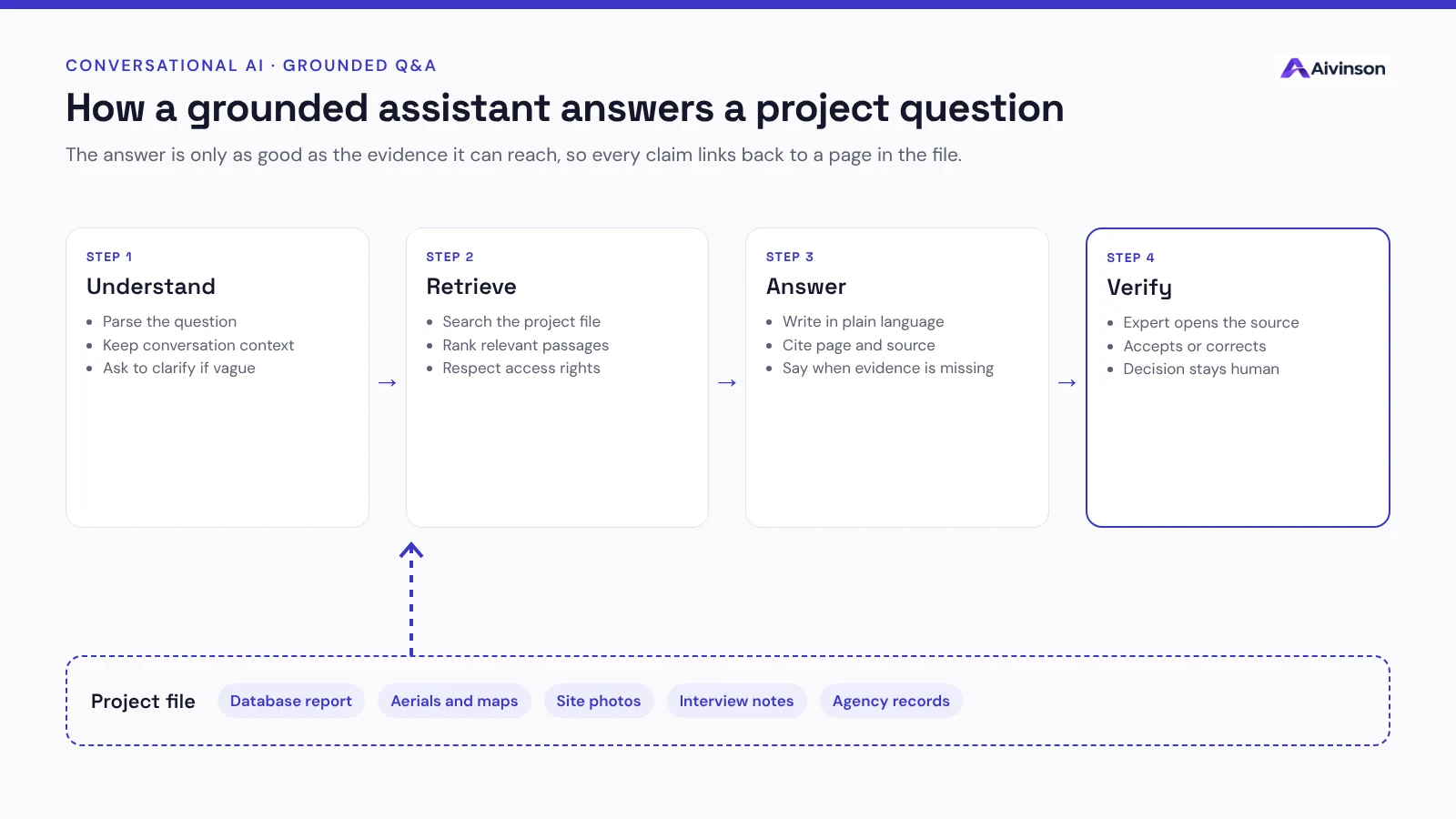
A grounded assistant follows four steps. It interprets the question and the conversation so far, retrieves the most relevant passages from the document set, writes an answer that cites those passages, and leaves the final check to the user. Retrieval-augmented generation, described in a 2020 research paper, is the usual method.
The answer is only as good as the evidence the system can reach. If a document was never uploaded or a scan is unreadable, a well-designed assistant says the evidence is missing instead of guessing. That behavior matters more than conversational polish.
Where conversational AI fits in technical work
| Use | Value | Watch for |
|---|---|---|
| Q&A on a project file | Find facts across appendices in seconds | Check the cited page |
| Reviewer support | Confirm a statement’s source during review | Misgrounded citations |
| Standards lookup | Locate the relevant clause quickly | Outdated editions |
| Onboarding junior staff | Explain terms and report structure | Over-reliance on answers |
| Client questions | Draft replies from the report itself | Expert approval before sending |
Ask Vinson is built for the first two uses: it answers questions about a Phase I ESA project file and shows the source for each answer, so reviewers verify instead of searching. It works inside Report Writing, where the report and its evidence live together.
Conversational AI vs a search box
Keyword search returns documents; conversational AI returns an answer and the passages behind it. It handles follow-up questions in context, such as “and what about the adjoining property to the east?” The trade-off is that an answer can sound complete when it is not. Good systems show every source, and good users open them.
Risks and safeguards
- Hallucination: require citations and treat uncited statements as unverified. See AI accuracy.
- Confidentiality: client files must stay in systems with isolation and no training on customer data.
- Over-trust: conversational tone invites reliance; keep a human in the loop for decisions.
- Stale context: confirm the assistant is reading the current version of each document.
- Scope creep: an assistant that answers questions should not quietly make findings.
These safeguards echo the principles in our Responsible AI guide.
How to evaluate a conversational AI tool
- Does every answer cite a specific page or source in your files?
- Does it say clearly when the evidence is missing?
- Can it handle follow-up questions without losing context?
- Is your data isolated and excluded from model training?
- Can you test it on a past project where you know the answers?
A short test on a finished project shows more than any product tour. Compare its answers with what your team found, page by page. For field-specific systems, see Domain-specific AI.
Keep experts in charge of every finding
See how Aivinson drafts from your evidence, flags what needs attention and leaves every decision and signature with your team.
Frequently asked questions
What is conversational AI?
Conversational AI is technology that lets people interact with software in natural language, by text or voice, across several turns. Modern systems use large language models to interpret questions and generate replies, often grounded in a specific set of documents. In technical work, the most useful systems cite the page behind every answer.
What is the difference between a chatbot and conversational AI?
Older chatbots followed scripts and keyword rules, so they handled only expected questions. Conversational AI uses language models to understand open questions, keep context across turns and generate new answers. The term now covers both simple bots and advanced assistants. Accuracy depends on the evidence the system can reach.
How does conversational AI use project documents?
It retrieves the passages most relevant to a question from the project’s files and writes an answer from them, citing each source. This approach, called retrieval-augmented generation, lets users verify answers instead of trusting the model’s memory. If the evidence is missing, a good assistant says so instead of guessing.
Is conversational AI accurate enough for technical work?
For finding and summarizing facts in provided documents, it can be very useful, provided every answer cites its source and users check it. It should not make professional judgments, and its answers need verification before they enter a report. Use it to find facts faster, then let the expert decide what they mean.
Is it safe to put client files into a conversational AI tool?
Only if the tool isolates each firm’s data, encrypts it, restricts access and does not use customer content to train models. Check contracts and security documentation before uploading confidential project files. Ask where data is stored, who can access it and how long it is kept, and confirm the answers in writing.