Trust in AI: What Makes AI Output Trustworthy in Technical Work
Trust in AI is justified confidence that an AI system’s output is accurate, reliable and appropriate for its purpose. In professional work it is earned through grounding in sources, traceable claims, transparency about limits, secure data handling and review by a qualified person, not through fluent output alone.
On this page
The danger with generative AI is not that people distrust it; it is that they trust it too easily. Well-written text looks authoritative. This guide explains what should earn trust and how to check it. It is part of our generative AI series.
Trust vs trustworthiness
Trust is a human attitude; trustworthiness is a property of the system and how it is used. The goal is calibrated trust: relying on AI where it has proven reliable and checking it where it has not. Over-trust leads to unchecked errors in reports; under-trust wastes the time savings the tools offer.
Characteristics of trustworthy AI
| Characteristic | What it means in technical work |
|---|---|
| Valid and reliable | Output is correct and consistent for the task |
| Grounded and traceable | Each claim links to a source document |
| Transparent | Users know what the system did and what it could not do |
| Secure and private | Client data is isolated, protected and not reused without consent |
| Accountable | A named person approves and owns the result |
| Fair and unbiased | Errors do not fall systematically on certain cases |
These mirror widely used principles, such as the OECD AI Principles, which call for transparency, robustness, safety and accountability.
Grounding is the foundation of trust
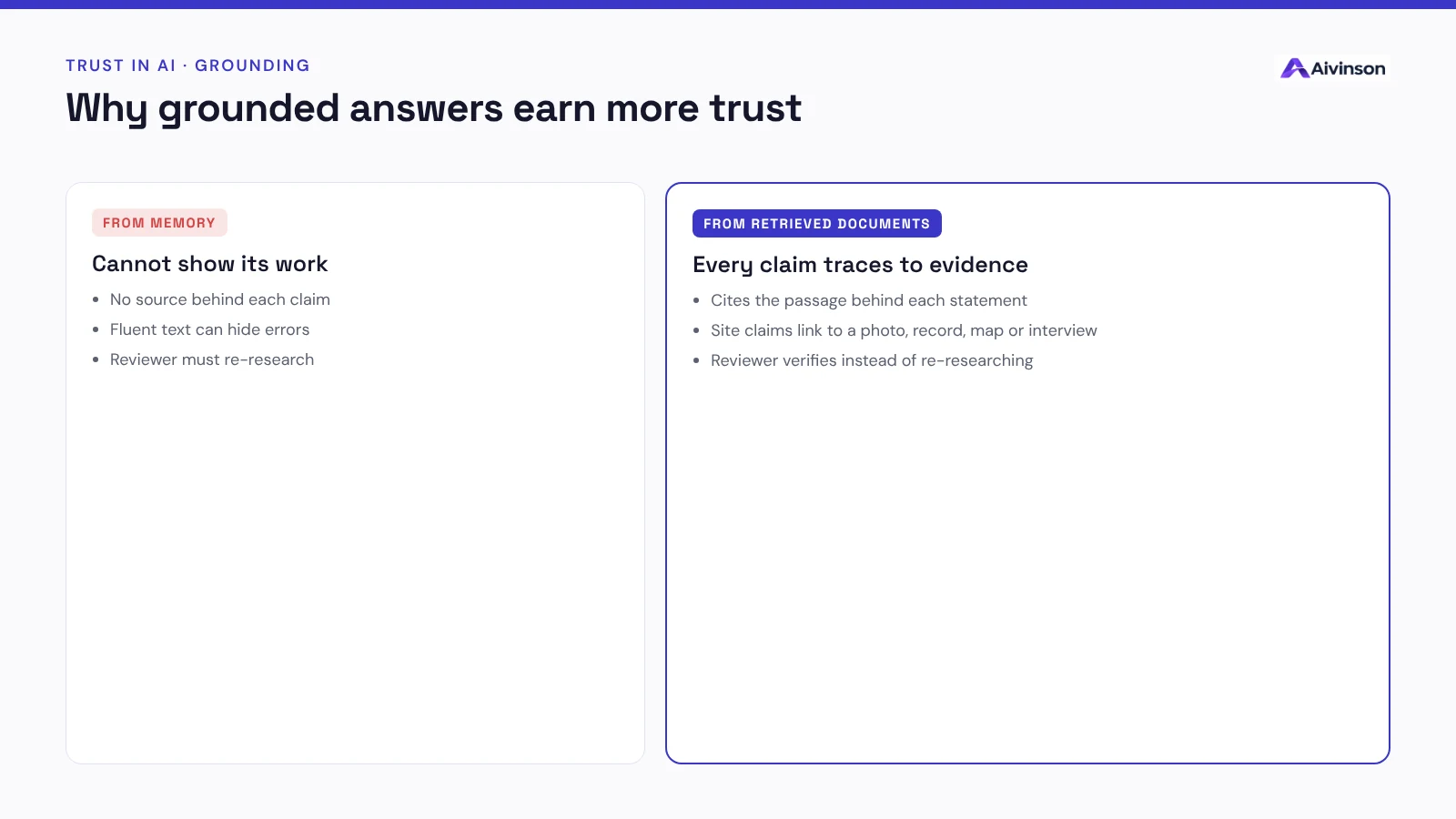
A model answering from memory cannot show its work. A model answering from retrieved documents can. Retrieval-augmented generation, introduced in a 2020 research paper, lets the system cite the passage behind each statement, so reviewers verify instead of re-researching.
In report production, this means every sentence about a site should trace to a photo, a record, a map or an interview. Ask Vinson answers project questions with sources for exactly this reason.
How to verify AI output before relying on it
- Check every factual claim against its cited source, starting with dates, numbers and names.
- Confirm that standards and regulations cited are current editions.
- Look for statements with no source and treat them as unverified.
- Compare conclusions with the evidence; strong claims need strong evidence.
- Record what was checked and by whom.
Reviewers should apply the same discipline they use for junior staff drafts. Our guide to writing REC findings shows the evidence-linked structure that makes this easy.
Trust, accountability and professional ethics
Professional codes already define who is trusted: the licensed or qualified person who signs. The NSPE Code of Ethics for Engineers requires engineers to hold public safety paramount and to perform services only in areas of their competence. Using AI does not change those duties; it adds a tool that must be understood before it is relied on.
Adoption data such as the Stanford AI Index shows AI use rising quickly across industries. Trust will follow systems that make verification easy and keep humans accountable. Our guide to AI governance covers the organizational controls.
Common causes of misplaced trust
- Polished language that hides weak or missing evidence.
- Citations that look real but were never checked.
- Consistent tone across sections, mistaken for consistent accuracy.
- Time pressure that turns review into skimming.
- Early successes that lead teams to skip verification later.
Each of these is a process problem, not a model problem. Review checklists and visible source links address most of them.
Trust signals clients look for
Clients and lenders increasingly ask how consultants use AI. The answers that build trust are concrete: drafts are grounded in project evidence, every claim is traceable, client data is isolated and never used for training, and a named professional reviews and signs. A short written statement of these practices, shared on request, answers most questions and differentiates firms that have thought it through.
Building trust in AI inside a firm
Start with low-risk, high-volume tasks such as summarizing appendices, measure error rates during review, and expand use as the system proves reliable. Share examples of caught errors so staff learn what to look for. Trust grows from evidence, the same way it does with any new team member.
Draft technical reports from your evidence
See how Aivinson grounds every draft in your site data and appendices, while your experts review, edit and sign.
Frequently asked questions
What does trust in AI mean?
Trust in AI means justified confidence that an AI system’s output is accurate, reliable and suitable for its purpose. In professional work that confidence should be calibrated: earned through grounding, traceability, transparency, security and human review, rather than assumed from fluent or confident-sounding output.
How can you tell if AI output is trustworthy?
Check whether each claim cites a source you can open, whether cited standards are current, and whether conclusions match the evidence. Output with untraceable statements, outdated references or unusually confident conclusions should be treated as unverified until a qualified reviewer confirms it.
Why is grounding important for trust in AI?
Grounding ties AI output to specific source documents, usually through retrieval-augmented generation. That lets the system cite where each statement came from, so reviewers can verify claims quickly and spot unsupported text. Answers from model memory alone cannot be traced or checked this way.
Can AI be trusted for engineering or environmental reports?
It can be trusted for defined tasks, such as drafting from project evidence or summarizing records, when output is grounded and reviewed. It should not be trusted to make findings or sign reports. Those remain the responsibility of the qualified professional under the relevant standard and license.
What reduces over-trust in AI?
Clear source citations, visible flags for unsupported statements, training that focuses on verification, and workflows that require named human approval all reduce over-trust. Sharing examples of errors caught during review helps staff develop realistic expectations of the tools. Calibrated expectations are the goal.