ASTM E2018 Scope: Baseline PCA, Exclusions and When to Add Specialists
The ASTM E2018-24 baseline scope is a visual, non-intrusive walk-through survey of a commercial property’s primary improvements, plus document review, interviews and opinions of costs to remedy material physical deficiencies. Items such as code compliance, warranties, off-site conditions and economic obsolescence are excluded unless the user adds them.
On this page
Scope is where most PCA disputes start. A user expects one thing; the report delivers the baseline. This guide, part of our property condition assessment series, explains the baseline and how to extend it deliberately.
What the baseline includes
- A walk-through survey of the site, structure, envelope, roofing, MEP, vertical transportation and life safety systems.
- Representative observation of interior spaces and units, extrapolated to similar areas.
- Review of available documents, including prior reports, and a check of building and fire department records.
- Interviews with the owner, property manager or maintenance staff.
- Opinions of costs to remedy material physical deficiencies.
- A property condition report with photographs, findings, cost tables and limitations.
ASTM describes a current walk-through, interviews and a check of building and fire department records as minimum requirements, and says information from prior reports must be verified. See the summary on the ASTM E2018-24 page.
What the baseline excludes
| Excluded by default | Why it matters | How to add it |
|---|---|---|
| Code and warranty compliance review | Not a code audit | Add a code or zoning review |
| Off-site conditions | Limited to the property | Add specific off-site evaluation |
| Economic obsolescence | Not a valuation | Use an appraisal or market study |
| Destructive testing and calculations | Visual and non-intrusive | Add a specialist investigation |
| Environmental conditions | Separate discipline | Order a Phase I ESA |
| Detailed accessibility audit | Baseline is limited | Add an accessibility survey |
Some exclusions are named in the guide; others reflect the non-intrusive nature of the baseline. Either way, the PCR should list what was not done.
How representative sampling works
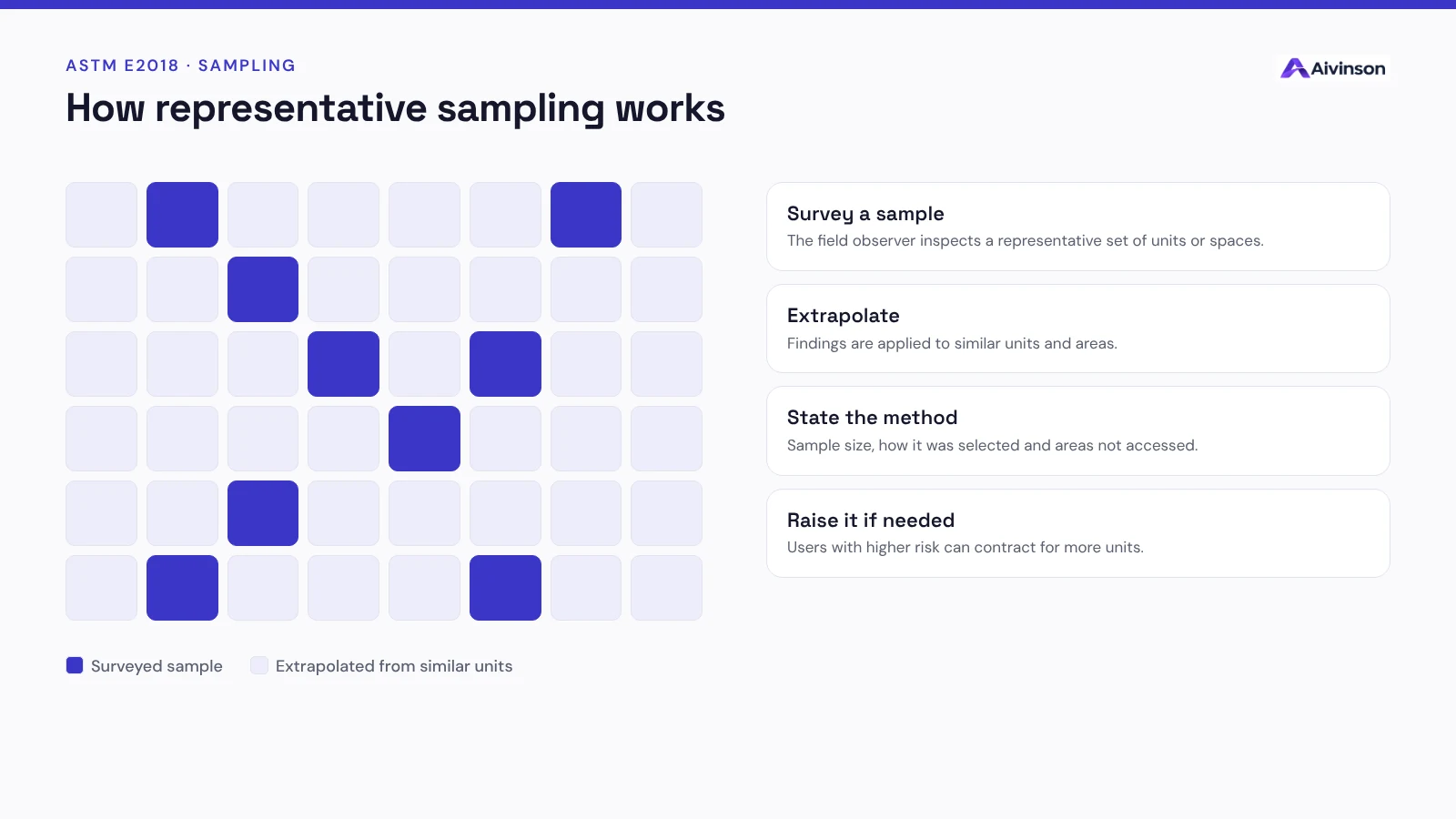
Large properties are rarely inspected room by room. The field observer surveys a representative sample of units or spaces and extrapolates to similar areas. The report should state the sample size, how it was selected and any areas not accessed. Users with higher risk tolerance needs, such as value-add buyers, often increase the sample.
When to add specialists
E2018-24 adds guidance on using specialists for enhanced evaluations of high-cost or critical systems. Common triggers include:
- Roofs near the end of their useful life or with visible leaks.
- Facades with cracking, spalling or prior repairs, especially on older high-rises.
- Structural distress such as settlement, deflection or corrosion.
- Elevators without current certificates or with major modernization due.
- Complex central plants or fire protection systems.
A generalist still meets the baseline, which many lenders accept. Specialists add cost but turn uncertain items into defensible numbers. ASTM’s feature on the revision stresses agreeing these choices with the user up front.
Writing a clear scope of work
- State the user, purpose and any reliance parties.
- Define the cost reporting threshold and long-term term.
- Specify sampling for units or tenant spaces.
- List specialists and additional services.
- Name lender formats or exhibits required.
A written scope prevents most disagreements at delivery. For portfolio programs, consistent scopes also make condition data comparable over time, a point emphasized in National Academies research on condition assessment surveys.
Accessibility within the baseline
A baseline PCA commonly includes only a limited visual survey of accessibility items such as parking, routes, entrances and common restrooms. It does not include measurements, counts or a full compliance determination. For multifamily, retail and hospitality properties, where accessibility claims are more common, users often add a detailed accessibility survey by a specialist.
Scope by property type
| Property type | Typical additions to the baseline |
|---|---|
| Multifamily | Higher unit sampling, accessibility survey, agency format |
| Office high-rise | Facade and elevator specialists, MEP review |
| Industrial | Roof specialist, structural review of slabs and framing |
| Retail center | Paving and site review, roof specialist, accessibility |
| Hospitality | Guestroom sampling, life safety, accessibility |
Scope and the report
The PCR should mirror the scope: each addition gets its own section, and limitations list what was excluded or not accessed. Our guide to the property condition report covers structure, and our E2018-24 summary covers what changed. Capturing scope items as checklists in Site Assistant helps field teams cover every agreed item.
PCA reports are coming to Aivinson
Site Assistant and Report Writing already handle field capture and review. Join the waitlist for early access, including PCA reports when they launch.
Frequently asked questions
What does the ASTM E2018 baseline scope include?
The baseline includes a visual walk-through survey of the site and primary building systems, review of available documents with a check of building and fire department records, interviews with knowledgeable people, opinions of costs to remedy material physical deficiencies, and a property condition report.
What is excluded from a baseline PCA?
ASTM E2018-24 excludes items such as code and warranty compliance review, off-site conditions and economic obsolescence unless the user adds them. Because the baseline is visual and non-intrusive, destructive testing, engineering calculations, environmental assessment and detailed accessibility audits are also separate services.
When should I add a specialist to a PCA?
Add a specialist when a high-cost or critical system shows distress or is near the end of its life, such as an aging roof, a cracking facade, structural movement, elevators due for modernization, or complex central plants. Specialists turn uncertain items into defensible cost opinions.
How many units are inspected in a PCA?
ASTM E2018-24 allows representative sampling, so the field observer surveys a sample of units or spaces and extrapolates to similar areas. The sample size depends on the scope and user needs, and the property condition report should state the sample and any areas that could not be accessed.
Does a PCA include environmental review?
No. A baseline PCA evaluates physical condition only. Environmental conditions, such as contamination from past uses, are evaluated in a Phase I ESA under ASTM E1527-21, which is often ordered alongside the PCA for acquisitions and loans so both reports can be reviewed together.