Property Condition Report (PCR): What’s Inside and How to Read It
A property condition report (PCR) is the written deliverable of a property condition assessment under ASTM E2018-24. It documents the scope, system-by-system observations, document review and interviews, opinions of costs for immediate, short-term and long-term needs, limitations and photographs, and reflects the property’s condition at one point in time.
On this page
Lenders and buyers often read only the executive summary and cost tables. Reviewers read everything. This guide explains each section of the PCR produced by a property condition assessment and what to check before relying on it.
PCR structure at a glance
| Section | What it should contain |
|---|---|
| Executive summary | Overall condition, key deficiencies, summary cost tables |
| Purpose and scope | User objectives, scope, deviations, additional services |
| Property description | Site, building type, size, age, systems |
| Walk-through survey | System-by-system observations and condition ratings |
| Document review and interviews | Records reviewed, people interviewed, key information |
| Opinions of costs | Immediate, short-term and long-term tables with assumptions |
| Limitations | Out-of-scope items, access limits, sampling assumptions |
| Appendices | Photographs, qualifications, supporting documents |
The structure follows the reporting section of ASTM E2018-24, which describes format, writing protocols, documentation, the executive summary and the record of the walk-through, document review and interviews.
The executive summary
The executive summary should let a decision-maker understand the property in one page: building description, overall condition, the most significant deficiencies, and summary cost tables. Every number here must match the detailed tables. Inconsistent totals are the most common reviewer comment.
System observations and condition ratings
Each system section describes what was observed, its approximate age and its condition. Ratings such as good, fair and poor are tied to whether repairs are needed. An item in good condition needs no immediate or short-term repair; fair means it works but may need repair soon; poor means it is not working or needs repair now or soon. Ratings without supporting observations or photos weaken the report.
Reading the cost tables
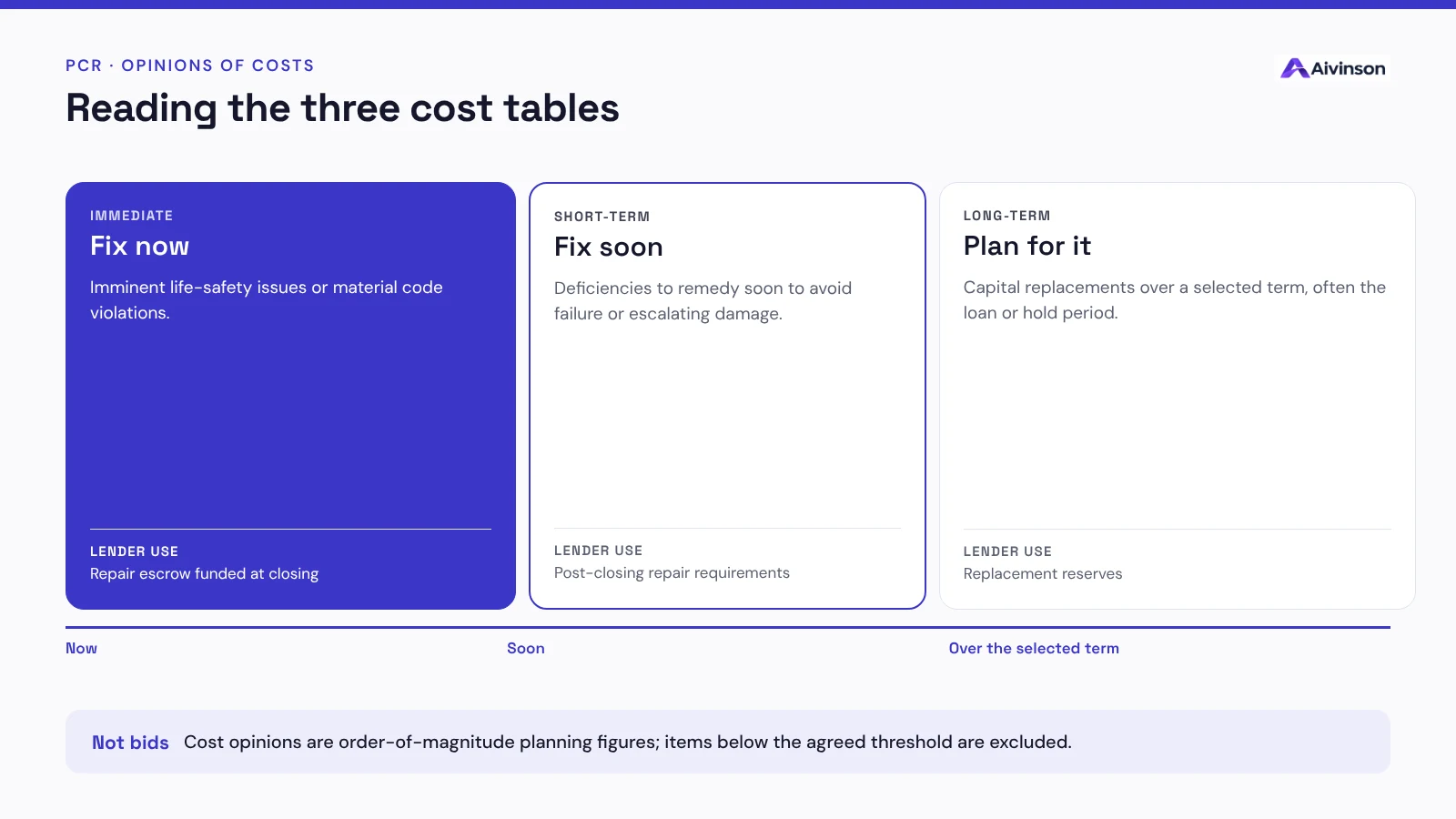
- Immediate costs: conditions such as imminent life-safety issues or material code violations, usually funded at closing.
- Short-term costs: deficiencies to remedy soon to avoid failure or escalating damage.
- Long-term costs: capital replacements over a selected term, often aligned with the loan or hold period.
- Thresholds: items below the agreed reporting threshold are excluded from tables.
- Assumptions: unit costs, quantities, escalation and the term used.
Cost opinions are order-of-magnitude estimates, not bids. ASTM describes them as often developed under time constraints without engineering calculations or testing, so users should treat them as planning figures. The ASTM announcement of the E2018 revision explains that the main goal is to identify deficiencies needing immediate or near-term attention.
Limitations and out-of-scope items
Every PCR states what was not done: areas not accessed, units not sampled, systems not tested, and out-of-scope items such as code compliance, warranties and off-site conditions. Reviewers should read this section carefully, because a clean report with broad limitations may hide more risk than a report with clear findings. Our guide to ASTM E2018 scope lists the common exclusions.
What reviewers check first
- Executive summary totals match the detailed cost tables.
- Every cost item maps to an observation and, ideally, a photo.
- Thresholds, term and escalation assumptions are stated.
- Sampling assumptions explain how many units or areas were seen.
- Immediate items are clearly separated and justified.
- Recommendations for specialists follow from specific observations.
Research on facility condition surveys from the National Academies highlights the same theme: condition data is only useful when it is consistent and traceable.
Photographs and documentation
Photographs are evidence, not decoration. Each significant deficiency should have at least one labeled photo showing location and condition, and the photo log should follow the same system order as the report. Supporting documents, such as permits or roof warranties, belong in appendices and should be referenced in the text.
How lenders use the PCR
Lenders use immediate costs to size repair escrows funded at closing, short-term costs to set post-closing repair requirements, and long-term costs to size replacement reserves. Agency programs specify formats and terms, so the same property may need different tables for different lenders. A clear PCR with stated assumptions makes those conversions faster and avoids reissuing the report.
Producing PCRs faster
Assembling photos, observations and cost tables into a consistent PCR is the slowest part of the work. Capturing observations once in Site Assistant and reviewing in Report Writing keeps evidence and text together. PCA report drafting is on the Aivinson roadmap; see the platform overview for what is available today.
PCA reports are coming to Aivinson
Site Assistant and Report Writing already handle field capture and review. Join the waitlist for early access, including PCA reports when they launch.
Frequently asked questions
What is a property condition report?
A property condition report is the written deliverable of a property condition assessment. Under ASTM E2018-24 it documents the scope, walk-through observations, document review and interviews, opinions of costs and limitations, and it reflects the physical condition of the property at a single point in time.
What is the difference between immediate and short-term costs?
Immediate costs address conditions that need action now, such as imminent life-safety issues or material code violations. Short-term costs address deficiencies that should be remedied soon to prevent failure or escalating damage. Lenders often fund immediate costs at closing through a repair escrow.
Are PCR cost estimates accurate?
PCR cost opinions are order-of-magnitude estimates intended for planning and negotiation, not contractor bids. They are usually developed without engineering calculations or testing, so actual repair costs can differ. For major items, users often obtain specialist evaluations or contractor pricing.
How long is a property condition report valid?
ASTM E2018-24 does not set a fixed shelf life, because a PCR reflects conditions on the day of the survey. Many lenders accept reports up to six months to a year old, but conditions can change quickly after storms, deferred maintenance or major system failures, so updates are common.
What do condition ratings like good, fair and poor mean?
Ratings describe whether a system needs repair. Good means no immediate or short-term repair is needed, fair means it is working but may need repair soon, and poor means it is not working properly or needs immediate or short-term repair. Ratings should always be supported by observations.