Property Condition Assessment (PCA): The Complete Technical Guide
A property condition assessment (PCA) is a non-intrusive evaluation of a commercial property’s physical condition, performed under ASTM E2018-24. It combines a walk-through survey, document review and interviews to identify material physical deficiencies and estimate the cost to remedy them. The deliverable is a property condition report (PCR).

On this page
Where a Phase I ESA asks whether a property is contaminated, a PCA asks what it will cost to keep it working. Buyers use it to price acquisitions, lenders to size reserves, and owners to plan capital spending. The baseline process is defined by ASTM, but every engagement is shaped by the user’s objectives.
Key takeaways
- ASTM E2018-24 replaced E2018-15 in January 2024 with more than 140 revisions and a stronger focus on user objectives.
- The baseline PCA is visual and non-intrusive: no destructive testing, engineering calculations or code compliance review.
- Cost opinions are order-of-magnitude estimates for immediate, short-term and, increasingly, long-term needs.
- The PCR reflects one point in time and reduces, but does not eliminate, uncertainty.
- Specialists are added for high-cost or critical systems when the user’s risk tolerance requires it.
What is a property condition assessment?
A PCA is the physical due diligence counterpart to an environmental site assessment. It evaluates the condition of a commercial property’s primary improvements, including the site, structure, building envelope, roofing, mechanical, electrical and plumbing systems, vertical transportation and life safety systems. The consultant identifies material physical deficiencies and provides opinions of the cost to remedy them.
The industry baseline is ASTM E2018-24, the Standard Guide for Property Condition Assessments: Baseline Property Condition Assessment Process. As a guide rather than a practice, it defines good commercial and customary practice and is commonly adapted by lenders and users. The work product is the property condition report, or PCR.
A PCA is not a warranty or an insurance policy. It reflects what a qualified observer could see on the day of the survey, supplemented by documents and interviews.
Who uses a PCA, and why
| User | Primary question | How the PCR is used |
|---|---|---|
| Buyer or investor | What will this property cost to own? | Price negotiation, capital plan, hold strategy |
| Lender | Is the collateral sound over the loan term? | Repair escrows, replacement reserves, loan terms |
| Owner or asset manager | What capital work is coming? | Budgeting and maintenance planning |
| Tenant on a long lease | What condition am I accepting? | Lease negotiation and exit baseline |
Agency lenders often add their own requirements on top of the ASTM baseline. Fannie Mae, for example, publishes instructions for multifamily PCAs in its Form 4099, including report exhibits and reserve tables.
What changed in ASTM E2018-24
ASTM approved E2018-24 on January 1, 2024, replacing E2018-15 with more than 140 revisions. Much of the change was editorial, but several updates affect practice:
- Greater emphasis on the user’s objectives, risk tolerance, schedule and budget when defining scope.
- A new section on the user’s options and responsibilities.
- “Immediate repair” now focuses on conditions that represent an imminent life-safety issue, among others.
- Long-term costs are defined within the guide, and their term can be aligned with the user’s plans.
- More guidance on using specialists for high-cost or critical systems such as structure, roofing, facades, elevators and MEP.
ASTM’s own Standardization News feature on the revision explains why user communication became the focus. Our detailed guide to ASTM E2018-24 covers each change.
The PCA process, step by step
Figure 1 shows the baseline process. Each step feeds the cost opinions in the final report.
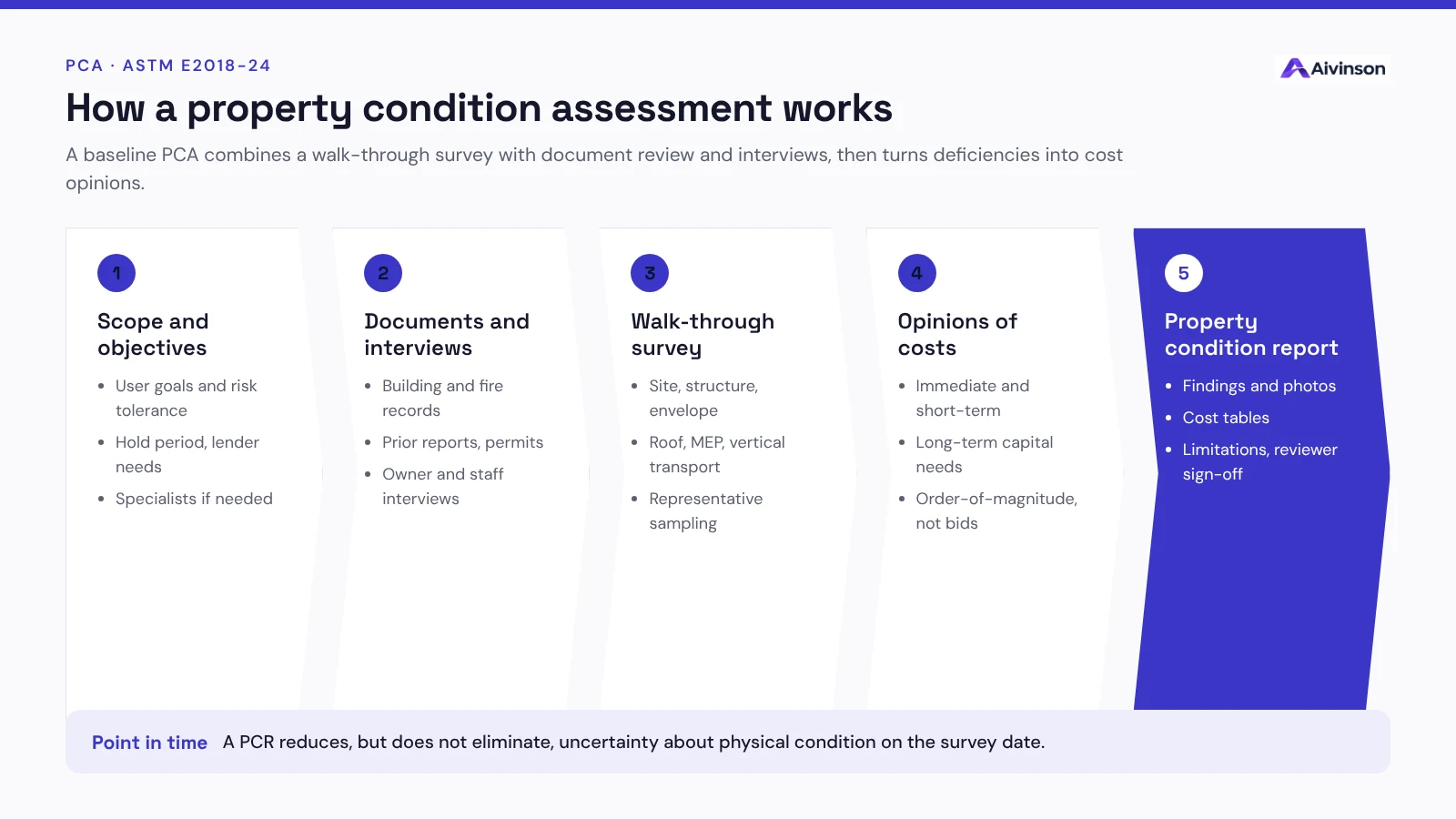
1. Scope and user objectives
The engagement starts with the user’s purpose: acquisition, refinance, lease or capital planning. Hold period, lender requirements, cost thresholds and the need for specialists are agreed before the site visit, because they determine depth and cost.
2. Document review and interviews
The consultant reviews available documents such as prior reports, permits, certificates of occupancy, warranties and maintenance records, and checks building and fire department records for open violations. Interviews with the owner, property manager and maintenance staff reveal history that is not visible, such as recurring leaks or recent replacements. Information from prior reports must be verified, not copied.
3. Walk-through survey
The field observer walks the site, building exterior, roof and a representative sample of interior spaces and units. The survey is visual and non-intrusive. Observations from a representative sample can be extrapolated to similar areas, which is why sampling assumptions must be stated in the report.
4. Opinions of costs
For each material physical deficiency, the consultant provides an opinion of the cost to remedy it. These are order-of-magnitude estimates, often developed without engineering calculations or testing, and are not contractor bids.
5. The property condition report
The PCR combines the walk-through, document review and interviews into findings, photographs, cost tables and limitations. A PCR reviewer typically checks the report before release. Mobile capture tools such as Site Assistant keep photos and notes tied to each system, and a shared editor like Report Writing keeps review comments in one place.
Systems reviewed during the walk-through
| System | Typical observations |
|---|---|
| Site | Paving, drainage, curbs, sidewalks, landscaping, site lighting, retaining walls |
| Structure | Foundations, framing, visible distress, settlement, cracking |
| Building envelope | Facades, windows, doors, sealants, balconies |
| Roofing | Membrane or covering, flashing, drainage, age and remaining life |
| Mechanical (HVAC) | Equipment type, age, condition, maintenance |
| Plumbing | Water heaters, piping types, fixtures, drainage |
| Electrical | Service, distribution, panels, visible hazards |
| Vertical transportation | Elevators and escalators, certificates, age |
| Life safety | Fire alarm, sprinklers, extinguishers, egress |
| Accessibility | Limited visual survey of common accessibility items |
How cost opinions work
Cost opinions are grouped by timing so users can act on them. Under E2018-24, immediate costs address conditions such as imminent life-safety issues or material building code violations. Short-term costs address deficiencies that should be remedied soon to avoid further damage or failure. Long-term costs, now defined in the guide, project capital replacement over a term the user selects, such as the loan term or hold period.
Most engagements set a reporting threshold so minor items do not clutter cost tables. E2018-15 used a default threshold of $3,000 per item unless otherwise agreed; today the threshold is normally set in the scope of work. Condition ratings such as good, fair and poor are tied to whether repairs are needed now or soon.
Tip: ask for cost tables that separate immediate, short-term and long-term items, and state the escalation and term assumptions. That makes the PCR usable for both lenders and asset managers.
What a property condition report contains
- Executive summary with overall condition, key deficiencies and cost tables
- Purpose, scope, user objectives and any deviations or additions
- Property description and system-by-system observations
- Document review and interview summaries
- Opinions of costs with assumptions and thresholds
- Limitations, out-of-scope items and recommendations for further evaluation
- Photographs, qualifications and reviewer sign-off
Our guide to the property condition report explains each section and the common review issues.
What a PCA does not cover
The baseline PCA is not technically exhaustive. Under ASTM E2018-24, items such as warranty and code compliance reviews, off-site conditions and economic obsolescence are out of scope unless the user adds them. Destructive testing, engineering calculations, environmental assessment, seismic risk analysis and detailed accessibility audits are typically separate services. Our guide to ASTM E2018 scope explains how to add specialists.
PCA vs other assessments
| Assessment | Purpose | Typical use |
|---|---|---|
| Property condition assessment | Physical deficiencies and cost to remedy | Acquisition and financing |
| Phase I ESA | Environmental conditions (RECs) | CERCLA liability and lender due diligence |
| Home inspection | Condition of a single-family home | Residential purchase |
| Facility condition assessment | Ongoing capital planning | Portfolio and asset management |
ASTM has noted that E2018 is commonly cited for facility condition assessments but is not a perfect fit, and its subcommittee approved a work item for a separate FCA guide. Research on condition assessment surveys from the National Academies explains why ongoing facility programs need repeatable methods. Our comparison of a PCA vs a building inspection goes deeper.
When to order a PCA
Order the PCA as soon as the property is under contract, alongside the Phase I ESA. Access, document requests and specialist scheduling take time, and immediate or short-term items often become negotiation points. For lender deals, confirm the lender’s format and reliance language first, because reworking a report into a new format later costs time and money. For leases, schedule the PCA before commencement so the report can serve as the condition baseline at exit.
Replacement reserves and lender requirements
Lenders often use the long-term cost table to size replacement reserves, the monthly deposits a borrower makes for future capital work. Agency programs specify the reserve term, escalation and table format, and may require per-unit summaries. The consultant should follow the lender’s instructions exactly, while keeping the ASTM baseline for observations and immediate and short-term costs.
Accessibility in a PCA
Many PCAs include a limited visual accessibility survey of common items such as parking, routes, entrances and restrooms. This is not a full ADA or Fair Housing compliance audit, which requires measurements and a specialist. If accessibility risk matters to the user, for example in multifamily or retail properties, the scope should add a detailed accessibility survey.
How to choose a PCA consultant
- Experience with the property type, such as multifamily, office, industrial or retail.
- Qualified field observers and a named PCR reviewer.
- Access to specialists for roofs, facades, structure and elevators.
- Familiarity with the lender’s format and reserve requirements.
- Clear cost assumptions and a consistent cost library.
- Realistic turnaround with a firm site visit date.
Ask for a sample PCR. The quality of observations, photographs and cost tables in a sample is the best predictor of the report you will receive.
Common deficiencies found in PCAs
- Roofs at or past expected useful life, with ponding, blistering or failed flashing.
- Asphalt paving with alligator cracking, potholes and poor drainage.
- Aging rooftop HVAC units and water heaters near replacement.
- Facade sealant failure, spalling concrete and corroded balcony rails.
- Outdated electrical panels or visible wiring hazards.
- Expired elevator certificates or fire protection inspections.
- Trip hazards, damaged guardrails and other life-safety items.
Most of these are predictable from age and maintenance history, which is why document review and interviews matter as much as the walk-through.
How to review a PCR before relying on it
- Scope matches the agreed objectives, term, thresholds and sampling.
- Every cost item ties to an observation and a photograph.
- Immediate items have a clear life-safety or code basis.
- Long-term table term and escalation are stated.
- Limitations and areas not accessed are listed.
- Specialist recommendations follow from specific findings.
A short review against this list catches most issues before a lender or investment committee does.
Cost and timeline
A baseline PCA for a single commercial building is typically priced in the low thousands of dollars, rising with building size, number of buildings and units, system complexity, travel, specialists and lender-specific formats. Standard turnaround is commonly two to three weeks after the site visit, with expedited delivery available at a premium.
As with environmental reports, the largest share of consultant time is writing. Firms that capture observations once and draft from them deliver faster and more consistently. Our PCA report workflow guide shows where time goes.
PCA reports are coming to Aivinson
Site Assistant and Report Writing already handle field capture and review. Join the waitlist for early access, including PCA reports when they launch.
Frequently asked questions
What is a property condition assessment?
A property condition assessment is a non-intrusive evaluation of a commercial property’s physical condition under ASTM E2018-24. It combines a walk-through survey, document review and interviews to identify material physical deficiencies and estimate the cost to remedy them in a property condition report.
What is the difference between a PCA and a PCR?
The PCA is the assessment process: scoping, document review, interviews, the walk-through survey and cost opinions. The PCR, or property condition report, is the written deliverable that documents the findings, photographs, cost tables and limitations. People often use the two terms interchangeably.
Who performs a property condition assessment?
PCAs are usually performed by architects, engineers or experienced building professionals acting as field observers, with a PCR reviewer checking the report. For high-cost or critical systems such as roofing, structure, facades or elevators, users may add specialists to provide deeper evaluation.
How long does a property condition assessment take?
A baseline PCA for a single commercial building usually takes about two to three weeks from the site visit to the final report. Larger properties, multiple buildings, specialist reviews, lender formats and slow document access can extend the timeline. Expedited delivery is often available for a fee.
Is a PCA required for a commercial loan?
Many commercial and agency lenders require a PCA to evaluate collateral and size repair escrows and replacement reserves. Requirements vary by lender and program, so the scope of work should follow both ASTM E2018-24 and any lender-specific instructions, such as agency multifamily guidelines.
Does a PCA include code compliance or environmental review?
No. Under ASTM E2018-24, code compliance, warranty review, off-site conditions and economic obsolescence are outside the baseline scope unless added. Environmental conditions are evaluated separately in a Phase I ESA, which follows ASTM E1527-21 and the All Appropriate Inquiries rule.