ASTM E2018-24: What Changed from E2018-15
ASTM E2018-24, approved January 1, 2024, replaced E2018-15 as the standard guide for baseline property condition assessments. It made more than 140 revisions, emphasizing user objectives, redefining immediate repair around imminent life-safety issues, defining long-term costs, and expanding guidance on specialists and user responsibilities.
On this page
Most changes are editorial, but a handful change how a property condition assessment is scoped and how cost opinions are presented. This guide focuses on those.
Timeline and status
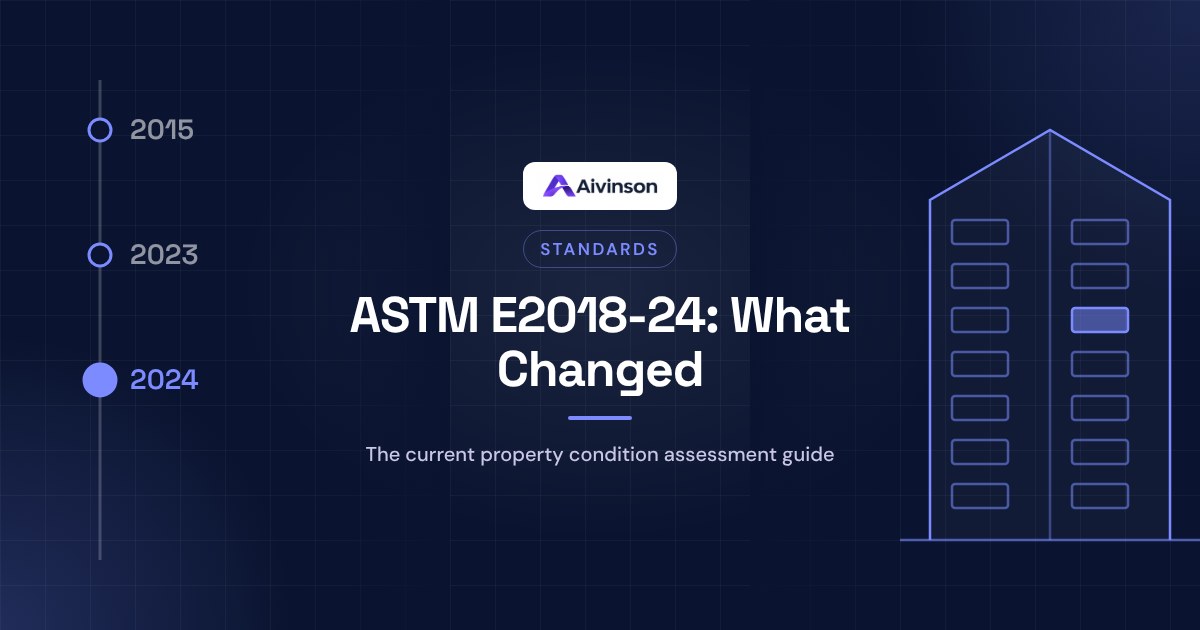
| Edition | Status |
|---|---|
| E2018-15 | Replaced; historical |
| E2018-23 | Briefly current in 2023, then replaced |
| E2018-24 | Current edition, approved January 1, 2024 |
The current guide is available from ASTM International. ASTM encouraged users to adopt it promptly, and most lenders and consultants now reference E2018-24.
1. User objectives come first
The revision puts more emphasis on understanding why the user needs the PCA: acquisition, financing, lease or planning. Consultants are guided to tailor scope to the user’s risk tolerance, schedule, budget and purpose. As the subcommittee chair put it in ASTM’s Standardization News feature, a consultant’s standard PCA will not automatically meet every user’s needs. A new section describes the user’s options and responsibilities.
2. Immediate repair redefined
E2018-15 tied immediate repair to material existing or potentially unsafe conditions. E2018-24 focuses the definition on conditions that represent an imminent life-safety issue, alongside other immediate needs such as material code violations. The practical effect is fewer items labeled immediate without a clear safety or compliance basis, which matters because lenders often fund immediate items at closing.
3. Long-term costs defined
Long-term costs were a footnote in earlier editions. E2018-24 brings them into the definitions and discusses format and intent. The term can be aligned with the user’s plans, for example a shorter horizon for a planned resale or the loan term for a lender. E2018-24 also removed the one-year time frame that E2018-15 attached to conditions contributing to future failure.
4. Specialists for critical systems
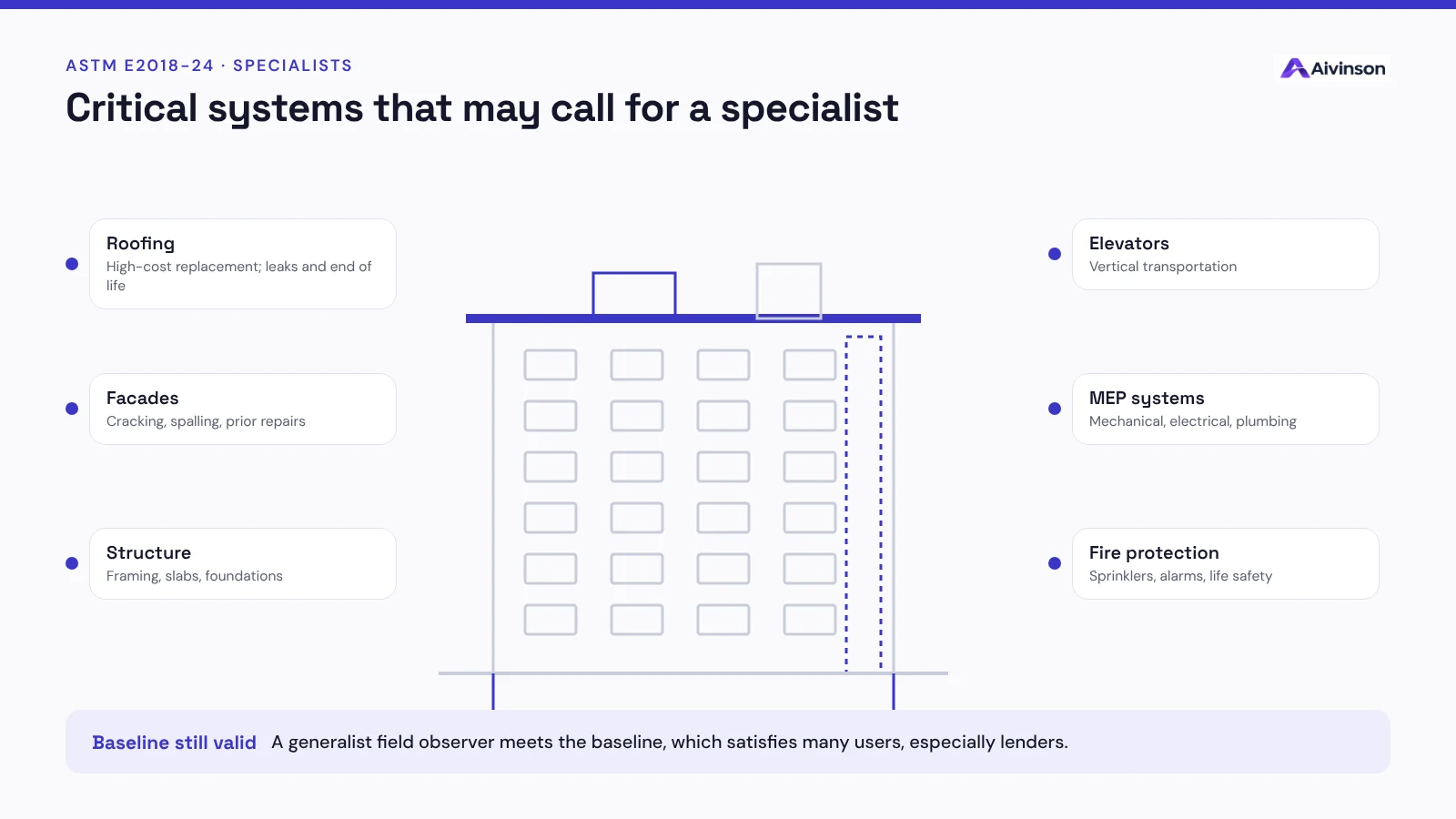
The guide adds discussion of when to use specialists for enhanced evaluation of high-cost or critical systems, including structure, roofing, facades, elevators, and mechanical, electrical, plumbing and fire protection systems. A generalist field observer still meets the baseline, which satisfies many users, especially lenders. Our E2018 scope guide explains when to add specialists.
5. Other changes
- Nearly every definition was refined to reflect current market practice.
- A referenced documents section compiles sources cited in the guide.
- More guidance on reports prepared for one user and relied on by others, such as subsequent lenders.
- Clearer treatment of representative sampling and limitations.
The ASTM announcement describes the revision as based on an industry survey and focused on clarity and current practice.
Updating proposals and templates
- Replace E2018-15 references in proposals, engagement letters and report templates.
- Add a section that records the user’s objectives, term and risk tolerance.
- Revise immediate repair language around imminent life-safety and code issues.
- Add or update the long-term cost table and its term assumptions.
- Offer specialist options for critical systems in proposals.
- Clarify reliance terms for subsequent users and lenders.
Making these changes once in templates avoids repeated review comments and makes reports consistent across field observers.
Reliance and subsequent users
PCAs are often prepared for one party and later relied on by another, such as a new lender after a refinance or a buyer on resale. E2018-24 addresses these situations more directly. A report scoped for a lender may not answer a buyer’s questions about long-term capital needs, so subsequent users should check the original objectives, term and thresholds before relying on it, and consider an update if conditions or needs have changed.
Example: classifying cost items under E2018-24
| Observation | Likely category | Reason |
|---|---|---|
| Missing guardrail at a raised walkway | Immediate | Imminent life-safety issue |
| Active roof leak with interior damage | Short-term | Remedy soon to prevent escalating damage |
| Rooftop units at end of useful life | Long-term | Planned capital replacement over the term |
| Minor cosmetic wall damage below threshold | Not tabulated | Below agreed reporting threshold |
What it means for users and consultants
Users should define objectives, term and thresholds in the engagement, decide on specialists early and review immediate items for a clear basis. Consultants should update proposal templates, cost table formats and report language. Lenders benefit from clearer immediate and long-term cost categories. Field teams can capture observations against the updated system list in Site Assistant.
ASTM has also approved a work item for a separate facility condition assessment guide, because E2018 is a point-in-time transactional tool. See our comparison of PCAs, inspections and FCAs.
PCA reports are coming to Aivinson
Site Assistant and Report Writing already handle field capture and review. Join the waitlist for early access, including PCA reports when they launch.
Frequently asked questions
When did ASTM E2018-24 take effect?
ASTM approved E2018-24 on January 1, 2024, and published it that month. It replaced earlier editions, including E2018-15 and the short-lived E2018-23. Users and consultants were encouraged to adopt it promptly, and most lenders and engagement letters now reference E2018-24 for new property condition assessments.
What is the biggest change in E2018-24?
The biggest practical change is the emphasis on user objectives. E2018-24 asks consultants to tailor the PCA to the user’s purpose, risk tolerance, schedule and budget, and adds a section on user options and responsibilities. Redefined immediate repair and defined long-term costs also change reports.
How does E2018-24 define immediate repair?
E2018-24 focuses immediate repair on conditions that represent an imminent life-safety issue, along with other immediate needs such as material building code violations. This replaced the E2018-15 language about material existing or potentially unsafe conditions and narrows what should be labeled immediate.
Does E2018-24 require long-term cost tables?
E2018-24 defines long-term costs and discusses their format, and most PCRs include them. The term can be matched to the user’s plans, such as a loan term or hold period. Whether a long-term table is included, and its term, should be agreed in the scope of work.
Does E2018-24 cover facility condition assessments?
Not specifically. E2018-24 is designed for point-in-time transactional assessments. Many facility condition assessments cite it, but ASTM has noted it is not a perfect fit, and its subcommittee approved a work item to consider a separate guide for facility condition assessments.