PCA vs Building Inspection vs Facility Condition Assessment
A property condition assessment evaluates a commercial property’s physical deficiencies and the cost to remedy them under ASTM E2018-24. A home inspection evaluates a single-family home against an inspector standard of practice, usually without cost estimates. A facility condition assessment supports ongoing capital planning across a portfolio.
On this page
All three involve walking a building and reporting its condition, so they are easily confused. The difference lies in the standard, the user and whether the output includes cost opinions. This guide compares them side by side and links back to our property condition assessment guide.
Side-by-side comparison
| Attribute | Property condition assessment | Home or building inspection | Facility condition assessment |
|---|---|---|---|
| Typical property | Commercial, multifamily | Single-family home | Institutional or corporate portfolio |
| Common standard | ASTM E2018-24 | Inspector standards of practice | Owner or program methodology |
| Primary user | Buyer, lender | Home buyer | Owner, asset manager |
| Cost opinions | Yes, immediate to long-term | Usually no | Yes, often with capital forecasts |
| Timing | Transaction, point in time | Transaction, point in time | Recurring program |
| Output | Property condition report | Inspection report | Condition database and capital plan |
Property condition assessment
A PCA is built for transactions. A field observer, usually an architect or engineer, performs a visual walk-through, reviews documents, interviews staff and provides opinions of costs to remedy material physical deficiencies. The baseline is ASTM E2018-24, and lenders often add their own requirements. The deliverable is a property condition report.
Home and building inspections
A home inspection evaluates a residence’s readily accessible systems against an inspector standard of practice, such as the InterNACHI Home Inspection Standards of Practice. It is designed for a single buyer, identifies defects and safety issues, and generally does not include cost opinions or document reviews with municipal agencies.
Commercial building inspections exist too, and some follow inspector-developed commercial standards. They can be appropriate for small properties, but lenders financing commercial real estate usually expect an ASTM E2018-based PCA with cost tables.
Facility condition assessments
A facility condition assessment (FCA) supports long-term asset management for universities, governments, hospitals and corporate portfolios. FCAs are repeated over time and feed capital planning systems, often with condition indexes and multi-year forecasts.
Many FCAs cite E2018, but ASTM has said it is not a perfect fit because a PCA is a static, point-in-time report. As ASTM’s Standardization News coverage notes, the E50.02 subcommittee approved a work item to consider a separate FCA standard.
How to choose the right assessment
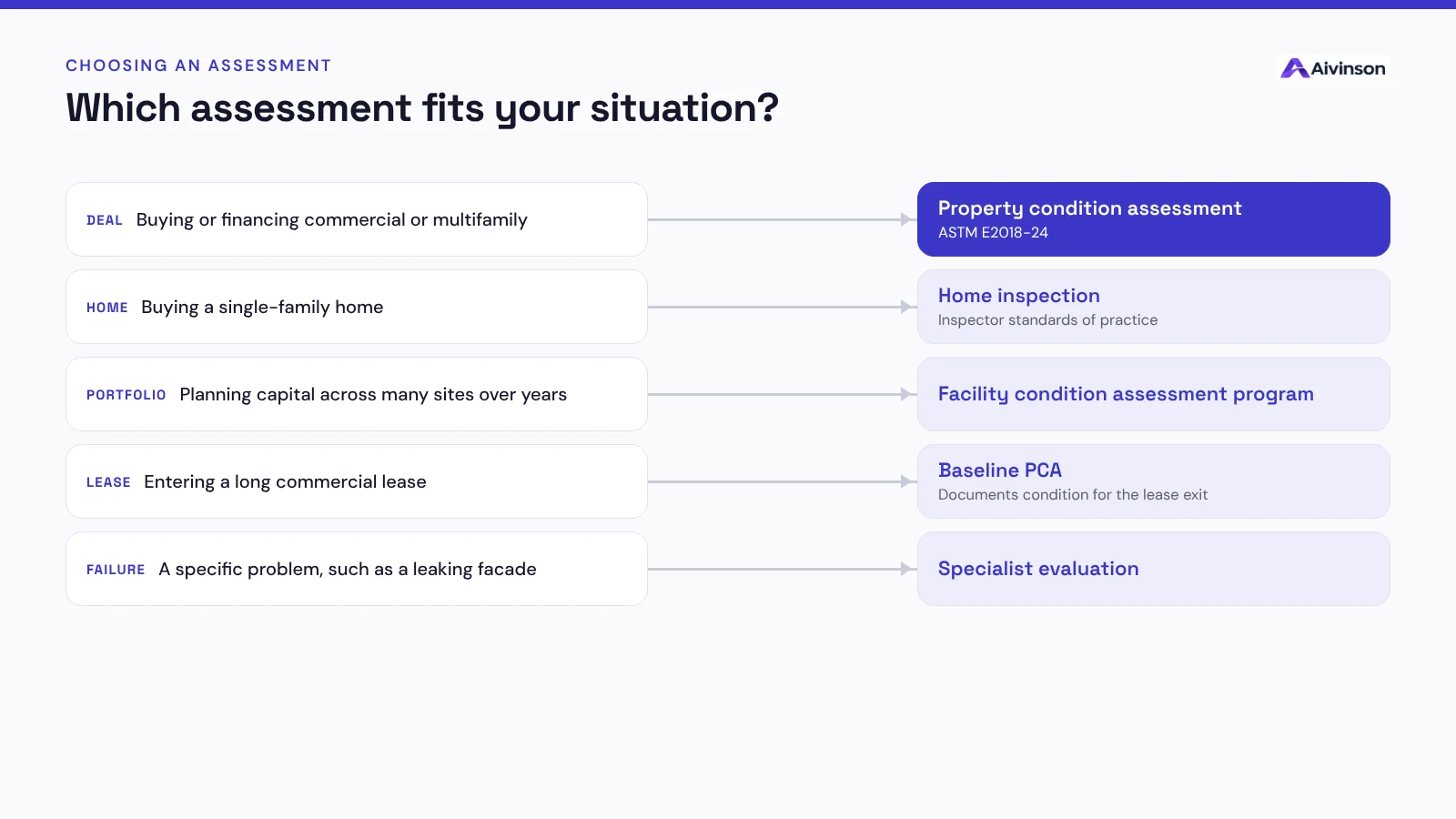
- Buying or financing a commercial or multifamily property: order a PCA under ASTM E2018-24.
- Buying a single-family home: order a home inspection.
- Managing a portfolio and planning capital over many years: run an FCA program.
- Entering a long commercial lease: consider a PCA to set a baseline for the lease exit.
- Facing a specific failure, such as a leaking facade: hire a specialist instead of a general assessment.
Matching the tool to the question avoids paying for the wrong level of detail and makes the report easier to use. The scope should also be agreed in writing before the site visit, especially for thresholds, sampling and specialists.
How the cost data differs
The biggest practical difference is cost data. A PCA gives opinions of costs to remedy each material deficiency, grouped as immediate, short-term and long-term, which lenders use for escrows and reserves. A home inspection usually describes defects and recommends further evaluation without pricing. An FCA often produces multi-year capital forecasts and condition indexes that roll up across a portfolio.
If the decision depends on numbers, such as a price reduction or a reserve, the assessment must produce numbers. That alone usually decides between an inspection and a PCA.
Common misconceptions
- “A PCA is just a bigger home inspection.” It adds document review, agency records and cost opinions, and it follows a different standard.
- “A PCA checks code compliance.” Code compliance is excluded from the baseline unless added.
- “An FCA can replace a PCA for a sale.” Lenders usually want a transactional PCA in their format.
- “A clean report means no risk.” Every report has limitations and reflects one point in time.
Reading the scope and limitations sections of any report is the fastest way to understand what it can and cannot support.
Where the work overlaps
All three rely on careful field observation, photographs and clear writing. The capture and reporting tools are similar, which is why platforms built for site work translate across assessment types. Site Assistant captures observations offline on a phone or tablet, and Report Writing manages review. PCA reports are on the Aivinson roadmap; the platform overview shows what is available today.
PCA reports are coming to Aivinson
Site Assistant and Report Writing already handle field capture and review. Join the waitlist for early access, including PCA reports when they launch.
Frequently asked questions
Is a property condition assessment the same as a building inspection?
No. A property condition assessment follows ASTM E2018-24 and includes document review, interviews and opinions of costs to remedy deficiencies for commercial transactions. A building or home inspection follows an inspector standard of practice and usually reports defects without cost estimates or agency record checks.
What is a facility condition assessment?
A facility condition assessment is a recurring evaluation of buildings in a portfolio, used for long-term capital planning. It often produces a condition database, condition indexes and multi-year forecasts. Unlike a transactional PCA, an FCA is updated over time and tied to an owner’s asset management program.
Do lenders accept a home inspection instead of a PCA?
For commercial and multifamily loans, lenders usually require a PCA based on ASTM E2018-24 with cost tables for immediate, short-term and long-term needs. A home inspection is designed for single-family purchases and generally lacks the cost opinions and reporting structure lenders need.
Which is more expensive, a PCA or a home inspection?
A PCA usually costs more than a home inspection because it covers larger, more complex properties, includes document review and interviews, and requires cost opinions. Fees rise with building size, the number of buildings and units, specialist reviews and lender-specific report formats.
Can a PCA be used for capital planning?
Yes, with limits. A PCA’s long-term cost table can inform capital planning, and E2018-24 lets the term match the user’s plans. For recurring, portfolio-wide planning, a facility condition assessment program is usually a better fit because it is updated over time.