How to Write REC Findings in a Phase I ESA Report
A strong REC finding names the condition, cites the specific evidence, states which part of the ASTM E1527-21 REC definition it meets, and gives a clear conclusion. Reviewers and lenders should be able to trace each finding back to a source in the appendices without asking the consultant.
On this page
Most reviewer comments on a Phase 1 Environmental Site Assessment are not about the classification itself. They are about how the finding is written: missing evidence, vague language or conclusions that do not match the facts. This guide gives a repeatable structure.
Findings, opinions and conclusions
ASTM E1527-21 separates three elements. Findings are the facts identified in the records, site visit and interviews. Opinions are the EP’s judgment about what those facts mean, including whether they meet the REC definition. Conclusions summarize the RECs, CRECs and HRECs. Keeping these separate makes the reasoning visible.
A five-part structure for every REC
| Part | What to write | Example |
|---|---|---|
| Condition | What and where | Former 1,000-gallon gasoline UST, northeast corner |
| Evidence | Specific sources with dates | 1962 fire insurance map; owner interview |
| Regulatory status | Database or agency records | Not listed; no removal or closure records |
| Definition | Which REC prong applies | Likely presence due to a likely release |
| Conclusion | Classification and next step | REC; Phase II recommended |
The same structure works for CRECs and HRECs, with the regulatory status describing the closure and any controls.
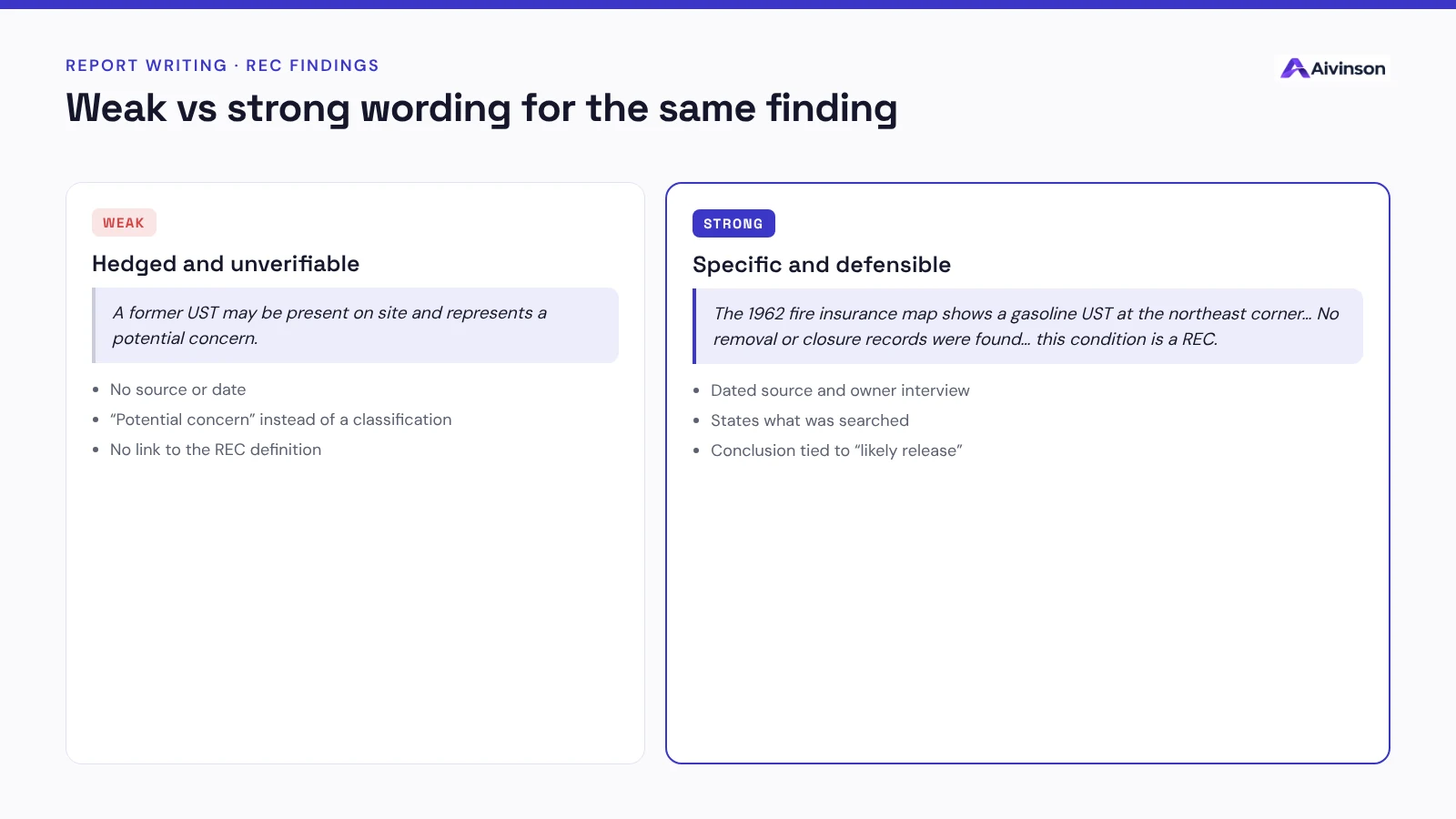
Example: weak vs strong wording
Weak: “A former UST may be present on site and represents a potential concern.”
Strong: “The 1962 fire insurance map shows a gasoline UST at the northeast corner of the subject property, and the owner stated the tank was abandoned in place in the 1980s. No removal, closure or tightness testing records were found in state databases or agency files. Based on the likely release from an unclosed, decades-old UST, this condition is a recognized environmental condition.”
The strong version is longer, but a reviewer can verify every claim. It cites dated sources, states what was searched and ties the conclusion to the REC definition in ASTM E1527-21.
Common reviewer red flags
- Hedged terms such as “potential concern” or “possible issue” instead of a classification.
- Findings with no source or date.
- Off-site conditions called RECs without a migration rationale.
- HRECs based on old closures without comparison to current criteria.
- Data gaps listed without a statement of significance.
- Conclusions that differ between the executive summary and the evaluation.
Each of these invites questions that delay closing. A quick self-review against this list catches most of them.
Writing off-site and vapor findings
For off-site sources, explain the pathway. State the distance, the inferred groundwater flow direction, the chemicals of concern and why migration to the subject property is or is not likely. Vapor migration should be addressed explicitly for chlorinated solvents and petroleum sources near occupied buildings. Where vapor screening under ASTM E2600 was performed as an add-on, summarize it separately from the E1527-21 conclusion.
Writing CREC and HREC findings
For a CREC, add the closure document, the controls and evidence of compliance: “The 2009 no further action letter requires a recorded groundwater use restriction, which appears in the deed. No groundwater wells were observed. This condition is a controlled recognized environmental condition.”
For an HREC, add the closure standard and the current-criteria check: “Soil was excavated in 1998 and the release closed to residential standards without controls. The closure concentrations are below current unrestricted-use criteria. This condition is a historical recognized environmental condition.”
Keeping the executive summary consistent
Reviewers read the executive summary first and the evaluation second. If the two disagree, every finding is questioned. Write the evaluation first, then build the summary from it, listing each REC, CREC and HREC with one sentence of evidence. Recheck both after every review comment, because edits to one section often miss the other. A shared editor with linked sections removes most of this risk.
Recommendations and legal context
Recommendations are optional under E1527-21, but if included they should follow from each REC: for example, a limited subsurface investigation targeted at the former UST. Avoid generic recommendations that do not tie to a finding. Remember that the findings support CERCLA landowner protections defined in 42 U.S.C. § 9601, so precision has legal consequences.
Writing at this standard across dozens of reports is where teams lose time. Vinson Author drafts findings in this structure from the evidence, with sources cited, and the EP edits and confirms each classification.
Findings drafted from the evidence
See how Vinson Author writes evidence-linked REC findings in your firm’s format for your EP to review.
Frequently asked questions
What should a REC finding include?
A REC finding should include the condition and its location, the specific evidence with sources and dates, the regulatory status found in database and agency records, which part of the ASTM E1527-21 REC definition applies, and a clear conclusion. Optional recommendations should tie directly to that finding.
Should a Phase I report use the term potential REC?
Avoid it. ASTM E1527-21 asks the Environmental Professional to classify each condition, so terms like potential REC or possible concern leave the reader without a conclusion. If evidence is insufficient to decide, describe the data gap and explain whether it is significant to identifying RECs.
How do you write a REC for an off-site source?
Explain the migration pathway. State the distance, inferred groundwater flow direction, the chemicals of concern and the evidence that migration to the subject property is likely, including vapor migration. Without that rationale, an off-site condition should not be called a REC at the subject property itself.
Are recommendations required for each REC?
No. Recommendations are optional under ASTM E1527-21, although many lenders expect them. When included, each recommendation should follow from a specific finding, such as a targeted subsurface investigation for a former UST, rather than a generic statement that further assessment may be warranted at some point.
Why do reviewers reject REC findings?
Reviewers usually reject findings for missing evidence, undated sources, hedged language, off-site RECs without a migration rationale, HRECs without comparison to current criteria, or conclusions that conflict between the executive summary and the evaluation section. A consistent five-part structure prevents most of these.