Phase I vs Phase II ESA: When You Need Sampling
A Phase I ESA is a non-intrusive review of records, site conditions and interviews that identifies recognized environmental conditions (RECs) under ASTM E1527-21. A Phase II ESA follows when RECs need testing: it samples soil, groundwater or soil vapor under ASTM E1903 to confirm or rule out contamination.

On this page
The two assessments answer different questions. The Phase 1 Environmental Site Assessment asks whether contamination is present or likely. The Phase II asks how much, where and whether it exceeds regulatory limits. Knowing when to move from one to the other saves time and money.
Phase I vs Phase II at a glance
| Attribute | Phase I ESA | Phase II ESA |
|---|---|---|
| Standard | ASTM E1527-21 | ASTM E1903-19 |
| Purpose | Identify RECs | Test whether RECs represent contamination |
| Methods | Records review, site visit, interviews | Soil, groundwater, soil vapor or material sampling |
| Intrusive | No | Yes |
| Satisfies AAI | Yes | Not required for AAI |
| Typical timeline | 2–4 weeks | Several weeks, depending on lab and scope |
| Typical cost | Low thousands | Often several times a Phase I |
| Output | Findings, opinions, conclusions | Analytical results compared with screening levels |
What a Phase I ESA does
The Phase I combines a records review, site reconnaissance, interviews and user-provided information. The Environmental Professional evaluates the evidence and reports RECs, CRECs, HRECs and data gaps. Because it is the basis for All Appropriate Inquiries, a compliant Phase I is what protects a buyer’s CERCLA defenses. The practice is defined in ASTM E1527-21.
A Phase I never confirms contamination. It concludes that contamination is present or likely, which is why a REC is a statement about evidence, not test results.
What a Phase II ESA does
A Phase II is scoped from the RECs. The consultant develops a conceptual site model, designs a sampling plan, collects samples, sends them to an accredited laboratory and compares results with applicable screening levels. Common methods include soil borings, temporary or permanent monitoring wells, soil gas probes and building material samples. The practice is described in ASTM E1903-19.
The outcome is quantitative: contamination is confirmed or not, delineated or not, and above or below regulatory thresholds. That lets the parties price remediation, adjust the deal, or move to regulatory programs such as voluntary cleanup.
When a Phase I REC justifies a Phase II
- The REC involves a known source with likely subsurface impact, such as a former UST or dry cleaner.
- A lender or buyer needs quantified risk to price or finance the deal.
- Redevelopment will disturb soil or change use to a more sensitive one, such as residential.
- Vapor intrusion is a concern for occupied buildings.
- The EP identifies a significant data gap that sampling can resolve.
Not every REC needs a Phase II. Sometimes the risk is small relative to the deal, or contractual protections and insurance are a better fit. A CREC often needs verification of controls instead of new sampling.
What a Phase II costs and what drives it
Phase II pricing depends on the number of RECs, the media sampled and access. Drilling, monitoring well installation, laboratory analysis and the number of sampling rounds are the main drivers. Urban sites with limited access, deep groundwater or vapor intrusion concerns cost more. Because pricing varies widely, request a scope tied to each REC, with a clear sampling rationale, before comparing quotes.
What happens after a Phase II
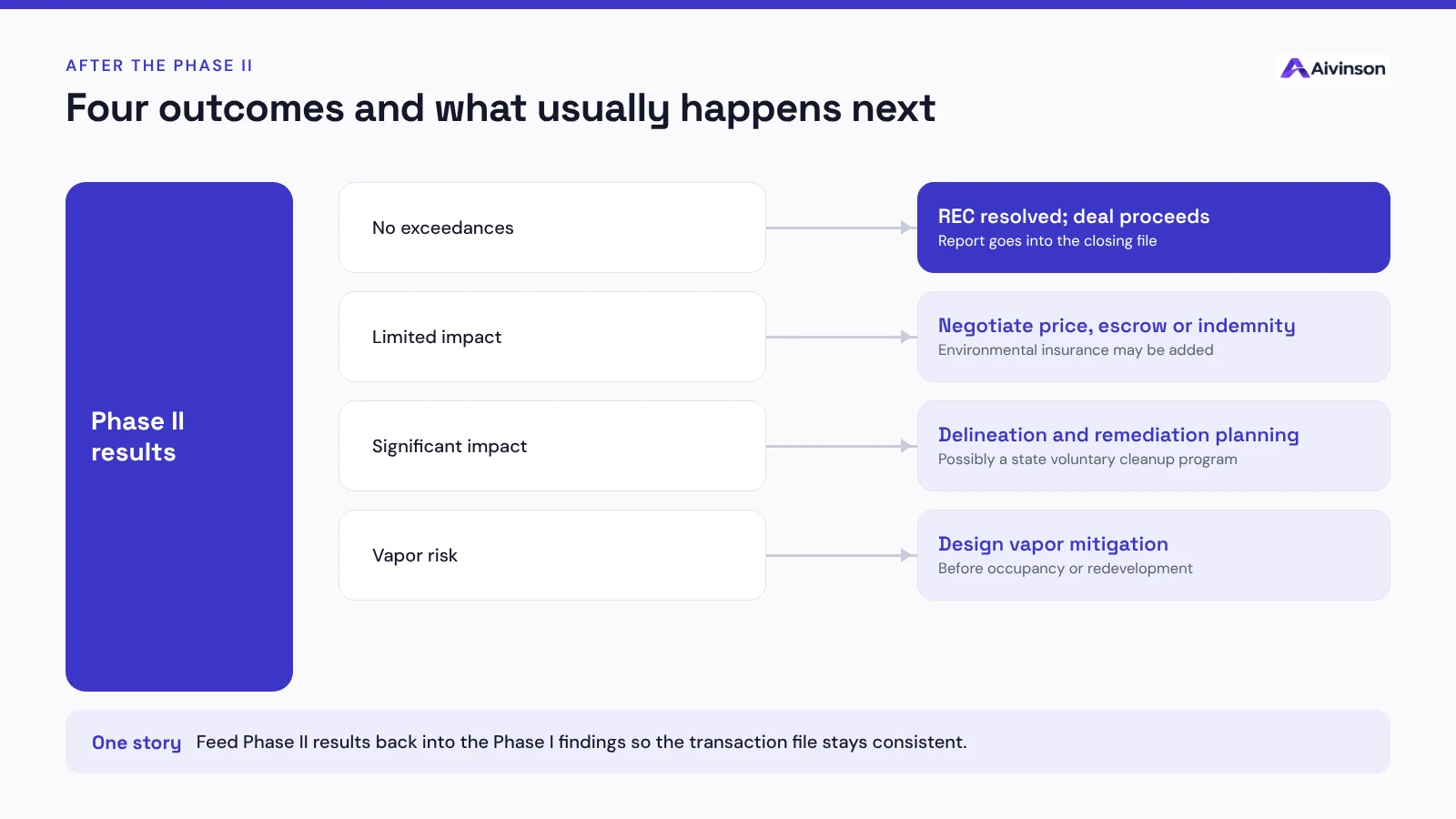
- No exceedances: the REC is resolved and the deal proceeds, often with the report in the closing file.
- Limited impact: parties negotiate price, escrow or indemnities, and may add insurance.
- Significant impact: delineation, remediation planning or a state voluntary cleanup program may follow.
- Vapor risk: mitigation systems may be designed before occupancy or redevelopment.
Whatever the outcome, the Phase II results should feed back into the Phase I findings so the transaction file tells one consistent story.
Liability context
CERCLA defines hazardous substances and the landowner liability protections that a Phase I supports; see 42 U.S.C. § 9601. A Phase II is not required for AAI, but once a buyer knows about contamination, continuing obligations such as taking reasonable steps apply, so Phase II results often shape the post-closing plan.
Clear Phase I findings make Phase II scoping faster. Firms using the Aivinson Phase I ESA workflow draft REC statements tied to evidence, so the Phase II team can scope directly from the report. Budget guidance is in our Phase I cost guide.
Write Phase I findings that scope Phase II faster
See how Aivinson drafts evidence-linked REC statements your EP can review and sign.
Frequently asked questions
What is the main difference between a Phase I and Phase II ESA?
A Phase I ESA is non-intrusive and identifies recognized environmental conditions from records, site observation and interviews. A Phase II ESA is intrusive and tests those conditions with soil, groundwater, soil vapor or material sampling, then compares laboratory results with applicable regulatory screening levels.
Is a Phase II ESA always required after a Phase I?
No. A Phase II is recommended when RECs need confirmation and the risk matters to the transaction. If the Phase I finds no RECs, or the risk is managed through contract terms, insurance or existing regulatory closure, many buyers and lenders proceed without a Phase II.
How long does a Phase II ESA take?
A Phase II usually takes several weeks, depending on scope, drilling access, laboratory turnaround and reporting. Simple soil and groundwater sampling may take three to six weeks, while larger investigations with multiple sampling rounds, monitoring wells or vapor intrusion work can take considerably longer.
Which ASTM standards cover Phase I and Phase II ESAs?
Phase I ESAs follow ASTM E1527-21, which EPA recognizes for All Appropriate Inquiries. Phase II ESAs follow ASTM E1903-19, a standard practice for designing and conducting sampling to evaluate recognized environmental conditions identified in a Phase I or through other means, such as prior reports or agency files.
Does a Phase II ESA satisfy All Appropriate Inquiries?
No. All Appropriate Inquiries is satisfied by the Phase I ESA process under ASTM E1527-21 or the federal rule. A Phase II provides additional information about contamination, but it is not required for AAI and does not replace the Phase I’s records review, site visit, interviews and the EP’s signed declaration.