What Is an HREC (Historical Recognized Environmental Condition)?
A historical recognized environmental condition (HREC) is a past release of hazardous substances or petroleum products at a property that was addressed to the regulator’s satisfaction or meets unrestricted-use criteria, without any required controls. Under ASTM E1527-21 an HREC is not a REC, but the EP must confirm the closure meets current standards.
On this page
HRECs are reassuring findings, which is exactly why they deserve scrutiny. A closure issued decades ago may not satisfy today’s cleanup criteria. This guide, part of our Phase 1 Environmental Site Assessment series, explains how EPs confirm an HREC and when they must reclassify it.
The HREC definition under ASTM E1527-21
An HREC has three characteristics:
- A past release of hazardous substances or petroleum products occurred at the subject property.
- The release was addressed to the satisfaction of the regulatory authority or meets unrestricted-use criteria.
- No activity and use limitations or other controls are required.
Because nothing remains above unrestricted-use criteria and no controls apply, the condition is historical. ASTM E1527-21, published by ASTM International, places HRECs outside the list of current RECs but requires them to be described in the report so the user understands the history.
How EPs confirm an HREC
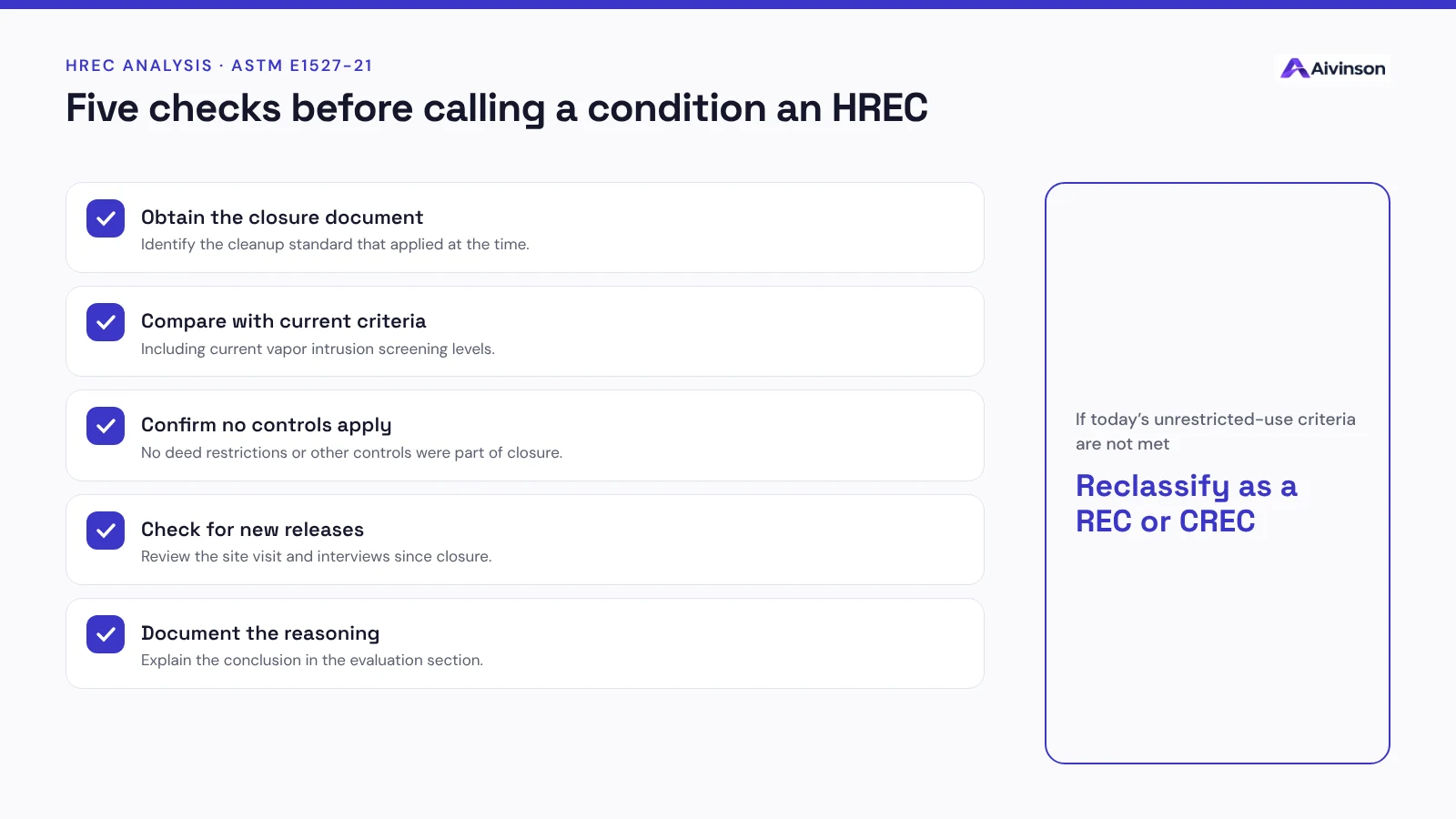
The 2021 revision tightened the HREC analysis. The EP should not accept an old closure letter at face value. Instead, the EP should:
- Obtain the closure document and identify the cleanup standard that applied at the time.
- Compare that standard with current unrestricted-use criteria, including any new vapor intrusion screening levels.
- Confirm no controls, such as deed restrictions, were part of the closure.
- Check the site visit and interviews for evidence of new releases since closure.
- Document the reasoning in the evaluation section.
If criteria have changed and the old closure would not meet today’s unrestricted-use standards, the condition may become a REC or a CREC. The standard’s non-mandatory flowchart helps EPs walk through these questions.
HREC examples
| Situation | Likely classification | Why |
|---|---|---|
| UST removed in 1998, soil excavated, NFA to residential standards | HREC | Unrestricted closure, no controls |
| Same UST, closure relied on commercial-use restriction | CREC | Closure depends on a control |
| Solvent release closed in 1995 before vapor intrusion criteria existed | Possibly REC | May not meet current criteria |
| Heating oil spill cleaned up, no agency file found | REC or data gap | Closure cannot be verified |
The same history can produce different outcomes depending on the closure basis and current criteria. That is why the EP’s documentation matters as much as the label.
HREC vs REC vs CREC
The three categories differ on two questions: was the release resolved, and does resolution depend on controls? A REC has no confirmed resolution. A CREC was resolved with controls that allow contamination to remain. An HREC was resolved without controls. For the base definition and examples, see our guide to RECs.
Industry users often see these terms in investment due diligence. INREV’s glossary entry on RECs and ICMA’s plain-language explainer show how non-specialists interpret them, which is a useful reminder to write HREC statements clearly.
Why HRECs get reclassified
Cleanup criteria are not static. Since many older closures were issued, agencies have adopted vapor intrusion screening levels, lowered criteria for some chlorinated solvents and, in 2024, designated PFOA and PFOS as CERCLA hazardous substances. A closure that relied only on soil and groundwater criteria from the 1990s may not address vapor risk at all.
Reclassification is not a failure of the earlier work. It reflects new knowledge. When an HREC is reclassified, the EP should explain what changed and whether further assessment, such as a vapor evaluation or a limited Phase II, would resolve the question.
HREC checklist for reviewers
- Is the closure document identified by agency, date and case number?
- Is the cleanup standard at closure stated?
- Does the report compare it with current unrestricted-use criteria?
- Is it confirmed that no controls or restrictions apply?
- Do the site visit and interviews show no new releases?
Writing an HREC in the report
A defensible HREC statement names the release, the date and agency of closure, the standard applied, and why the EP concludes it still meets unrestricted-use criteria. Vague wording such as “closed, no further action” invites lender questions. A useful structure is: condition, evidence, closure basis, current-criteria comparison, conclusion.
Pulling closure dates and agency details from appendices is repetitive work. The Vinson Analyst reads regulatory files and database reports to surface closure records, and the Aivinson Phase I ESA workflow drafts the statement for the EP to confirm.
Verify closures faster
See how Aivinson surfaces closure records from the appendices and drafts HREC statements for your EP to confirm.
Frequently asked questions
What is an HREC in a Phase I ESA?
An HREC, or historical recognized environmental condition, is a past release of hazardous substances or petroleum products that was addressed to the regulator’s satisfaction or meets unrestricted-use criteria without required controls. It is described in the report for context but is not treated as a current REC.
Is an HREC considered a REC?
No. Under ASTM E1527-21, an HREC is not a recognized environmental condition because the release was resolved without controls. However, the Environmental Professional must confirm the closure still meets current unrestricted-use criteria. If it does not, the condition may be reclassified as a REC or a CREC.
What is the difference between an HREC and a CREC?
Both involve a past release with regulatory closure. An HREC was closed to unrestricted-use criteria with no controls, while a CREC relies on controls such as deed restrictions or engineering systems that allow contamination to remain in place. If closure required any control, the finding is a CREC.
Can an old closure letter still support an HREC?
Sometimes. An old no further action letter supports an HREC only if the cleanup standard applied then still meets today’s unrestricted-use criteria. EPs should compare the historical standard with current criteria, including vapor intrusion screening levels, and document that comparison in the report.
Does an HREC need further investigation?
Usually not. An HREC indicates the past release was resolved without controls, so a Phase II ESA is rarely required. Further work may be needed if the closure cannot be verified, current criteria are stricter, or the site visit shows evidence of new releases since the closure was issued.