PCA and Property Condition Report Workflow: Field Walk to Cost Tables
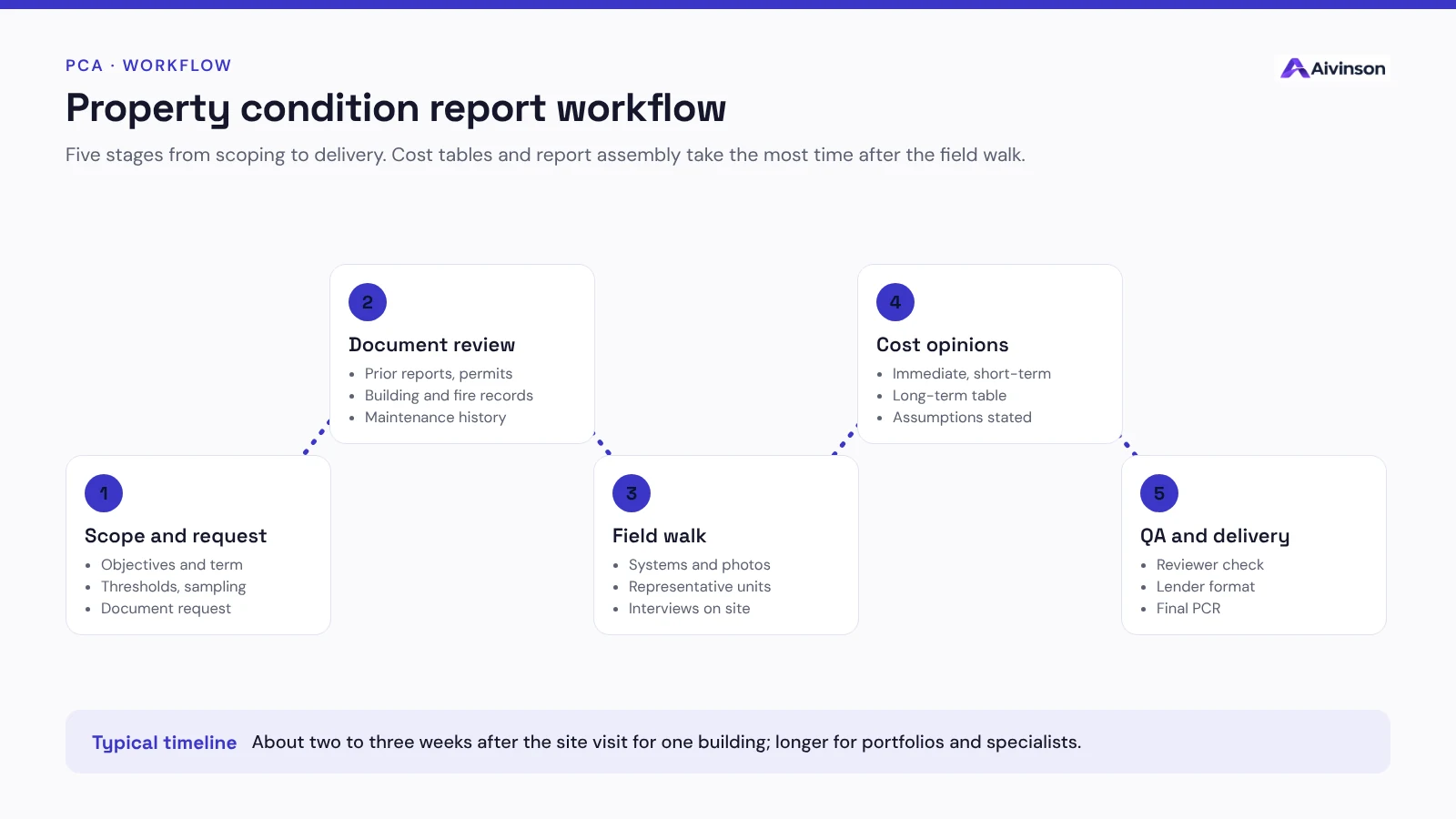
A property condition report workflow moves from scoping and document requests through document review, the field walk and interviews, cost opinions, PCR review and delivery. For a single commercial building, the report usually follows about two to three weeks after the site visit, with cost tables and report assembly taking the most time.
On this page
ASTM E2018-24 defines what a property condition assessment covers, not how a firm should run the work. This guide lays out a workflow that keeps PCRs consistent and on schedule.
The workflow at a glance
| Step | Owner | Typical timing |
|---|---|---|
| Scope and document request | Project manager | Days 1–3 |
| Document review | Field observer | Before and after the site visit |
| Field walk and interviews | Field observer | 1–3 days on site |
| Cost opinions | Field observer or estimator | Days 3–10 after visit |
| QA and delivery | PCR reviewer | Days 8–15 after visit |
1. Scope and document request
Agree the user’s objectives, reliance parties, cost threshold, long-term term, sampling and specialists, as ASTM E2018-24 encourages. Send a document request list early: prior reports, permits, certificates of occupancy, warranties, capital history and maintenance logs. Late documents are a common cause of revisions.
2. Document review
Review what the owner provides and check building and fire department records for open violations. Prior reports are useful leads, but their information must be verified on site. Build a system list before the visit so the field walk is structured.
3. Field walk and interviews
Walk the site, exterior, roof and representative interior spaces, photographing each system and deficiency. Interview the property manager and maintenance staff about recurring problems and recent replacements. Capturing photos and notes against the system list, for example with Site Assistant on a phone or tablet, even offline, avoids rework when writing.
4. Cost opinions
Translate each material deficiency into a remedy and an order-of-magnitude cost, grouped as immediate, short-term or long-term. State quantities, unit costs, escalation and the term. Keep a firm cost library so similar items are priced consistently across reports. The ASTM announcement of the revision notes that identifying near-term deficiencies is the PCA’s main goal, so those items deserve the most care.
5. QA and delivery
A PCR reviewer checks that every cost item ties to an observation and photo, totals match the executive summary, assumptions are stated and limitations are complete. Using one shared editor such as Report Writing keeps comments and versions together through delivery.
Building a cost library
Consistent cost opinions depend on a maintained cost library: standard remedies, units of measure, unit costs and regional factors for common items such as roof replacement, paving, HVAC units and water heaters. Update it at least annually and record the source of each figure. A library reduces time spent researching prices on every report and makes reviewer checks faster, because outliers stand out.
Measuring PCA throughput
| Metric | What it reveals |
|---|---|
| Days from award to site visit | Scheduling and access |
| Days from site visit to draft | Writing capacity |
| Review cycles per PCR | Draft quality |
| Cost table edits after review | Library and estimating consistency |
| Reports per observer per month | Overall throughput |
Most firms find the largest gap between the site visit and the first complete draft, which is where structured capture and drafting tools help most.
Handling portfolios
Portfolio PCAs multiply every bottleneck. Standardize the scope, document request list, system checklist and cost library across all sites before the first visit, and assign one reviewer to compare reports for consistency. Summarize the portfolio in one table that rolls up immediate, short-term and long-term costs by property, so the user can compare sites without reading every report.
Common bottlenecks
- Document requests sent after the site visit.
- Photos stored separately from notes and renamed by hand.
- Cost tables rebuilt in spreadsheets for every report.
- Executive summary totals edited separately from detailed tables.
- Review comments scattered across email.
Programs that repeat assessments over time, like facility condition assessments, depend on consistent data even more; National Academies research on condition surveys makes the same point. PCA report drafting is on the Aivinson roadmap; see the platform overview for what is available today, and our PCR guide for report structure.
PCA reports are coming to Aivinson
Site Assistant and Report Writing already handle field capture and review. Join the waitlist for early access, including PCA reports when they launch.
Frequently asked questions
How long does a property condition report take?
For a single commercial building, a property condition report is usually delivered about two to three weeks after the site visit. Portfolios, specialists, lender formats and late documents extend the timeline. Most of the time after the visit goes into cost opinions, report assembly and review.
What documents should be requested for a PCA?
Request prior condition reports, permits and certificates of occupancy, warranties, capital expenditure history, maintenance logs, roof and elevator records, and any known violations. Send the request at scoping so the field observer can review documents before the site visit and verify them on site.
Who reviews a property condition report?
A PCR reviewer, typically a senior architect or engineer, checks the report before delivery. The review confirms that each cost item ties to an observation, totals match the executive summary, assumptions and limitations are stated, and the report meets the scope and any lender requirements.
How are PCA cost opinions developed?
The field observer or an estimator converts each material deficiency into a remedy and an order-of-magnitude cost using quantities and unit costs, then groups items as immediate, short-term or long-term. Assumptions such as escalation and term are stated, and many firms maintain a cost library.
Where does a PCA workflow lose the most time?
Most time is lost after the field walk: renaming and sorting photos, rebuilding cost tables in spreadsheets, reconciling executive summary totals and chasing review comments by email. Capturing observations once against a system list and reviewing in one shared editor removes much of that work.