Phase I ESA Report Workflow: From Site Visit to Signed Report
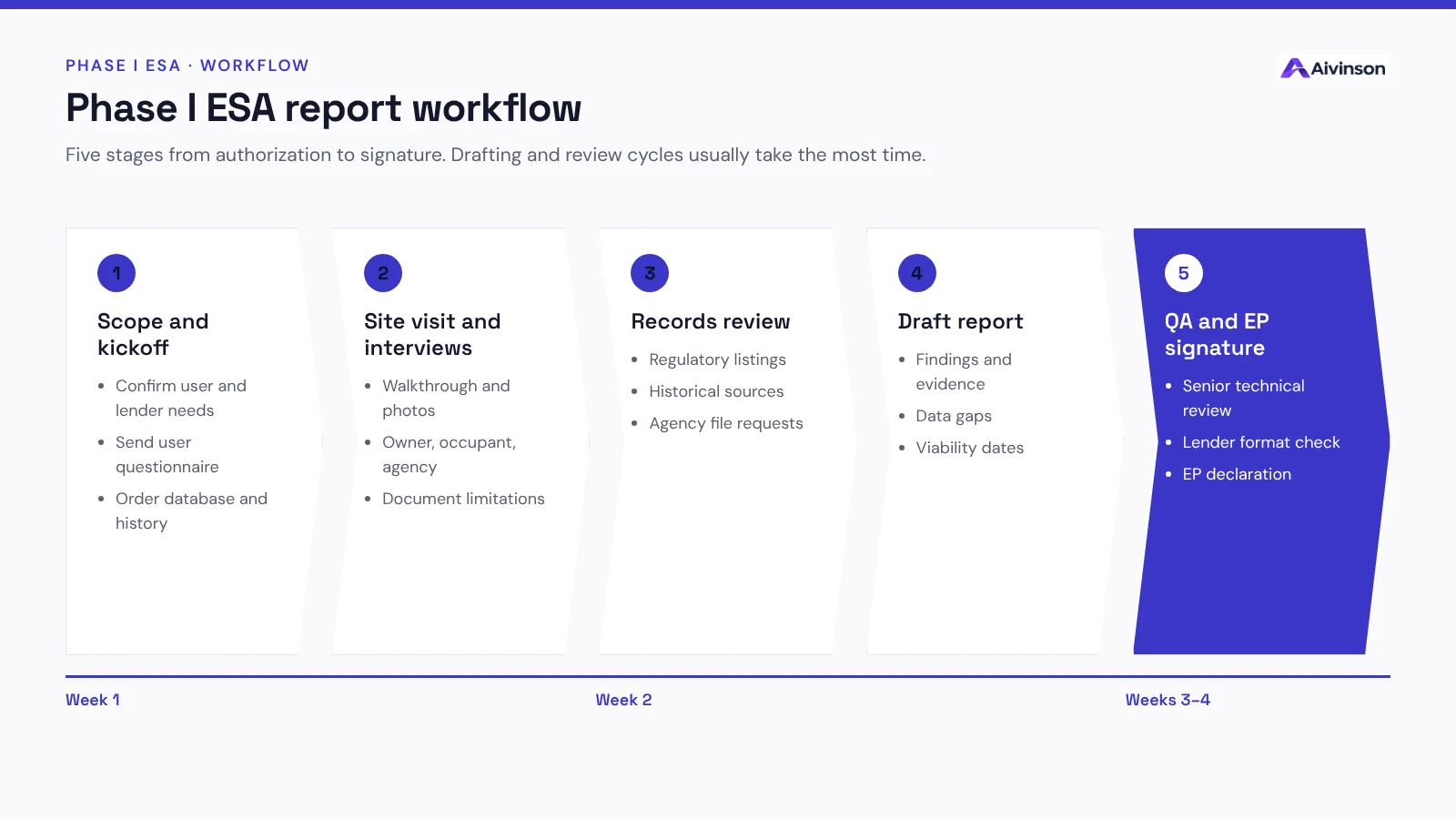
A Phase I ESA report workflow runs from scoping and kickoff through the site visit and interviews, records review, drafting, quality review and the Environmental Professional’s signature. A standard commercial report takes about two to four weeks, and drafting and review cycles are usually the largest share of effort.

On this page
The Phase 1 Environmental Site Assessment standard defines what must be done. It does not tell a firm how to organize the work. This guide lays out a workflow that keeps reports compliant and on schedule.
The workflow at a glance
| Step | Owner | Typical timing |
|---|---|---|
| Scope and kickoff | Project manager | Days 1–2 |
| Site visit and interviews | Field assessor | Days 3–10 |
| Records review and agency files | Assessor or analyst | Days 3–15 |
| Draft report | Assessor or author | Days 8–15 |
| QA review and EP signature | Senior reviewer and EP | Days 12–20 |
1. Scope and kickoff
Confirm the user, the lender and any reliance requirements, the expected closing date and any non-scope add-ons. Send the user questionnaire and request the lien and AUL search. Order the regulatory database report and standard historical sources. Schedule the site visit with an eye on the 180-day viability window described in 40 CFR 312.20.
2. Site visit and interviews
The assessor walks the property, photographs conditions and observes adjoining properties. Capturing photos, notes and voice memos against a structured checklist, for example in Site Assistant, avoids rework later. Interviews with the owner, site manager, occupants and a local official happen in the same window, and unanswered requests are logged.
3. Records review
The team reviews regulatory listings within the search distances, physical setting sources and historical sources for the property and adjoining properties. Agency file requests are often the slowest item, so they should be sent at kickoff. Vinson Analyst can read the database report, aerials and fire insurance maps to flag candidate conditions for the assessor to confirm.
4. Drafting
The draft assembles site description, user information, records, site visit, interviews and the evaluation, with every finding linked to evidence. This is where most hours go. Firms now generate the full draft with Vinson Author from the collected evidence, then the assessor edits. Our guide to writing REC findings covers the structure reviewers expect.
5. QA review and signature
A senior reviewer checks compliance with ASTM E1527-21, the lender format and internal consistency. The EP then confirms each classification and signs the declaration. Using one shared editor, such as Report Writing, keeps comments, versions and approvals in one place.
The EP must meet the qualifications in 40 CFR 312.10, and the declaration date is one of the five 180-day components.
Measuring workflow performance
| Metric | Why it matters |
|---|---|
| Days from authorization to site visit | Shows scheduling and access delays |
| Days from site visit to first draft | Shows drafting capacity |
| Review cycles per report | Shows draft quality |
| Reports per assessor per month | Shows overall throughput |
| Updates required for viability | Shows timing discipline |
Tracking even two or three of these makes it clear where time goes. In most firms the biggest gap is between the site visit and the first draft.
Where AI fits responsibly
AI is most useful for the repetitive parts: reading appendices, organizing evidence and producing a complete first draft in the firm’s format. It should never decide classifications or sign the report. The EP reviews every finding, edits the draft and makes the declaration, so professional accountability stays exactly where the AAI rule places it.
Where workflows break down
- Late user questionnaires and title searches delay the evaluation.
- Field notes captured on paper or scattered across phones get lost or retyped.
- Historical sources are read twice: once in research and again while writing.
- Review comments travel by email, so versions conflict.
- Viability dates are checked only at the end, after the window has narrowed.
Fixing these is mostly about capturing evidence once and drafting from it. That is the approach behind the Aivinson Phase I ESA solution, where the EP reviews and signs while the platform handles assembly.
Run the whole workflow in one platform
See how Aivinson connects the site visit, the appendices and the draft, so your EP reviews instead of retyping.
Frequently asked questions
How long does a Phase I ESA report take to produce?
A standard commercial Phase I ESA usually takes about two to four weeks from authorization to signed report. The timeline depends on records availability, agency file requests, interview responses and review cycles. Drafting and quality review are typically the largest share of the total effort.
Who is involved in a Phase I ESA workflow?
A typical team includes a project manager who scopes the work, a field assessor who performs the site visit and interviews, an analyst or assessor who reviews records, a senior reviewer who checks quality, and the Environmental Professional who confirms the findings and signs the AAI declaration.
What slows down Phase I ESA reports most?
The most common delays are late user questionnaires and title searches, slow agency file responses, unresponsive interviewees, retyping field notes, and review comments scattered across email. Sending requests at kickoff and drafting from a single shared evidence record reduce most of these delays significantly.
Can AI write a Phase I ESA report?
AI can organize evidence and draft the report from site data and appendices, which saves significant time. It cannot replace the Environmental Professional. Under the AAI rule, an EP must make the findings and sign the declaration, so AI-drafted content must be reviewed and approved by the EP.
When should the site visit be scheduled?
Schedule the site visit early enough to finish on time, but close enough to the expected closing that the 180-day viability window covers it. The site visit date is one of the five components that must be within 180 days of acquisition, so late closings can require an update.