Phase I ESA Cost and Timeline: What Drives Price and Turnaround
A standard Phase 1 Environmental Site Assessment on a single commercial parcel typically costs about $2,000 to $6,000 in 2026 and takes two to four weeks. Industrial history, multiple parcels, lender add-ons and expedited delivery increase price, while records access and interview responses drive the timeline.

On this page
Pricing for a Phase 1 Environmental Site Assessment varies more than buyers expect, because the effort depends on the property’s history, not its size alone. This guide breaks down the drivers so you can budget accurately and avoid the delays that push closings.
Typical Phase I ESA cost ranges in 2026
| Property profile | Typical range | Why |
|---|---|---|
| Vacant or lightly developed land | Lower end | Short history, few records |
| Office, retail or multifamily | Mid range | Standard records and site visit |
| Industrial, manufacturing or fueling | Upper end or above | Long history, more records and RECs |
| Portfolio or multi-parcel | Per-site pricing, often discounted | Shared research, more site time |
| Expedited delivery | Surcharge on base fee | Compressed schedule |
Most quotes for a standard commercial parcel fall between about $2,000 and $6,000. Prices above that range usually reflect complex industrial history, large sites, many tenant spaces or significant non-scope work.
What drives the price
- Historical complexity. Long-developed or industrial properties need more historical sources and more evaluation.
- Size and access. More buildings, tenant spaces and acreage add site reconnaissance time.
- Database and records costs. Commercial database reports, historical maps and agency file requests carry direct costs.
- Lender requirements. Many lenders specify report formats, reliance language and additional scope.
- Non-scope services. Asbestos, lead-based paint, radon or vapor encroachment screening under ASTM E2600 are priced separately.
- Turnaround. Rush schedules require resequencing work and usually carry a premium.
For consulting firms, the largest cost is labor: reading historical sources and writing the report. That is why report production speed directly affects margin.
How long a Phase I ESA takes
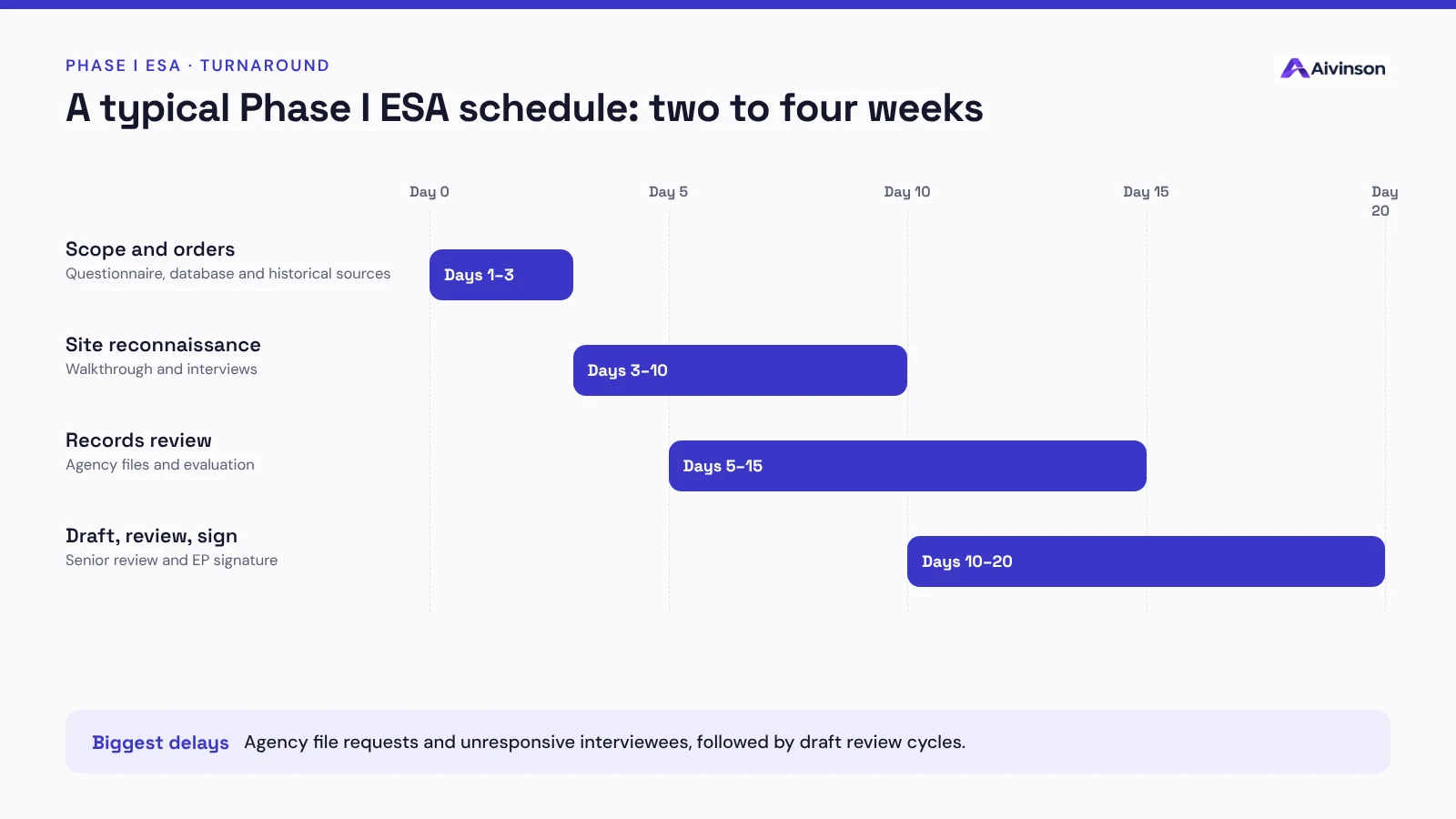
Standard turnaround is two to four weeks from authorization. The typical sequence is:
- Days 1–3: scope confirmation, user questionnaire, database and historical source orders.
- Days 3–10: site reconnaissance and interviews.
- Days 5–15: records review, agency file requests and evaluation.
- Days 10–20: report drafting, senior review and EP signature.
Agency file requests and unresponsive interviewees cause most delays. Draft review cycles are the next biggest factor.
Viability affects timing and cost
A Phase I ESA must be completed within one year before acquisition, and key components within 180 days, under 40 CFR 312.20. If a closing slips past the window, the report needs an update, which adds cost. Scheduling the database search and site visit close to the expected closing date reduces that risk.
The standard itself, ASTM E1527-21, requires each 180-day component to be dated in the report, so reviewers can confirm viability quickly.
What the base fee includes
A standard Phase I quote under ASTM E1527-21 should include the regulatory database report, standard historical sources, the site reconnaissance, interviews, evaluation, a report signed by the Environmental Professional and the AAI declaration. It usually includes reliance for the named user and, often, the lender.
It usually excludes agency file request fees above a set amount, travel to remote sites, additional tenant spaces, non-scope services and report updates after the 180-day window expires. Ask for these assumptions in writing so the final invoice matches the quote.
The cost of getting it wrong
The cheapest Phase I can be the most expensive one. A report that misses a REC, lacks required dates or omits the EP declaration may fail lender review, delay closing and weaken CERCLA liability protection. Cleanup costs for a single solvent release can exceed the purchase price of a small property. Paying for a qualified EP and a complete scope is inexpensive insurance compared with that exposure.
How to avoid delays and surprises
- Return the user questionnaire and title or AUL search early.
- Provide site access contacts and prior environmental reports at kickoff.
- Agree lender requirements and non-scope add-ons before the site visit.
- Ask the consultant to flag RECs as soon as they are identified, not at final delivery.
- Confirm the expected closing date so the 180-day window covers it.
Consultants shorten turnaround most by compressing drafting. Teams using the Aivinson Phase I ESA solution capture site data in Site Assistant and generate the full draft with Vinson Author, so the EP spends time on review rather than formatting. For background on findings, see our guides to RECs and Phase I vs Phase II.
Deliver Phase I ESAs faster
See how Aivinson turns site data and appendices into a full draft, so your team spends its time on review.
Frequently asked questions
How much does a Phase 1 Environmental Site Assessment cost?
A standard Phase I ESA on a single commercial parcel typically costs about $2,000 to $6,000 in 2026. Industrial or long-developed properties, multiple parcels, lender-specific requirements, non-scope add-ons and expedited delivery can push the price higher. Portfolio work is usually priced per site, often with a volume discount.
How long does a Phase I ESA take?
Standard turnaround is about two to four weeks from authorization. The schedule depends on records availability, agency file requests, interview responses and report review cycles. Expedited delivery is often possible for a surcharge, but delays in site access or user information can still slow the final report.
Who pays for a Phase I ESA?
The user who relies on the report usually pays. In an acquisition that is typically the buyer, and in a refinance it is usually the borrower. Lenders often require the report and reliance language naming them, even when the borrower orders and pays for the assessment directly, so confirm reliance requirements before engagement.
Can I reuse an old Phase I ESA to save money?
Partly. A prior Phase I can support a new one, but all appropriate inquiries must be within one year before acquisition and key components within 180 days. An older report usually needs an update covering interviews, lien searches, records review, a new site visit and a new EP declaration.
What add-ons increase Phase I ESA cost?
Common add-ons include asbestos and lead-based paint surveys, radon testing, wetlands review, vapor encroachment screening under ASTM E2600, and lender-specific formats. Each is outside the ASTM E1527-21 scope, so it is priced separately and should be agreed in writing before the site visit is scheduled.