AI Accuracy: How to Measure and Improve It in Technical Work
AI accuracy is how often an AI system’s output is correct for the task it was given. For generative AI in technical work, it means three things: statements are factually right, each is supported by the cited source, and nothing important is missing. It must be measured on your own tasks, not taken from a vendor claim.
On this page
Accuracy numbers are easy to quote and hard to interpret. A model that scores well on a public benchmark can still misstate a date in your report. This guide explains what to measure, what the research says and how to raise accuracy in practice. It belongs to our Generative AI series.
What accuracy means for generative AI
For a classifier, accuracy is one number: correct predictions divided by total predictions. Generative AI produces paragraphs, so a single score hides the failures that matter. A drafted report section can be fluent, mostly right and still contain one wrong viability date that invalidates the conclusion.
| Dimension | Question it answers | Typical failure |
|---|---|---|
| Factual accuracy | Is the statement true? | Wrong date, value or name |
| Groundedness | Does the cited source support it? | Real source, wrong claim |
| Completeness | Is anything important missing? | An omitted finding or data gap |
| Consistency | Do sections agree with each other? | Summary contradicts the evaluation |
| Currency | Are standards and rules current? | Superseded edition cited |
What the research shows
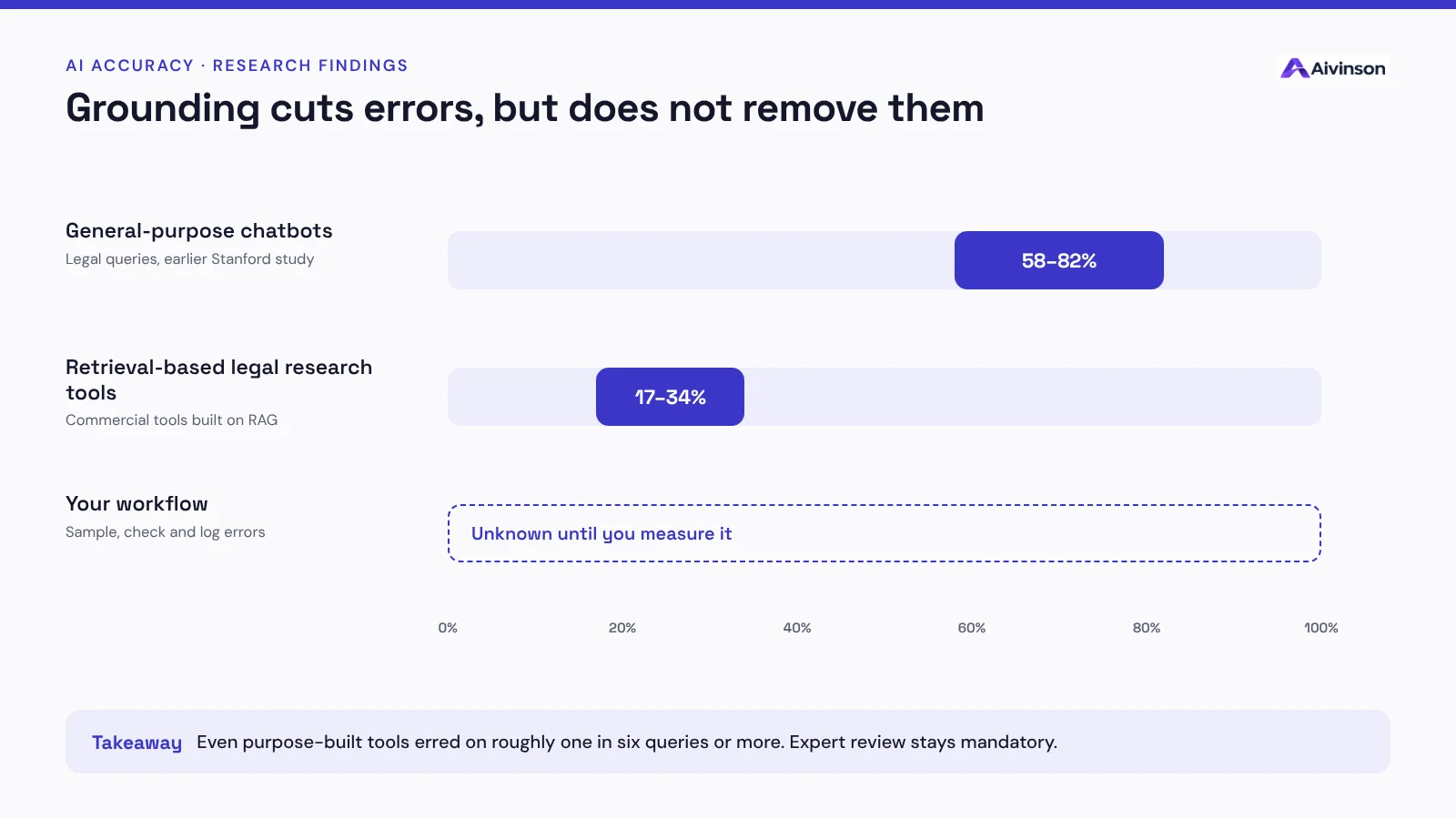
Stanford RegLab and HAI researchers tested AI on legal research, a field with clear right answers and severe consequences for errors. Their report, “AI on Trial”, found that general-purpose chatbots hallucinated on 58% to 82% of legal queries in an earlier study. Purpose-built legal research tools using retrieval did better, but still produced incorrect or misgrounded answers on more than 17% of queries, and one tool on more than 34%.
Two lessons carry over to engineering and due diligence. Grounding in real documents reduces errors substantially. And grounding alone does not remove them, because a system can cite a real source that does not support its claim. That second failure is the one reviewers miss most often.
Metrics worth tracking
- Statement error rate: wrong statements per 100 checked, by report section.
- Citation validity: share of cited sources that actually support the statement.
- Omission rate: findings or data gaps the reviewer had to add.
- Flag precision: share of AI flags that pointed to a real issue.
- Flag recall: share of real issues the AI flagged before review.
- Post-delivery errors: corrections requested by clients or lenders.
Precision and recall matter most for flagging tools. High recall with low precision floods reviewers with false alarms; high precision with low recall misses problems. Track both on a sample of real reports.
How grounding improves accuracy
Retrieval-augmented generation, introduced in a 2020 research paper, lets a model answer from retrieved documents instead of memory. In report production, that means drafting from the project’s own database report, aerials, photos and interviews, and linking each statement to its page.
Grounding changes the reviewer’s job from re-researching to verifying. It also makes errors visible: a statement without a source is unsupported by definition. Ask Vinson answers project questions this way, with the source shown for each answer.
Why accuracy varies by task
| Task | Typical accuracy | Why |
|---|---|---|
| Extracting listed facts from a record | High | The answer is on the page |
| Summarizing a long appendix | Medium to high | Risk of omission |
| Arithmetic and unit conversion | Unreliable in free text | Use validated tools |
| Applying a definition to evidence | Medium | Depends on complete facts |
| Professional judgment | Not delegable | The expert decides |
This is why the right question is not “how accurate is the model?” but “how accurate is it on this task, with this evidence?” Our AI reasoning guide covers the judgment tasks in more depth.
A practical accuracy test for your firm
- Pick 10 recent reports where the correct answer is known.
- Have the AI draft or answer from the same evidence.
- Score every statement for factual accuracy, groundedness and completeness.
- Record errors by section and type, not just a total.
- Repeat after changing templates or tools, and compare.
The NIST AI Risk Management Framework calls this the Measure function: test systems in context and track results over time. A small, repeatable test beats any benchmark score.
Accuracy and accountability
No accuracy level transfers responsibility. A system that is right 99% of the time still needs a reviewer, because the 1% may be the finding that matters. The goal of better accuracy is shorter, more focused review, not no review. See Human in the loop AI for how to design that review, and Trust in AI for calibrating reliance.
Keep experts in charge of every finding
See how Aivinson drafts from your evidence, flags what needs attention and leaves every decision and signature with your team.
Frequently asked questions
How accurate is AI for technical reports?
It depends on the task and the evidence. Extracting facts from a provided record can be highly accurate, while free-text arithmetic and professional judgment are not reliable. Research on legal tools found errors on more than one in six queries even with retrieval, so expert review stays essential.
What is an AI hallucination?
A hallucination is output that is false or unsupported but presented confidently, such as an invented date, regulation or citation. A related failure is misgrounding, where the system cites a real source that does not actually support the statement. Both are caught by checking each claim against its source.
How do you measure AI accuracy?
Score a sample of AI output against known correct answers. Track statement error rate, citation validity, omissions, and the precision and recall of any flags, by report section. Repeat the test after tool or template changes and compare results over time. A test on ten known reports is often enough to see patterns.
Does retrieval-augmented generation eliminate errors?
No. Grounding in real documents reduces errors substantially, but studies of commercial retrieval-based tools still found incorrect or misgrounded answers on a meaningful share of queries. Reviewers must check that each cited source actually supports the claim. Grounding makes that check fast, because the source is one click away.
Can high AI accuracy replace expert review?
No. Accuracy improvements shorten review and focus it on the statements most likely to be wrong, but responsibility for findings stays with the qualified professional. A rare error can still be the one that changes the outcome of a transaction. Better accuracy earns shorter review, not no review.